
SECTION 1
Historical Context & Motivation
The concept of nested iteration — placing one loop inside another — is as old as computation itself, arising naturally from the need to process tabular and multi-dimensional data. Long before electronic computers, mathematicians computing artillery tables or astronomical charts performed the same repetitive inner calculations for every row of an outer table, effectively executing a nested loop by hand. When the first stored-program computers appeared in the late 1940s, programmers immediately encoded these patterns in machine code, and the formal study of loop nesting became central to algorithm design and complexity analysis.
1945 • Von Neumann Architecture
1957 • FORTRAN and the DO Loop
DO loop, making nested iteration syntactically straightforward. Scientists nesting DO loops to multiply matrices helped drive early supercomputing research.1968 • Dijkstra's Structured Programming
1995 • Java and the AP Curriculum
for and while loops at the center of introductory CS education, where they remain a core exam topic.2020s • Modern Relevance
The fundamental question nested iteration answers is deceptively simple: How do we systematically perform work on every combination of elements drawn from two (or more) independent sequences? Whether you are comparing every pair of students in a class roster, printing a rectangular grid of characters, or processing each cell of a 2-D array, the answer involves placing one iterative structure inside another. The sections that follow develop the mechanics, the mental model, and the analytical tools you need to wield nested loops with confidence on the AP exam and beyond.
SECTION 2
Core Principles & Definitions
At its core, a nested loop is simply a loop whose body contains another loop. The outer loop controls the first dimension of repetition (often rows), while the inner loop controls the second dimension (often columns). Each time the outer loop advances by one iteration, the inner loop runs through its full cycle of iterations. This multiplicative relationship is the defining characteristic of nested iteration and directly determines the total number of operations performed.
Outer Loop
Inner Loop
Iteration Count
Row-Major vs. Column-Major
Dependent Bounds
j < i), the result is a triangular iteration pattern — common in selection sort and pair comparisons.KEY TAKEAWAY
SECTION 3
Visualizing Nested Loop Execution
The diagram below traces the execution of a simple nested for loop that prints a 4 × 5 grid. The outer variable r ranges from 0 to 3 (rows), and the inner variable c ranges from 0 to 4 (columns). Each numbered cell shows the order in which the inner-body statement executes, illustrating the row-major traversal pattern.
Notice that the inner loop resets to c = 0 every time the outer loop increments r. This is the most common source of confusion for students new to nested iteration: the inner variable is re-initialized on every outer iteration. If the outer loop runs 4 times and the inner loop runs 5 times per outer cycle, the total inner-body executions equal 4 × 5 = 20, as the numbered cells confirm. Tracing through a small grid like this is one of the most reliable strategies for AP free-response questions.
 Grid algorithms turn a visual pattern into explicit row and column operations. Bounds checks determine which neighboring cells can be accessed.
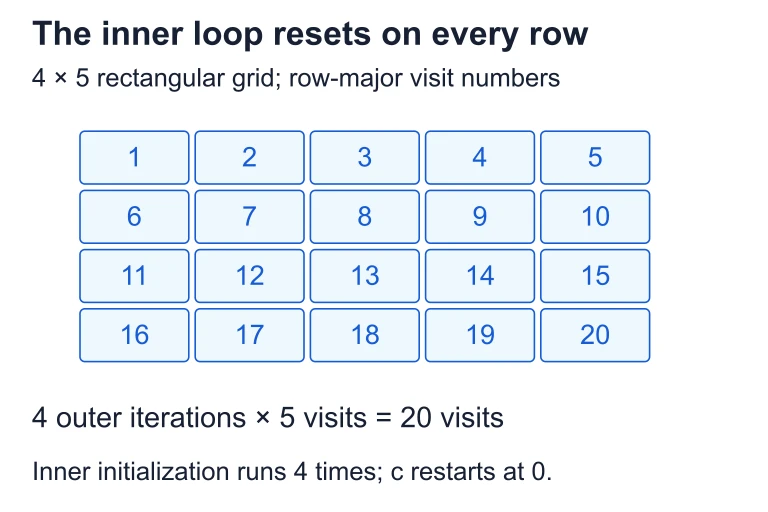 Four outer-loop iterations each run five inner iterations: 20 body executions in row-major order. The inner counter is initialized four times.
SECTION 4
How Nested Iteration Works in Java
Java supports nested iteration with any combination of for, while, and enhanced for-each loops. The AP CS A exam overwhelmingly tests standard for loops for index-based 2-D array traversal, so that is our primary focus. Understanding the execution flow requires a precise model of how the JVM evaluates loop headers and bodies.
Execution Sequence
- Outer init: The outer loop's initialization statement runs exactly once.
- Outer condition check: If the outer condition is true, execution enters the outer body.
- Inner init: The inner loop's initialization runs, resetting the inner variable.
- Inner cycle: The inner condition is checked; if true, the inner body executes, the inner update runs, and the inner condition is checked again. This repeats until the inner condition is false.
- Outer update: When the inner loop terminates, the outer update runs, and the outer condition is rechecked. The process repeats from step 2.
TOTAL INNER-BODY EXECUTIONS
Where n is the number of outer iterations and m is the number of inner iterations per outer cycle. When the bounds are independent, this yields O(n × m) time complexity; if n = m, the complexity is O(n²).
TRIANGULAR ITERATION COUNT
When the inner loop's bound depends on the outer variable (e.g., for (int j = i + 1; j < n; j++)), the total iterations form a triangular number. This pattern appears in pair-comparison algorithms and selection sort.
AP Exam Tip
SECTION 5
Common Nested Iteration Patterns
Nested loops appear in several recurring patterns on the AP CS A exam and in real-world programming. Recognizing these patterns quickly is essential for both the multiple-choice section, where you may need to predict output without tracing every iteration, and the free-response section, where you must write correct nested structures under time pressure. The diagram below catalogs four canonical patterns and their typical use cases.
| Pattern | Inner Bound | Total Iterations | AP Use Case |
|---|---|---|---|
| Rectangular | j < m | n × m | 2-D array traversal, image processing |
| Upper Triangular | j = i+1; j < n | n(n−1)/2 | Unique pair comparison, selection sort |
| Staircase / Pyramid | j <= i | n(n+1)/2 | Pattern printing, insertion sort |
| Search / Early Exit | j < m (with break) | Best: 1; Worst: n × m | Finding a value in a 2-D array |
Summary of four canonical nested loop patterns
SECTION 6
Worked Example: Row Sums of a 2-D Array
Consider the following problem, representative of AP CS A free-response tasks: given a 2-D integer array int[][] grid, write a method that returns a 1-D array whose k-th element is the sum of all values in row k of the grid. We will develop the solution step by step, tracing through a concrete example.
Computing Row Sums with Nested Loops
- 1
Step 1 — Understand the Data Structure
Letgridbe a 3 × 4 array:{{2, 5, 1, 8}, {3, 7, 4, 6}, {9, 0, 2, 5}}. The method should return{16, 20, 16}because 2+5+1+8 = 16, 3+7+4+6 = 20, and 9+0+2+5 = 16. The result array has lengthgrid.length(number of rows).Expected output:{16, 20, 16} - 2
Step 2 — Declare the Result Array
Createint[] sums = new int[grid.length];. Each element initializes to 0 by default in Java. The outer loop will iterate once per row, using indexrfrom 0 togrid.length - 1. - 3
Step 3 — Write the Outer Loop (Rows)
for (int r = 0; r < grid.length; r++)— this loop controls which row we are summing. On each iteration,grid[r]is the current row (a 1-D array). The number of columns in that row isgrid[r].length, which handles ragged arrays safely. - 4
Step 4 — Write the Inner Loop (Columns)
Inside the outer loop:for (int c = 0; c < grid[r].length; c++) { sums[r] += grid[r][c]; }. The inner loop visits every column index in the current row, accumulating the running total intosums[r]. When the inner loop finishes,sums[r]holds the complete sum for rowr. - 5
Step 5 — Return the Result and Trace
After both loops finish, returnsums. Trace: r=0 → inner sums 2+5+1+8 → sums[0]=16. r=1 → inner sums 3+7+4+6 → sums[1]=20. r=2 → inner sums 9+0+2+5 → sums[2]=16. Total inner-body executions: 3 × 4 = 12.Return value:{16, 20, 16}— matches expected output ✓
Complete Java Method
public static int[] rowSums(int[][] grid) {
    int[] sums = new int[grid.length];
    for (int r = 0; r < grid.length; r++) {
        for (int c = 0; c < grid[r].length; c++) {
            sums[r] += grid[r][c];
        }
    }
    return sums;
}SECTION 7
Strengths, Limitations & Common Pitfalls
Nested iteration is indispensable for multi-dimensional data processing, but its power comes with costs. Understanding the trade-offs helps you make informed decisions about when to use nested loops versus alternative approaches, and it helps you avoid the mistakes that cost points on the AP exam.
| Strengths | Limitations |
|---|---|
| Natural mapping to 2-D data — rows and columns map directly to outer and inner loops | Quadratic (or worse) time complexity makes them slow on large inputs; doubling n quadruples the work |
| Highly readable — experienced programmers immediately recognize the row/column traversal idiom | Off-by-one errors are twice as likely since two loop bounds must be correct simultaneously |
| Flexible: inner bounds can depend on outer variable for triangular, staircase, or conditional patterns | Accidental infinite loops can occur if the inner loop modifies the outer variable or vice versa |
| Required by the AP CS A curriculum — mastery is non-negotiable for the exam | Difficult to debug without trace tables; print-statement debugging alone can produce overwhelming output |
Nested iteration: strengths and limitations
COMMON PITFALL
grid.length for both the row and column bounds. Remember: grid.length gives the number of rows, while grid[r].length gives the number of columns in row r. Confusing these produces an ArrayIndexOutOfBoundsException when the grid is not square.SECTION 8
Connections to Advanced Topics
While the AP CS A exam focuses on two-level nesting, the concept scales to deeper nesting and connects to fundamental topics in computer science. Understanding where nested iteration sits in the broader landscape motivates best practices and prepares you for college-level algorithms courses.
| AP CS A Concept | Advanced Extension |
|---|---|
| Two-level nested for loops | Triple-nested loops for 3-D arrays (e.g., voxels in medical imaging); arbitrary k-level nesting in combinatorics |
| O(n²) time complexity | Formal Big-O analysis; amortized analysis; recognizing when O(n log n) algorithms like merge sort outperform O(n²) selection sort |
| Row-major 2-D array traversal | Cache-aware programming: row-major traversal exploits spatial locality in CPU caches, while column-major causes cache misses — a performance concern in data science and game engines |
| Nested loops for pattern printing | Recursion as an alternative to iteration; converting nested loops into recursive algorithms; dynamic programming with memoized 2-D tables |
| Manual nested iteration | Stream API and functional programming: Java Streams with flatMap can replace nested loops, improving readability in some contexts |
AP CS A nested iteration and its advanced counterparts
The key takeaway for forward-looking students is that nested iteration is not merely a Java syntax topic; it is the imperative embodiment of the Cartesian product of two sets. Every pair (r, c) you visit in a rectangular traversal corresponds to an element of the set {0, …, R−1} × {0, …, C−1}. This set-theoretic perspective will serve you well in discrete mathematics, database query optimization (cross joins), and combinatorial algorithm design.
SECTION 9
Practice Problems
Question 1: CONCEPTUAL
for (int i = 0; i < 3; i++)
    for (int j = 0; j < 4; j++)
        System.out.print("*");
How many asterisks are printed?- A. 7
- B. 12
- C. 16
- D. 4
Show answer (B)
Question 2: BASIC CALCULATION
int count = 0;
for (int i = 1; i <= 5; i++)
    for (int j = 1; j <= i; j++)
        count++;
System.out.println(count);- A. 10
- B. 25
- C. 15
- D. 20
Show answer (C)
Question 3: INTERMEDIATE
int[][] mat = {{1, 2, 3}, {4, 5, 6}, {7, 8, 9}};
int result = 0;
for (int r = 0; r < mat.length; r++)
    for (int c = 0; c < mat[r].length; c++)
        if (r == c)
            result += mat[r][c];
System.out.println(result);
What is printed?- A. 45
- B. 15
- C. 12
- D. 25
Show answer (B)
r == c selects the main diagonal of the matrix: mat[0][0] = 1, mat[1][1] = 5, mat[2][2] = 9. Their sum is 1 + 5 + 9 = 15. A (45) is the sum of all elements 1 through 9, ignoring the diagonal filter. C (12) could arise from summing the anti-diagonal (3 + 5 + 7) incorrectly, or from a misread of indices. D (25) does not correspond to any meaningful subset sum of this matrix.Question 4: APPLIED
4 ptspublic static boolean isSymmetric(int[][] matrix) that returns true if the given square matrix is symmetric (i.e., matrix[i][j] == matrix[j][i] for all valid i and j), and false otherwise. You must use nested iteration. For full credit, avoid redundant comparisons by only checking the upper triangle.Show answer
public static boolean isSymmetric(int[][] matrix) and returns a boolean value.
Point 2 — Correct outer loop over rows: Outer loop iterates from 0 to matrix.length - 1 (or equivalent). Uses proper bounds for the square matrix.
Point 3 — Correct inner loop with triangular bound and comparison: Inner loop starts at j = i + 1 and runs to matrix[i].length. The body compares matrix[i][j] != matrix[j][i] and returns false immediately if they differ. Starting at j = 0 is acceptable but does not earn the efficiency consideration.
Point 4 — Correct return of true after all comparisons pass: After both loops complete without finding a mismatch, the method returns true.
Sample solution:
public static boolean isSymmetric(int[][] matrix) {
    for (int i = 0; i < matrix.length; i++) {
        for (int j = i + 1; j < matrix[i].length; j++) {
            if (matrix[i][j] != matrix[j][i]) {
                return false;
            }
        }
    }
    return true;
}
Question 5: CRITICAL THINKING
3 ptstarget appears in a 2-D array int[][] data that may be ragged (rows of different lengths). Write the method public static int countOccurrences(int[][] data, int target). Additionally, in a brief comment or separate explanation, state the worst-case time complexity in terms of N, the total number of elements across all rows.Show answer
data.length for the row count, and the inner loop uses data[r].length (not data[0].length or data.length) for the column count. This correctly handles ragged arrays.
Point 2 — Correct counting logic: An accumulator variable (e.g., int count = 0) is declared before the loops. Inside the inner loop, if (data[r][c] == target) count++; correctly increments on a match. The method returns count after both loops.
Point 3 — Correct complexity analysis: The worst-case time complexity is O(N) where N is the total number of elements across all rows, because each element is visited exactly once. Note that while there are two loops, the total work is proportional to the total number of cells, not the square of any single dimension.
Sample solution:
public static int countOccurrences(int[][] data, int target) {
    int count = 0;
    for (int r = 0; r < data.length; r++) {
        for (int c = 0; c < data[r].length; c++) {
            if (data[r][c] == target) {
                count++;
            }
        }
    }
    return count;
    // Worst-case: O(N) where N = total elements
}SUMMARY
Nested Iteration — Key Concepts Review
Summary
Nested iteration places one loop inside another, causing the inner loop to complete its full cycle for every single iteration of the outer loop. This produces a multiplicative total of inner-body executions: n × m for independent rectangular bounds, or n(n−1)/2 for triangular patterns with dependent bounds. The standard row-major traversal idiom uses grid.length for the row count and grid[r].length for the column count, correctly handling both rectangular and ragged arrays.
On the AP CS A exam, nested loops appear in 2-D array traversal, pair comparison algorithms like selection sort, pattern printing, and search operations with early exit. The key to mastery is building trace tables — tracking the outer variable, inner variable, and any accumulators row by row — to verify output and avoid off-by-one errors. Remember that the inner loop variable is re-initialized on every outer iteration, and always use the correct .length expression for each dimension.