
SECTION 1
Historical Context & Motivation
From the earliest days of programming, language designers wrestled with a fundamental question: when a function receives data, does it get a fresh copy, or does it operate on the original? The answer determines whether side effects propagate across a program and whether large data structures can be shared efficiently. Java's designers chose a model rooted in decades of language evolution—one that treats primitive values and object references very differently when they are passed into or returned from methods.
1960s • Pass-by-Reference in FORTRAN & ALGOL
1972 • C's Pass-by-Value with Pointers
1980s • Smalltalk & Object References
1995 • Java Codifies Pass-by-Value of References
The question this lesson addresses is deceptively simple: when you pass an object to a method in Java, or return an object from one, what exactly is transmitted? Understanding the answer—a copy of the reference, not a copy of the object—is the key to reasoning about aliasing, mutation, and encapsulation in every AP Computer Science A program.
SECTION 2
Core Principles & Definitions
Before diving into code, it is essential to internalize several foundational ideas that govern how Java manages memory and parameter passing. Each principle below appears repeatedly on the AP exam, and confusing any one of them is a common source of errors.
Reference vs. Object
Pass-by-Value (Always)
Mutation Through a Reference
Reassignment ≠ Mutation
Returning a Reference
SECTION 3
Visual Explanation — Memory Model
The following diagram illustrates what happens in memory when a reference is passed to a method. Focus on how the stack frames for main and grow both contain arrow-shaped references that point to the same Dog object on the heap.
main() and the violet arrow from grow(d) both terminate at the same Dog object on the heap. Calling d.setAge(5) mutates the shared object, so after grow returns, myDog.getAge() also yields 5.Notice the critical distinction: both stack variables store the same hex address (0x3A7). They are independent copies of that address, but they point to the same location. If grow were to execute d = new Dog("Fido", 1), only the local variable d would change; myDog in main() would remain untouched.
SECTION 4
How It Works — Pass-by-Value of References in Detail
Passing a Reference as an Argument
When you write someMethod(myObj), Java evaluates myObj to obtain the reference value (the address of the object on the heap), then copies that value into the formal parameter declared in the method signature. This copy is a new variable living in the called method's stack frame. Because both variables now hold the same address, any state-changing call through either reference modifies the same object. However, reassigning the parameter inside the method has no effect on the caller's reference—the copy simply starts pointing elsewhere.
Returning a Reference from a Method
A return statement in a method whose return type is a class copies the reference value back to the caller's context. The caller can store this in a variable, thereby creating a new alias to the object. This mechanism is fundamental when writing accessor (getter) methods that return instance variables of a reference type. If the returned object is mutable, the caller can use the returned reference to modify private state—a classic encapsulation leak that appears frequently on the AP exam.
Code Walkthrough — Passing vs. Reassigning
Consider the following class and driver:
public class Point {
  private int x;
  private int y;
  public Point(int x, int y) { this.x = x; this.y = y; }
  public void translate(int dx, int dy) { x += dx; y += dy; }
  public String toString() { return "(" + x + ", " + y + ")"; }
}
public class Demo {
  public static void shift(Point p) {
    p.translate(1, 1);   // mutates the shared object
    p = new Point(0, 0); // reassigns local copy only
  }
  public static void main(String[] args) {
    Point pt = new Point(3, 4);
    shift(pt);
    System.out.println(pt); // prints (4, 5)
  }
}
After shift(pt) is called, the parameter p is a copy of pt's reference. The translate call mutates the shared Point to (4, 5). The subsequent p = new Point(0, 0) redirects only the local p; pt in main still points to the mutated Point (4, 5).
 Two variables can provide access to one shared object. Copying a reference creates another access path; it does not duplicate the object.
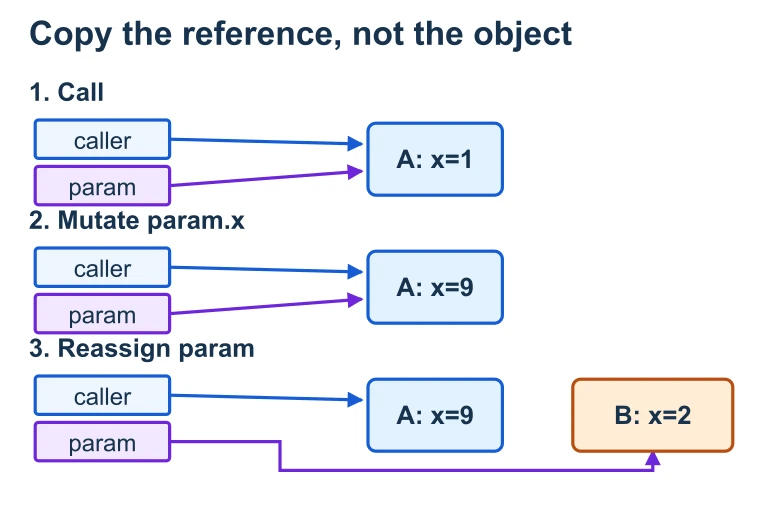 Java passes every argument by value. A copied reference initially reaches the same object, so its mutation is shared. Reassigning the parameter to a new object leaves the caller’s reference pointing to the original object.
SECTION 5
Detailed Breakdown — Aliasing Scenarios
The interplay between passing references, returning references, and storing them creates several distinct aliasing scenarios. Recognizing these patterns quickly is crucial for tracing code on the AP exam.
| Scenario | Inside Method | Caller After Call |
|---|---|---|
| Pass + Mutate | d.setAge(5); | Sees updated age (5) |
| Pass + Reassign | d = new Dog("Bo"); | Original object unchanged |
| Return Reference | return new Dog("Lu"); | Caller stores new alias |
| Return field reference | return this.myList; | Caller can mutate private field—encapsulation risk |
Common reference-passing scenarios on the AP exam
SECTION 6
Worked Example
Consider the following complete program. Trace through it step by step to predict the final output.
public class BankAccount {
  private double balance;
  public BankAccount(double b) { balance = b; }
  public void deposit(double amt) { balance += amt; }
  public double getBalance() { return balance; }
  public String toString() { return "$" + balance; }
}

public class Bank {
  public static BankAccount openAndDeposit(BankAccount acct, double amt) {
    acct.deposit(amt);
    BankAccount bonus = new BankAccount(50.0);
    acct = bonus;  // reassign local parameter
    return bonus;
  }
  public static void main(String[] args) {
    BankAccount mine = new BankAccount(100.0);
    BankAccount gift = openAndDeposit(mine, 25.0);
    System.out.println(mine);  // ?
    System.out.println(gift);  // ?
  }
}
Worked example
- 1
Step 1 — Identify the objects at the call site
Inmain,minereferences a BankAccount with balance 100.0. A copy of that reference is passed toacctinopenAndDeposit.acct → BankAccount(100.0)(same object asmine) - 2
Step 2 — Mutation through acct
acct.deposit(25.0)is called. Sinceacctandminealias the same object, the balance of that shared BankAccount becomes 125.0.Shared object balance = 125.0 - 3
Step 3 — New object created
BankAccount bonus = new BankAccount(50.0)allocates a brand-new object on the heap.bonusis a local variable pointing to this new object.bonus → BankAccount(50.0) - 4
Step 4 — Parameter reassignment (no effect on caller)
acct = bonusmakes the local parameteracctpoint to the bonus account. This does NOT changemineinmain, which still references the original BankAccount (now with balance 125.0).mine still → BankAccount(125.0) - 5
Step 5 — Return and final output
return bonussends a copy of the reference to the 50.0-balance account back tomain, where it is stored ingift. The println statements output:mine → $125.0, gift → $50.0
SECTION 7
Common Pitfalls & Comparisons
Students frequently confuse pass-by-value of a reference with true pass-by-reference (which Java does not support). The table below contrasts common misconceptions with correct reasoning.
| Misconception | Reality | Why It Matters |
|---|---|---|
| "Java passes objects by reference." | Java passes the reference by value—a copy of the pointer, not the object. | Reassigning a parameter inside a method cannot change the caller's variable. |
| "Returning an object creates a new copy." | Returning copies the reference, not the object. Two variables now alias the same object. | If the object is mutable, the caller can change its state through the returned reference. |
| "A getter that returns a private object is safe." | Returning a mutable private field exposes it. The caller can modify internal state. | This is a privacy leak. Use defensive copying or return immutable views. |
| "Primitives and objects are passed the same way." | Both are pass-by-value, but the effect differs because one copies a number, the other copies an address. | Mutating an object parameter affects the caller; changing an int parameter does not. |
Common misconceptions about Java parameter passing
SECTION 8
Connection to Advanced Topics
The mechanics of passing and returning references underpin several more advanced concepts that extend beyond the AP curriculum but are crucial for college computer science. Understanding these connections now will deepen your reasoning.
| AP-Level Concept | Advanced Extension |
|---|---|
| Aliasing through parameter passing | Concurrency hazards: two threads with aliases to the same object can create race conditions. |
| Returning a private mutable field | Defensive copying and immutable collections (e.g., Collections.unmodifiableList) to enforce encapsulation. |
| Pass-by-value of references | In languages like C++, true pass-by-reference (using &) allows a function to reassign the caller's variable. |
| Garbage collection after references go out of scope | Manual memory management in C/C++, weak references, and reference counting in Python. |
AP concepts vs. advanced extensions
On the AP exam, you will not be asked about concurrency or defensive copying explicitly. However, questions about encapsulation often test whether you understand that returning a reference to a mutable private field allows external code to violate the class's invariants. Recognizing this pattern quickly is a hallmark of strong exam performance.
SECTION 9
Practice Problems
Question 1: CONCEPTUAL
public static void mystery(String s) {
    s = s + " world";
}
If the caller executes String msg = "hello"; mystery(msg);, what is the value of msg after the call?
A) "hello world"
B) "hello"
C) "world"
D) null- A. "hello world"
- B. "hello"
- C. "world"
- D. null
Show answer (B)
mystery, s = s + " world" creates a new String object and reassigns the local parameter s to point to it. Since Java is pass-by-value, the caller's msg variable still references the original "hello" string. (String objects are also immutable, so even if there were no reassignment, msg could never change.) A is wrong because reassignment of a local parameter cannot affect the caller. C is wrong because there is no mechanism to strip "hello". D is wrong because nothing sets msg to null.Question 2: BASIC CALCULATION
public class Num {
    private int val;
    public Num(int v) { val = v; }
    public void add(int n) { val += n; }
    public int getVal() { return val; }
}

public static void bump(Num x) {
    x.add(10);
}

Num a = new Num(5);
bump(a);
System.out.println(a.getVal());
What is printed?
A) 5
B) 10
C) 15
D) 0- A. 5
- B. 10
- C. 15
- D. 0
Show answer (C)
x. Calling x.add(10) mutates the shared object's val from 5 to 15. A is wrong because the mutation via x is visible through a. B is wrong because it would require ignoring the initial value. D is wrong because val was initialized to 5 and only increased.Question 3: INTERMEDIATE
public class Box {
    private int size;
    public Box(int s) { size = s; }
    public void grow(int n) { size += n; }
    public int getSize() { return size; }
}

public static Box resize(Box b) {
    b.grow(3);
    b = new Box(100);
    b.grow(5);
    return b;
}

Box x = new Box(10);
Box y = resize(x);
System.out.println(x.getSize() + " " + y.getSize());
What is printed?
A) 10 105
B) 13 105
C) 100 105
D) 13 100- A. 10 105
- B. 13 105
- C. 100 105
- D. 13 100
Show answer (B)
resize, b.grow(3) mutates the shared Box (size becomes 13). Then b = new Box(100) reassigns the local parameter to a new object. b.grow(5) makes this new object's size 105. x still points to the original Box (size 13). The returned reference is stored in y (size 105). A is wrong because it ignores the initial grow(3). C is wrong because x cannot be redirected by parameter reassignment inside the method. D is wrong because grow(5) also applies to the new Box.Question 4: APPLIED
Roster class that stores an ArrayList<Student> as a private instance variable. The class includes the following accessor:
public ArrayList<Student> getStudents() {
    return students;
}
Part (a): Explain why this accessor creates an encapsulation problem.
Part (b): Write a corrected version of getStudents that prevents the caller from modifying the internal list.
Part (c): Suppose a caller writes roster.getStudents().add(new Student("Eve")); using the original (buggy) accessor. Describe what happens to the Roster object's internal state.
Part (d): If Student is a mutable class, explain why even a defensive copy of the list might not fully protect encapsulation.Show answer
ArrayList<Student>. Because the caller now has an alias to the same list object, it can call add, remove, or set to modify internal state without going through Roster's methods. This violates encapsulation because the Roster class loses control over its own data.
(b) [1 pt] public ArrayList<Student> getStudents() {
return new ArrayList<Student>(students);
}
This creates a shallow copy of the list, so changes to the returned list (adding or removing elements) do not affect the internal list.
(c) [1 pt] The add call modifies the Roster's internal ArrayList directly, inserting a new Student ("Eve") that the Roster class never validated or approved.
(d) [1 pt] A shallow copy of the list still contains references to the same Student objects. If the caller retrieves a Student from the copied list and calls a setter (e.g., student.setName("Hacker")), it mutates the original Student object that Roster also references. Full protection requires a deep copy.Question 5: CRITICAL THINKING
swap intended to exchange the objects that two reference variables point to:
public static void swap(Dog a, Dog b) {
    Dog temp = a;
    a = b;
    b = temp;
}
Part (a): Explain why calling swap(d1, d2) from main does NOT actually swap d1 and d2.
Part (b): Describe a design pattern or wrapper approach that would allow the caller to achieve the effect of swapping using Java's pass-by-value semantics.
Part (c): Explain how this limitation relates to the broader principle that Java is strictly pass-by-value.Show answer
d1 and d2 into local parameters a and b. The swap only exchanges these local copies. When swap returns, d1 and d2 in the caller are completely unaffected because reassigning a parameter never affects the caller's variable.
(b) [1 pt] One approach: wrap both references in a container object (e.g., a two-element array or a custom Pair class). Pass the container to the method; the method can then swap the contents of the container via mutation (e.g., Dog temp = arr[0]; arr[0] = arr[1]; arr[1] = temp;). Because the array is a shared object, the swap of its elements is visible to the caller.
(c) [1 pt] This limitation is a direct consequence of Java's strictly pass-by-value design. Since the method receives a copy of the reference (not a reference to the reference), it cannot redirect the caller's variable. True pass-by-reference (as in C++ with &) would allow the swap to work because the method would receive the actual caller variable, not a copy.