
SECTION 1
Historical Context & Motivation
Long before Java existed, programmers needed standardized mathematical routines—trigonometry, exponentiation, rounding—that could be called consistently across different projects and platforms. Early languages like Fortran (1957) shipped built-in mathematical intrinsics, and C (1972) introduced math.h, a header file containing functions such as sqrt and pow. When James Gosling and his team at Sun Microsystems designed Java in the early 1990s, they recognized that a well-defined, platform-independent math library was essential for a language whose motto was 'Write once, run anywhere.' The result was java.lang.Math, a class available since Java 1.0 (1996) that encapsulates common mathematical operations as static methods, meaning they belong to the class itself rather than to any instance.
1957 • Fortran Intrinsics
1972 • C's math.h
1996 • Java 1.0 and java.lang.Math
2004 • Java 5 and StrictMath
The central question the Math class addresses is straightforward: how can a language provide high-performance mathematical operations without requiring programmers to instantiate objects or manage state? Because mathematical functions like absolute value or square root are pure computations—they depend only on their input and produce a deterministic output—bundling them as static methods on a non-instantiable class is the natural design choice in an object-oriented language like Java.
SECTION 2
Core Principles & Definitions
The Math class resides in the java.lang package, which is auto-imported into every Java program. Its constructor is private, so you can never write new Math(). Every method and constant is declared static, which means you invoke them directly through the class name—for example, Math.abs(-7). Understanding why this design works, and what each AP-tested method does, is essential for the exam.
Static Methods
static. Call them using Math.methodName(args) without creating an instance.No Instantiation
new Math() produces a compile-time error.AP-Tested Methods
abs, pow, sqrt, and random. Know their signatures, return types, and edge cases.Return Types Matter
Math.abs is overloaded: it returns int when given an int and double when given a double. pow and sqrt always return double.SECTION 3
Visual Explanation — The Math Class API Map
java.lang.Math. Purple-bordered cards show the overloaded abs methods, cyan cards show pow and sqrt, and the pink card shows random. The amber cards at the bottom highlight the two commonly referenced constants.Notice the overloaded abs method: passing an int yields an int, while passing a double yields a double. The remaining three methods—pow, sqrt, and random—always return double. This distinction is a frequent source of AP exam traps, particularly when the return value is assigned to an int variable and an implicit cast or explicit cast is required.
SECTION 4
How Each Method Works
Math.abs — Absolute Value
ABSOLUTE VALUE
If x is negative, the sign is flipped; if non-negative, the value is returned unchanged. Overloaded for int and double.
Math.pow — Exponentiation
POWER
Both parameters are double; the return type is always double. For example, Math.pow(2, 10) returns 1024.0, not 1024.
Math.sqrt — Square Root
SQUARE ROOT
Returns double. Passing a negative argument returns NaN (Not a Number).
Math.random — Pseudorandom Numbers
RANDOM DOUBLE
To generate a random integer from a to b inclusive, use: (int)(Math.random() * (b − a + 1)) + a.
SECTION 5
Generating Random Integers in a Range
One of the highest-yield topics from the Math class on the AP exam is using Math.random() to produce integers in a specified range. Because Math.random() returns a double in [0.0, 1.0), you must scale, shift, and truncate the result. The general formula for a random integer from min to max inclusive is: (int)(Math.random() * (max − min + 1)) + min. The diagram below illustrates how each transformation maps the original [0.0, 1.0) interval onto discrete integers.
Math.random() transforms from a continuous [0.0, 1.0) interval into discrete integers in any desired range [min, max].| Desired Range | Expression | Explanation |
|---|---|---|
| 0 to 9 | (int)(Math.random() * 10) | Scale by 10, truncate. Min is 0 so no shift needed. |
| 1 to 6 (die roll) | (int)(Math.random() * 6) + 1 | 6 possible values (6 − 1 + 1 = 6), shifted up by 1. |
| −3 to 3 | (int)(Math.random() * 7) + (-3) | 7 possible values (3 − (−3) + 1 = 7), shifted by −3. |
| 25 to 50 | (int)(Math.random() * 26) + 25 | 26 possible values (50 − 25 + 1 = 26), shifted by 25. |
Common random-integer expressions
 A die roll can be generated with (int)(Math.random() * 6) + 1. Two independently generated rolls form an ordered pair of values from 1 through 6.
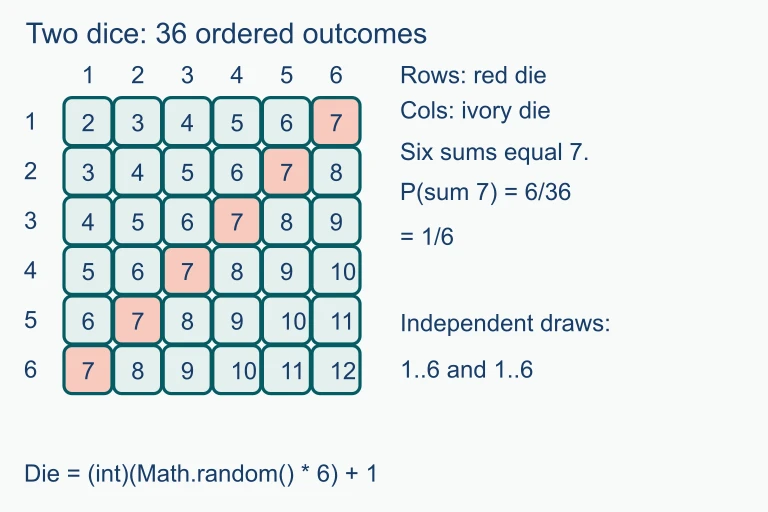 For two independent fair dice, six of the 36 equally likely ordered pairs sum to seven, so P(sum = 7) = 1/6. The red die supplies the row and the ivory die the column.
SECTION 6
Worked Example
Worked example
- 1
Step 1 — Recall the Distance Formula
The Euclidean distance between two points (x₁, y₁) and (x₂, y₂) is d = √((x₂ − x₁)² + (y₂ − y₁)²). We will implement this usingMath.sqrtandMath.pow. - 2
Step 2 — Set Up Variables
Suppose (x₁, y₁) = (1.0, 2.0) and (x₂, y₂) = (4.0, 6.0). We declare:double x1 = 1.0, y1 = 2.0, x2 = 4.0, y2 = 6.0; - 3
Step 3 — Compute the Squares of the Differences
Math.pow(x2 - x1, 2)evaluates toMath.pow(3.0, 2)which is9.0. Similarly,Math.pow(y2 - y1, 2)evaluates toMath.pow(4.0, 2)which is16.0.Sum = 9.0 + 16.0 = 25.0 - 4
Step 4 — Take the Square Root
Math.sqrt(25.0)returns5.0.distance = 5.0 - 5
Step 5 — Complete Code
The full expression in one line:double dist = Math.sqrt(Math.pow(x2 - x1, 2) + Math.pow(y2 - y1, 2));Note that bothMath.powandMath.sqrtreturndouble, so no cast is needed when storing in adoublevariable.
SECTION 7
Common Pitfalls & Exam Tips
| Pitfall | Why It Happens | Correct Approach |
|---|---|---|
Writing new Math() | Confusing static utility classes with instantiable classes. | Always call methods via Math.methodName() |
Assigning Math.pow to an int without casting | Math.pow returns double; Java does not implicitly narrow. | Use (int) Math.pow(2, 10) to get an int. |
| Off-by-one in random range | Forgetting the +1 in the multiplier, producing max−min values instead of max−min+1. | Always include (max − min + 1) as the multiplier. |
Thinking Math.random() can return 1.0 | The upper bound is exclusive: [0.0, 1.0). | Remember: 1.0 is never returned. The cast to int prevents exceeding max. |
Using math.abs (lowercase) | Java is case-sensitive; math is not Math. | Capitalize the M: Math.abs() |
Five common Math class pitfalls on the AP exam
SECTION 8
Connection to Advanced Topics
The AP exam focuses on a small subset of the Math class, but the full java.lang.Math API includes trigonometric functions (sin, cos, tan), logarithmic functions (log, log10), rounding utilities (ceil, floor, round), and comparison helpers (max, min). Understanding the static-method design pattern here also prepares you for other utility classes like Arrays and Collections that follow the same pattern.
| AP Scope | Beyond AP |
|---|---|
Math.abs, pow, sqrt, random | Math.sin, cos, tan, log, log10, ceil, floor, round, max, min |
| Static methods on a single class | Utility-class pattern reused across the standard library (Arrays, Collections, Objects) |
Math.random() for pseudorandom doubles | The Random class and ThreadLocalRandom for seeded, concurrent random number generation |
Casting double to int | Autoboxing, unboxing, and wrapper-class methods like Integer.parseInt |
AP scope vs. full Java Math ecosystem
As you move into college-level computer science, the utility-class pattern you learn from Math becomes a foundational design concept. You will encounter static factory methods, helper classes, and eventually the question of when statics are appropriate versus dependency injection—topics that trace directly back to the ideas embodied by java.lang.Math.
SECTION 9
Practice Problems
Question 1: CONCEPTUAL
Math m = new Math(); causes a compile-time error?- A. The Math class is abstract and cannot be instantiated.
- B. The Math class has a private constructor, preventing instantiation.
- C. The Math class is an interface, not a concrete class.
- D. The Math class requires an import statement before it can be referenced.
Show answer (B)
private, which prevents any code outside the class from invoking new Math(). A is wrong because Math is not declared abstract—it is a final class. C is wrong because Math is a concrete class, not an interface. D is wrong because Math resides in java.lang, which is auto-imported into every Java program.Question 2: BASIC CALCULATION
result after the following code executes?
int result = (int) Math.pow(3, 3) + Math.abs(-2);- A. 27
- B. 29
- C. 29.0
- D. Compile-time error
Show answer (B)
Math.pow(3, 3) returns 27.0 (a double), which is cast to int 27. Math.abs(-2) receives an int and returns int 2. The sum is 29, stored as an int. A is wrong because it omits the abs result. C is wrong because the variable is declared int, so the result cannot be 29.0. D is wrong because the explicit cast makes the assignment valid.Question 3: INTERMEDIATE
(int)(Math.random() * 8) + 5. Which of the following describes the set of values this expression can produce?- A. All integers from 5 to 13 inclusive
- B. All integers from 5 to 12 inclusive
- C. All integers from 0 to 12 inclusive
- D. All integers from 5 to 40 inclusive
Show answer (B)
Math.random() returns a value in [0.0, 1.0). Multiplying by 8 gives [0.0, 8.0). The (int) cast truncates to one of {0, 1, 2, 3, 4, 5, 6, 7}. Adding 5 shifts to {5, 6, 7, 8, 9, 10, 11, 12}. A is wrong because 13 would require the truncated value to be 8, which cannot happen since 8.0 is excluded. C is wrong because the + 5 shift means 0–4 are impossible. D confuses multiplication with addition.Question 4: APPLIED
public static double hypotenuse(double a, double b) that returns the length of the hypotenuse of a right triangle with legs a and b. Use only methods from the Math class. Assume a and b are positive.Show answer
public static double hypotenuse(double a, double b) {
    return Math.sqrt(Math.pow(a, 2) + Math.pow(b, 2));
}
Rubric:
• (1 pt) Correct method header returning double.
• (1 pt) Computes a² and b² using Math.pow(a, 2) and Math.pow(b, 2), or equivalently a a and b b.
• (1 pt) Returns Math.sqrt of the sum. Using Math.sqrt(a a + b b) is equally valid.Question 5: CRITICAL THINKING
public static int countSevens() that performs this simulation and returns the count. Your solution must use Math.random() to generate die values.Show answer
public static int countSevens() {
    int count = 0;
    for (int i = 0; i < 1000; i++) {
        int die1 = (int)(Math.random() * 6) + 1;
        int die2 = (int)(Math.random() * 6) + 1;
        if (die1 + die2 == 7) {
            count++;
        }
    }
    return count;
}
Rubric:
• (1 pt) Method header: public static int countSevens().
• (1 pt) Counter initialized to 0.
• (1 pt) Loop runs exactly 1000 iterations.
• (1 pt) Each die roll correctly uses (int)(Math.random() * 6) + 1 to produce values 1–6.
• (1 pt) Correctly checks if die1 + die2 == 7 and increments count.
• (1 pt) Returns count at the end. Note: the expected count is approximately 167 (probability of 7 is 6/36 = 1/6).