
SECTION 1
Historical Context & Motivation
Long before electronic computers existed, mathematicians and logicians grappled with a fundamental question: can a systematic, step-by-step procedure solve any well-defined problem? The pursuit of this question gave rise to the concept of an algorithm—a finite sequence of unambiguous instructions that transforms an input into a desired output. The word itself traces back to the ninth-century Persian mathematician al-Khwarizmi, whose works on arithmetic and algebra laid the groundwork for systematic computation. As mechanical and later electronic machines emerged, the need for formal languages to express algorithms led to the development of programming languages and compilers—the essential bridges between human reasoning and machine execution.
1843 • Ada Lovelace's Algorithm
1936 • Turing Machines & Church–Turing Thesis
1952 • Grace Hopper's A-0 Compiler
1995 • Java Released by Sun Microsystems
These milestones frame a central question that every computer scientist must confront: how do we express solutions to problems in a form that is both precise enough for a machine to execute and clear enough for a human to reason about? Understanding the interplay among algorithms, programming languages, and compilers is essential for writing correct, efficient Java programs—the very skill the AP Computer Science A exam assesses.
SECTION 2
Core Principles & Definitions
Before writing a single line of Java, it is essential to internalize the foundational concepts that underpin all of software development. An algorithm exists independently of any particular programming language; it is the logical blueprint. A programming language provides the syntax and semantics to express that blueprint, and a compiler (or interpreter) translates it into a form the hardware can execute. These three layers—logic, language, and translation—work in concert every time you run a Java program.
Algorithm
Programming Language
Compiler
Interpreter & JVM
Source Code vs. Bytecode vs. Machine Code
SECTION 3
Visual Explanation: From Source Code to Execution
The diagram below illustrates the complete lifecycle of a Java program, from the algorithm conceived in the programmer's mind to the final execution on any platform. Notice how Java's compilation strategy is a hybrid: the javac compiler first translates source code into bytecode, and then the JVM interprets (and optionally JIT-compiles) that bytecode into native machine instructions. This two-stage process is what gives Java its celebrated platform independence.
javac into bytecode, JVM interpretation, and finally CPU execution. The dashed box highlights Java's platform independence: the same .class file runs on any platform with a JVM.A critical insight from this diagram is the distinction between compile-time errors and run-time errors. When javac encounters a syntax error—such as a missing semicolon or a type mismatch—it halts compilation and no bytecode is produced. These are compile-time errors. Run-time errors, such as a NullPointerException or an ArrayIndexOutOfBoundsException, occur when the JVM is actually executing the bytecode. Java's static type system is specifically designed to catch as many errors as possible at compile time, which makes programs safer and more predictable—a theme that pervades the AP Computer Science A curriculum.
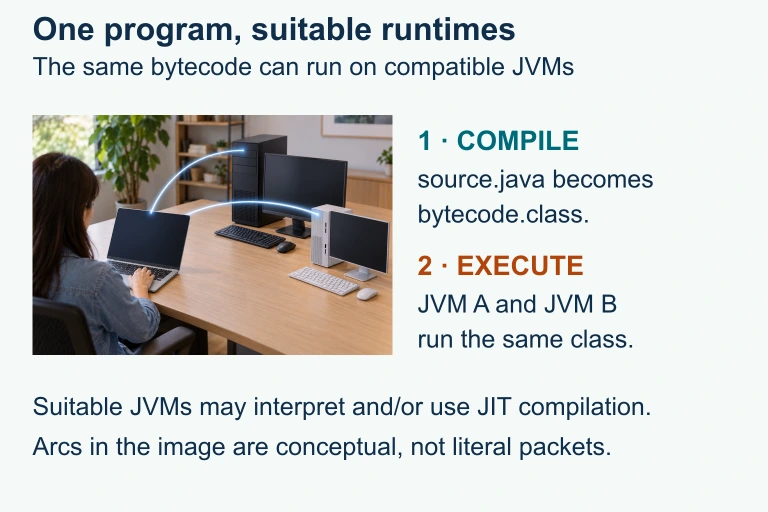 The same Java source compiles to bytecode that suitable JVMs can execute on different platforms.
SECTION 4
How It Works: The Compilation Pipeline in Depth
Although the AP Computer Science A exam does not require you to implement a compiler, understanding the stages of compilation deepens your intuition for why Java enforces certain rules. When you invoke javac MyProgram.java, the compiler proceeds through a series of well-defined phases, each of which checks or transforms the code. A conceptual understanding of these phases explains why the error messages you encounter reference specific line numbers, unexpected tokens, or incompatible types.
Phases of the Java Compiler
- Lexical Analysis (Scanning): The compiler reads the raw character stream and groups characters into tokens—keywords like
public, identifiers likemyVariable, operators like+, and literals like42. - Syntax Analysis (Parsing): Tokens are organized into a parse tree that reflects Java's grammar rules. If a token sequence violates the grammar (e.g., two operators in a row), a syntax error is reported.
- Semantic Analysis: The compiler verifies type correctness, checks that variables are declared before use, ensures method signatures match their invocations, and validates access modifiers. This is where type mismatch errors are caught.
- Bytecode Generation: After all checks pass, the compiler emits platform-independent bytecode stored in
.classfiles. These files contain instructions for the JVM's stack-based virtual architecture.
Algorithms and Efficiency: Big-O Notation Preview
While most of Big-O analysis appears later in the AP CSA curriculum, the concept of algorithmic efficiency is relevant from the very beginning. When you choose between two approaches to solve a problem—say, a linear search versus a more clever strategy—you are making an algorithmic decision. Efficiency is typically expressed in terms of the number of operations as a function of the input size n.
LINEAR TIME COMPLEXITY
where T(n) is the total number of operations, c is a constant cost per element, and n is the input size. A linear search through an array of n elements is O(n).
QUADRATIC TIME COMPLEXITY
Nested loops that each iterate over n elements result in O(n²) operations. Selection sort and insertion sort, which appear on the AP exam, exhibit this quadratic behavior in their worst cases.
SECTION 5
Classification of Programming Languages & Java's Place
Programming languages exist on a spectrum from extremely close to hardware (low-level) to highly abstract (high-level). Understanding where Java sits on this spectrum clarifies why you write code the way you do in AP Computer Science A. Java is a high-level, statically-typed, object-oriented language that compiles to an intermediate bytecode rather than directly to native machine code. This hybrid approach distinguishes it from purely compiled languages like C++ and purely interpreted languages like Python.
| Feature | Compiled (e.g., C++) | Interpreted (e.g., Python) | Hybrid (Java) |
|---|---|---|---|
| Translation | Source → native machine code | Source → executed line by line | Source → bytecode → JVM interprets/JIT |
| Portability | Must recompile for each platform | Portable if interpreter available | Write once, run anywhere (JVM) |
| Error Detection | Many errors caught at compile time | Most errors found at run time | Many errors caught at compile time |
| Execution Speed | Generally fastest | Generally slowest | Near-native with JIT optimization |
Comparison of compilation strategies across language types
SECTION 6
Worked Example: From Algorithm to Running Java Program
Let us walk through the complete process of solving a simple problem—computing the area of a circle given its radius—by first designing an algorithm, then encoding it in Java, and finally tracing the compilation and execution process.
Worked example
- 1
Step 1 — Design the Algorithm (Pseudocode)
Before touching Java, express the solution in plain pseudocode: (1) Accept a radius value as input. (2) Compute area = π × radius². (3) Output the result. This algorithm is language-independent and highlights the three algorithmic essentials: input, processing, and output. - 2
Step 2 — Write the Java Source Code
Translate the pseudocode into valid Java syntax. Declare adoublevariable for the radius, useMath.PIfor π, and callMath.pow(radius, 2)or simplyradius * radiusfor the squaring operation. The full statement:double area = Math.PI * radius * radius;Then print usingSystem.out.println(area);. Note how we invoke the Math class methods—this is using objects and methods, the core of this unit.double area = Math.PI * radius * radius; - 3
Step 3 — Compile with javac
Executejavac CircleArea.javaat the command line. The compiler performs lexical analysis (tokenizingdouble,area,=, etc.), parses the token stream into a syntax tree, checks thatMath.PIreturns adoubleand the multiplication is type-compatible, and then generatesCircleArea.classcontaining the bytecode.Output:CircleArea.class(bytecode file) - 4
Step 4 — Execute on the JVM
Runjava CircleArea. The JVM loads the bytecode, interprets (or JIT-compiles) it, and executes the instructions. Withradius = 5.0, the computation is π × 5.0 × 5.0 = 78.53981633974483. The JVM prints this value to the console viaSystem.out.println().Console output:78.53981633974483
SECTION 7
Strengths & Limitations of the Java Approach
No programming language or compilation strategy is universally optimal; each involves trade-offs. Java's design decisions—static typing, bytecode compilation, garbage collection—have consequences that you should understand both for the AP exam and for real-world software engineering. The table below summarizes the key strengths and limitations of Java's approach to algorithms, programming, and compilation.
| Aspect | Strength | Limitation |
|---|---|---|
| Static Typing | Catches type errors at compile time; IDE autocompletion; self-documenting code | More verbose than dynamically typed languages; requires explicit type declarations |
| Bytecode / JVM | Platform independence; JIT optimization can approach native speed | JVM startup overhead; slightly slower than fully compiled C/C++ in some cases |
| Object-Oriented | Encapsulation, inheritance, and polymorphism promote reuse and modularity | Simple scripts require boilerplate (class declaration, main method) |
| Garbage Collection | Automatic memory management prevents many memory leaks and dangling pointers | Less control over memory; potential GC pauses in latency-sensitive applications |
| Rich Standard Library | Extensive built-in classes (String, Math, ArrayList, etc.) reduce boilerplate | Library breadth can be overwhelming for beginners; not all classes are on AP subset |
Strengths and limitations of Java's design for AP Computer Science A
SECTION 8
Connection to Advanced Theory & the Full AP CSA Curriculum
The foundational concepts introduced in this lesson—algorithms, programming, and compilation—serve as the scaffolding upon which every subsequent AP Computer Science A topic is built. As you progress through the course, you will encounter increasingly sophisticated ideas that directly extend what you have learned here. The table below maps how introductory concepts evolve into their advanced counterparts.
| Introductory Concept | Advanced AP CSA Topic | Connection |
|---|---|---|
| Algorithm as a step-by-step procedure | Searching & sorting algorithms (Unit 7) | You will formalize algorithms for binary search, selection sort, insertion sort, and merge sort, analyzing their efficiency with Big-O notation. |
| Calling static methods (e.g., Math.pow()) | Writing your own methods & classes (Units 2, 5) | You will progress from using existing objects and methods to defining your own classes with instance variables, constructors, and methods. |
| Compile-time vs. run-time errors | Exceptions & debugging (throughout) | Understanding error types prepares you for handling ArrayIndexOutOfBoundsException, NullPointerException, and ClassCastException. |
| Static typing and variable declarations | Inheritance & polymorphism (Units 9, 10) | Java's type system enables compile-time polymorphism checking—the compiler verifies that a method exists on the declared type, even if the actual object is a subclass. |
| Sequential execution model | Recursion (Unit 10) | Recursion extends sequential execution by having methods call themselves, requiring you to trace the call stack—an operation the JVM manages. |
How introductory concepts map to advanced AP CSA topics
Beyond the AP exam, these concepts extend into university-level computer science. Formal algorithm analysis becomes the subject of courses in data structures and algorithms, where you study asymptotic complexity, graph algorithms, and NP-completeness. Compiler design is an entire field unto itself, encompassing formal language theory, optimization passes, and code generation for modern processor architectures. The object-oriented principles you learn in Java provide a natural stepping stone to design patterns, software architecture, and ultimately to understanding how large-scale systems like web frameworks and operating systems are structured.
SECTION 9
Practice Problems
Question 1: CONCEPTUAL
Greeting.java. After running javac Greeting.java successfully, which of the following files is produced?- A.
Greeting.exe - B.
Greeting.class - C.
Greeting.bin - D.
Greeting.byte
Show answer (B)
javac) translates source code from a .java file into bytecode stored in a .class file. Choice A (.exe) is a Windows native executable format produced by compilers for languages like C++, not Java. Choice C (.bin) is a generic binary format not associated with Java compilation. Choice D (.byte) is not a real file extension used in Java development, despite the output being called 'bytecode.'Question 2: BASIC
double result = Math.sqrt(144);
What value is stored in result after this line executes?- A. 144.0
- B. 12
- C. 12.0
- D. A compile-time error occurs
Show answer (C)
Math.sqrt(144) is a static method call on the Math class that returns the square root of 144 as a double, which is 12.0 (not the integer 12). Choice A (144.0) confuses the input with the output. Choice B (12) is numerically correct but does not reflect the actual stored type—Math.sqrt() returns a double, so the value includes the decimal point. Choice D is incorrect because the code is syntactically and semantically valid: the integer literal 144 is automatically promoted to a double parameter.Question 3: INTERMEDIATE
int x = 10;
System.out.println(x / 3);
System.out.println((double) x / 3);
Which of the following correctly describes the output of this code?- A. 3 followed by 3.0
- B. 3.0 followed by 3.3333333333333335
- C. 3.3333333333333335 followed by 3.3333333333333335
- D. 3 on the first line, then 3.3333333333333335 on the second line (each on its own line)
Show answer (D)
x / 3 performs integer division because both operands are int values—the fractional part is truncated, yielding 3. In the second statement, the cast (double) x converts x to 10.0 before the division occurs, so the operation becomes double division and the full decimal result 3.3333333333333335 is printed. Choice A incorrectly states the second output as 3.0, which would only happen if the cast applied after the division. Choice B incorrectly shows 3.0 as the first output; since both operands in x / 3 are int, the result is the int value 3, not 3.0. Choice C incorrectly applies double division to both expressions.Question 4: APPLIED
4 ptscylinderVolume that takes two double parameters—radius and height—and returns the volume of a cylinder. Use Math.PI for pi and Math.pow() for exponentiation. Include a brief explanation of which parts of your code the compiler checks at compile time versus what can only be verified at run time.Show answer
double), method name (cylinderVolume), and two double parameters. Example:public static double cylinderVolume(double radius, double height)
Point 2 — Correct computation (1 point): The body must compute V = pi * * h using Math.PI and Math.pow(radius, 2) (or radius * radius). Example:double volume = Math.PI Math.pow(radius, 2) height;
Point 3 — Correct return statement (1 point): The method must include a return statement that returns the computed double value. Without it, the code will not compile because Java requires all non-void methods to return a value along every execution path. A complete sample solution:public static double cylinderVolume(double radius, double height) {
return Math.PI Math.pow(radius, 2) height;
}
Point 4 — Compile-time vs. run-time explanation (1 point): The student must correctly distinguish what the compiler checks from what can only be verified at run time. At compile time, the compiler verifies: (a) that Math.PI and Math.pow() exist and are invoked with the correct number and types of arguments, (b) that the parameter types match double, and (c) that the return type is compatible with double. At run time, potential issues include passing a negative radius (which is mathematically nonsensical but not a Java error) or extremely large values causing overflow to Double.POSITIVE_INFINITY. The compiler cannot check the semantic correctness of the input values—it only enforces the type system and syntax.Question 5: CRITICAL THINKING
3 pts