
SECTION 1
Historical Context & Motivation
The concept of organizing data in a grid—rows and columns—predates electronic computing by centuries. Mathematicians formalized the matrix as a rectangular array of numbers in the mid-1800s, and that same tabular structure became one of the first data structures hard-wired into early programming languages. When Fortran introduced multi-dimensional arrays in 1957, engineers could finally represent grids of sensor readings, game boards, and pixel maps in code. Today, 2D arrays remain the backbone of image processing, spreadsheet computation, graph adjacency matrices, and countless AP Computer Science A exam questions.
1850s • Matrix Algebra Formalized
1957 • Fortran Multi-Dimensional Arrays
1972 • C Adopts Row-Major Order
1995 • Java's Array-of-Arrays Model
The central challenge this lesson addresses is deceptively simple: given a grid of values stored in a Java int[][], how do you systematically visit, inspect, and transform every element? Mastering the nested-loop patterns for row-major traversal, column-major traversal, and boundary-aware algorithms is essential for both the multiple-choice and free-response sections of the AP exam.
SECTION 2
Core Principles & Definitions
A 2D array in Java is declared as type[][] name = new type[rows][cols];. Internally, Java implements this as an array of arrays: the outer array holds references to row arrays, and each row array holds the actual data values. This design means arr.length returns the number of rows, while arr[0].length returns the number of columns in the first row. Understanding this distinction is critical for writing correct loop bounds.
Row-Major Traversal
Column-Major Traversal
Boundary Conditions
Sequential vs. Targeted Search
SECTION 3
Visual Explanation: Memory Layout & Traversal Orders
int[] row array (right, violet borders). Row-major order reads all columns of row 0 first, then row 1, then row 2. Column-major order reads all rows of column 0 first, then column 1, etc.The diagram above illustrates the fundamental memory model that underpins every 2D array algorithm in Java. Because grid is literally an array whose elements are references to row arrays, each row could theoretically have a different length—a ragged array. On the AP exam, however, you may assume rectangular arrays unless explicitly told otherwise. The key syntactic detail to remember is that grid.length yields the number of rows, while grid[0].length yields the number of columns.
SECTION 4
How It Works: Traversal Patterns in Code
Row-Major Traversal (Standard)
The canonical nested-loop structure places the row index in the outer loop and the column index in the inner loop. The outer loop runs from r = 0 to r < grid.length, and the inner loop runs from c = 0 to c < grid[r].length. Using grid[r].length rather than a hardcoded number ensures correctness even for ragged arrays.
ROW-MAJOR NESTED LOOP
r — row index (outer), c — column index (inner). Total iterations = rows × cols.
Column-Major Traversal
COLUMN-MAJOR NESTED LOOP
The outer loop now iterates over columns; the inner loop steps through each row within that column.
Enhanced for Loop Traversal
FOR-EACH OVER 2D ARRAY
The outer enhanced for loop yields each row array; the inner loop yields each element. Note: you lose direct access to row/column indices.
SECTION 5
Common 2D Array Algorithm Patterns
Beyond basic traversal, the AP exam expects you to implement several standard algorithms on 2D arrays. These algorithms combine nested-loop traversal with accumulation, search, and conditional logic patterns you already know from 1D arrays. The diagram below categorizes the most important patterns and shows sample code skeletons for each.
The neighbor check pattern deserves special attention because it introduces the risk of index-out-of-bounds errors. When inspecting the four orthogonal neighbors of grid[r][c], you must verify that r − 1 >= 0 before accessing the cell above, r + 1 < grid.length before accessing the cell below, and analogous checks for c − 1 and c + 1. Short-circuit evaluation with && is the standard approach: the bounds check appears first so Java never evaluates the array access when the index is invalid.
 Grid algorithms turn a visual pattern into explicit row and column operations. Bounds checks determine which neighboring cells can be accessed.
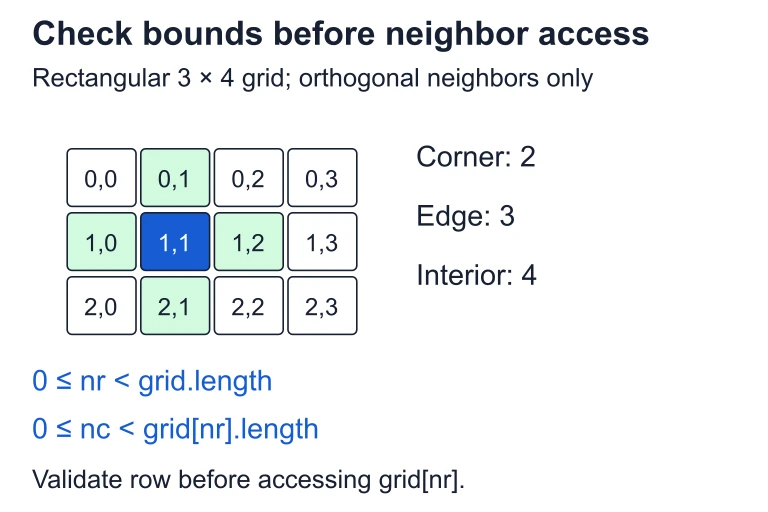 In this rectangular grid, an interior cell has four orthogonal neighbors, a noncorner edge cell has three, and a corner has two. Validate the target row before accessing that row’s length.
SECTION 6
Worked Example: Row with the Largest Sum
Consider the following problem: given a 2D array of integers, write a method that returns the index of the row whose elements have the largest sum. If there is a tie, return the index of the first such row.
Worked example
- 1
Step 1 — Declare tracking variables
We need two variables:int maxSuminitialized toInteger.MIN_VALUE(to handle rows with all negative values), andint maxRowinitialized to0to store the best row index found so far.int maxSum = Integer.MIN_VALUE; int maxRow = 0; - 2
Step 2 — Outer loop over rows
Iteraterfrom 0 togrid.length − 1. For each row, initialize a local accumulatorint rowSum = 0;.for (int r = 0; r < grid.length; r++) { int rowSum = 0; ... } - 3
Step 3 — Inner loop to compute row sum
Iteratecfrom 0 togrid[r].length − 1, accumulatingrowSum += grid[r][c];on each iteration.for (int c = 0; c < grid[r].length; c++) rowSum += grid[r][c]; - 4
Step 4 — Update max after inner loop
After the inner loop completes for rowr, comparerowSumtomaxSum. IfrowSum > maxSum, update bothmaxSumandmaxRow. Using strict greater-than ensures the first row wins ties.if (rowSum > maxSum) { maxSum = rowSum; maxRow = r; } - 5
Step 5 — Return result
After the outer loop finishes,maxRowholds the answer. For the grid {{2,7,1,4},{5,3,9,8},{6,0,2,5}}, the row sums are 14, 25, and 13, so the method returns 1.return maxRow; // returns 1
SECTION 7
Strengths, Limitations & Traversal Comparisons
| Approach | Strengths | Limitations |
|---|---|---|
| Indexed row-major loop | Full control over row and column indices; supports reading, writing, and neighbor access. | More verbose; off-by-one errors possible if bounds are wrong. |
| Enhanced for loop | Concise; eliminates index management; reduces ArrayIndexOutOfBoundsException risk. | Cannot modify elements in place; no direct access to row/column index. |
| Column-major indexed loop | Required for column-wise aggregation (e.g., column sums, column search). | Less cache-friendly in Java (rows are contiguous in memory); often slower for large arrays. |
Comparison of 2D array traversal strategies
SECTION 8
Connection to Advanced Data Structures
| AP-Level Concept | Advanced Extension |
|---|---|
| 2D array with nested for loops | Sparse matrix representations (HashMaps or linked structures) for large, mostly-zero grids. |
| Sequential search on 2D array | Staircase search on a sorted 2D array: O(R + C) by starting at top-right corner. |
| Neighbor checking with bounds guards | BFS/DFS flood-fill algorithms for connected-component labeling in image processing. |
| Row/column accumulation | Prefix-sum matrices enabling O(1) subregion queries after O(R × C) preprocessing. |
How AP concepts scale to college CS and industry
The patterns you master here—nested iteration, boundary checking, and accumulation over a grid—are the foundation of algorithms you will encounter in data structures courses (graph traversal via adjacency matrices), machine learning (matrix operations), and systems programming (memory-mapped 2D buffers). Even though the AP exam tests only rectangular int[][] arrays, the algorithmic thinking transfers directly to nested ArrayList structures and beyond.
SECTION 9
Practice Problems
Question 1: CONCEPTUAL
int[][] m = new int[5][3];, what are the values of m.length and m[0].length?- A. m.length is 3; m[0].length is 5
- B. m.length is 5; m[0].length is 3
- C. m.length is 15; m[0].length is 3
- D. m.length is 5; m[0].length is 5
Show answer (B)
new int[5][3], the first dimension (5) is the number of rows, so m.length == 5. Each row is an array of 3 elements, so m[0].length == 3. A reverses rows and columns. C confuses total element count with row count. D incorrectly reports column count as 5.Question 2: BASIC CALCULATION
int[][] grid = {{1,2,3},{4,5,6},{7,8,9}};
int result = 0;
for (int r = 0; r < grid.length; r++)
  result += grid[r][r];
What is the value of result after execution?- A. 12
- B. 15
- C. 45
- D. 6
Show answer (B)
grid[r][r], which traces the main diagonal: grid[0][0]=1, grid[1][1]=5, grid[2][2]=9. The sum is 1 + 5 + 9 = 15. A (12) might result from summing the first row. C (45) is the sum of all elements. D (6) is the sum of grid[0][0]+grid[0][1]+grid[0][2], the first row via a different misreading.Question 3: INTERMEDIATE
public static int mystery(int[][] g) {
  int count = 0;
  for (int c = 0; c < g[0].length; c++)
    for (int r = 0; r < g.length; r++)
      if (g[r][c] % 2 == 0)
        count++;
  return count;
}- A. 5
- B. 7
- C. 6
- D. 12
Show answer (C)
Question 4: APPLIED
public static double[] studentAverages(int[][] scores) that returns an array of doubles where element i is the average score for student i. If a student has zero quizzes, their average should be 0.0.Show answer
public static double[] studentAverages(int[][] scores) {
    double[] avgs = new double[scores.length];
    for (int r = 0; r < scores.length; r++) {
        int sum = 0;
        for (int c = 0; c < scores[r].length; c++) {
            sum += scores[r][c];
        }
        if (scores[r].length > 0) {
            avgs[r] = (double) sum / scores[r].length;
        }
    }
    return avgs;
}
Rubric: (1) Return array declaration — new double[scores.length]. (2) Outer loop — iterates r from 0 to scores.length−1. (3) Inner loop accumulation — correctly sums scores[r][c]. (4) Double division — casts to double to avoid integer truncation. (5) Edge case guard — checks scores[r].length > 0 before dividing. (6) Returns avgs.Question 5: CRITICAL THINKING
public static boolean isSymmetric(int[][] m) that returns true if and only if the square 2D array m is symmetric—that is, m[r][c] == m[c][r] for all valid r and c. You may assume m is square (same number of rows and columns).Show answer
public static boolean isSymmetric(int[][] m) {
    for (int r = 0; r < m.length; r++) {
        for (int c = r + 1; c < m[r].length; c++) {
            if (m[r][c] != m[c][r])
                return false;
        }
    }
    return true;
}
Rubric: (1) Efficient bounds — inner loop starts at r+1 (or equivalent approach that checks each pair once). Full credit also given for c = 0 with a full scan. (2) Correct comparison and early return — compares m[r][c] != m[c][r] and returns false immediately. (3) Return true at end — returns true only after all pairs pass.