

SECTION 1
Historical Context & Motivation
The distinction between class-level and instance-level members has roots that trace back to the earliest object-oriented programming languages. As software systems grew in complexity, developers needed a mechanism to share data and behavior among all objects of the same type without duplicating that information in every single instance. The static keyword in Java directly descends from design decisions made across decades of language evolution, formalizing the idea that some properties belong to the class blueprint itself rather than to any particular object created from it.
1967 • Simula 67 Introduces Classes
1980 • Smalltalk-80 Formalizes Class Methods
1983 • C++ Adopts static Keyword
1995 • Java Standardizes static
The central question this concept addresses is deceptively simple: if every BankAccount object tracks its own balance, where should the interest rate live when it is identical for every account? Storing a separate copy in each object wastes memory and creates a maintenance nightmare if the rate changes. Class variables and methods solve this problem by anchoring shared data and utility behavior to the class itself rather than to any one object.
SECTION 2
Core Principles & Definitions
In Java, every field or method declared with the static modifier belongs to the class rather than to any instance. These members are loaded into memory once when the class is first referenced by the JVM and persist for the lifetime of the program. Understanding the four core principles below is essential for both the AP exam and for writing well-structured Java code.
Class (Static) Variables
static, a class variable has exactly one copy shared by all instances. Changes made through any reference are visible everywhere. Example: a counter tracking the total number of objects created.Instance Variables
static, an instance variable has a separate copy in every object. Each object's state is independent. Example: the balance of an individual bank account.Class (Static) Methods
Math.sqrt()). They cannot access instance variables or this because no specific object is guaranteed to exist when they run.Access Rules
SECTION 3
Visual Explanation
totalStudents resides. Each colored box below is a separate object on the heap with its own name and gpa. The dashed arrows emphasize that every instance references the same shared counter.Notice how the static variable totalStudents exists in a single location associated with the Student class itself. When any constructor increments this counter, the change is visible through every reference — s1.totalStudents, s2.totalStudents, or (preferably) Student.totalStudents all evaluate to the same value. The AP exam strongly expects you to call static members using the class name rather than an object reference to convey intent clearly.
 Each issued ticket keeps its own number while one class counter advances. Shared class state and separate instance state serve different purposes.
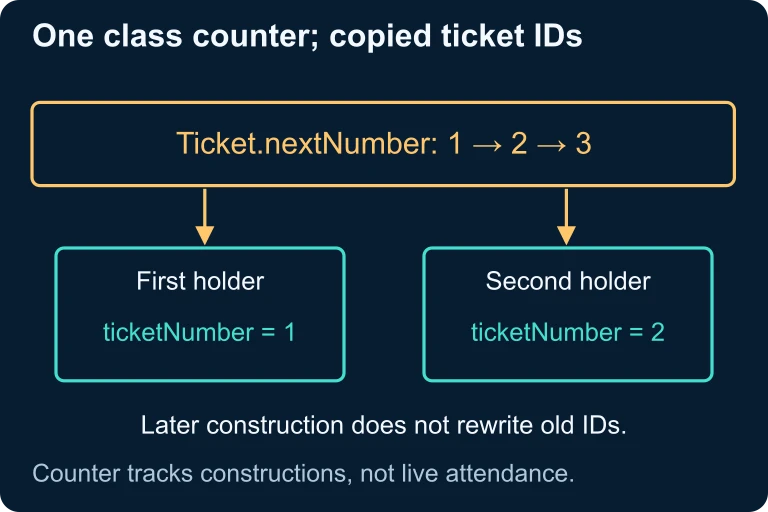 The Ticket constructor copies nextNumber into the new instance and then increments the shared counter. Tickets keep IDs 1 and 2 while nextNumber becomes 3. This counter records constructions.
SECTION 4
How Static Members Work Under the Hood
When the JVM loads a class for the first time, it allocates space for all static fields in a region of memory called the method area (metaspace). This happens before any constructor runs and before any object of that class exists. Static variables are initialized in the order they appear in the source code, and they remain alive until the class is unloaded — effectively for the entire program. Instance fields, by contrast, are allocated on the heap each time new is invoked.
Declaration Syntax
STATIC VARIABLE
The static keyword appears between the access modifier and the type. This variable is shared by all instances.
STATIC METHOD
A static method can only directly reference static fields. It cannot use this or call instance methods without an explicit object reference.
STATIC FINAL CONSTANT
Combining static with final creates a class-level constant. By convention these use ALL_CAPS naming. The value cannot be reassigned after initialization.
SECTION 5
Static vs. Instance — Detailed Breakdown
| Feature | Static (Class) Member | Instance Member |
|---|---|---|
| Keyword | static | (none — default) |
| Copies in memory | Exactly one per class | One per object |
| Accessed via | ClassName.member | objectRef.member |
| Lifetime | Class loading → program end | Object creation → garbage collection |
Can use this? | No | Yes |
| Typical use case | Counters, constants, utility methods | Object state and behavior |
Comprehensive comparison of static vs. instance members
SECTION 6
Worked Example — Designing a Dog Class
The following example demonstrates a complete class that uses both static and instance members. We will trace through the code step by step to see how the static variable dogCount changes as new objects are created.
Worked example
- 1
Step 1 — Define the Class
We declare aDogclass with one static variable, one static method, and standard instance members:public class Dog { private static int dogCount = 0; private String name; public Dog(String name) { this.name = name; dogCount++; } public static int getDogCount() { return dogCount; } public String getName() { return name; } }Before any objects are created,dogCountis initialized to 0. - 2
Step 2 — Create the First Object
Dog d1 = new Dog("Rex");The constructor setsthis.nameto "Rex" and incrementsdogCount.dogCountis now 1.d1.getName()returns "Rex". - 3
Step 3 — Create the Second Object
Dog d2 = new Dog("Bella");The same constructor runs again, setting the new object'snameto "Bella" and incrementing the same staticdogCount.dogCountis now 2. BothDog.getDogCount()andd1.getDogCount()return 2. - 4
Step 4 — Verify Independence of Instance State
System.out.println(d1.getName()); // Rex
System.out.println(d2.getName()); // Bella
System.out.println(Dog.getDogCount()); // 2
Each object retains its ownname, but both sharedogCount. This is the fundamental static-vs-instance distinction in action.Instance variables are independent; the static variable is shared and consistent across all objects.
SECTION 7
Strengths, Limitations & Common Mistakes
| Strengths | Limitations |
|---|---|
| Memory efficient — one copy shared by all instances avoids redundant storage | Overuse couples code tightly, making testing and subclassing harder |
Accessible without creating objects, ideal for utility methods like Math.max() | Static methods cannot be overridden polymorphically; they are hidden, not overridden |
Constants declared static final provide a single source of truth for values like π or tax rates | Mutable static variables create hidden global state, which can introduce concurrency bugs in multithreaded programs |
| Enables clean factory method patterns and counting utilities | Cannot access instance state directly — requires an object reference to reach non-static fields |
When to use and when to avoid static members
Key takeaway
SECTION 8
Connection to Advanced Concepts
While the AP exam focuses on basic static usage, the concept opens the door to several advanced patterns in software engineering. Understanding how Java's static keyword relates to these patterns provides useful context, even if the advanced topics themselves are beyond the AP scope.
| AP-Level Concept | Advanced Extension |
|---|---|
| Static variable as object counter | Singleton Pattern — uses a private static reference to guarantee exactly one instance of a class exists |
Static utility methods (e.g., Math.abs()) | Static Factory Methods — named static methods like List.of() that replace constructors for flexible object creation |
static final constants | Enum Types — a type-safe alternative to groups of static constants, e.g., enum Season { WINTER, SPRING, ... } |
| Static methods cannot be overridden | Method Hiding vs. Overriding — in inheritance, a static method in a subclass hides (not overrides) the parent's version, affecting polymorphic dispatch |
How AP-level static concepts extend into advanced Java
If you continue into college-level courses such as Data Structures or Software Engineering, you will encounter design debates about global mutable state — the risks that come with non-final static variables. Modern best practice favors dependency injection over static access for anything beyond constants and pure utility functions, because injected dependencies are easier to mock in unit tests and reason about in concurrent systems.
SECTION 9
Practice Problems
Question 1: CONCEPTUAL
public class Widget {
  private static int count = 0;
  private int id;
  public Widget() { count++; id = count; }
  public static int getCount() { return count; }
  public int getId() { return id; }
}
After executing the following code, what does Widget.getCount() return?
Widget w1 = new Widget();
Widget w2 = new Widget();
Widget w3 = new Widget();- A. 0
- B. 1
- C. 3
- D. The code does not compile
Show answer (C)
Widget constructor increments the single static variable count. After three objects are created, count equals 3. Option A (0) would be correct only if no constructors had run. Option B (1) confuses static with instance behavior — it would be true if each object had its own counter resetting to 0. Option D is wrong because the code is syntactically and semantically valid.Question 2: BASIC CALCULATION
public class Account {
  private static double interestRate = 0.05;
  private double balance;
  public Account(double b) { balance = b; }
  public static void setRate(double r) { interestRate = r; }
  public double getProjected() { return balance * (1 + interestRate); }
}
What is the output of this code?
Account a1 = new Account(1000);
Account a2 = new Account(2000);
Account.setRate(0.10);
System.out.println(a1.getProjected());
System.out.println(a2.getProjected());- A. 1050.0 and 2100.0
- B. 1100.0 and 2200.0
- C. 1050.0 and 2200.0
- D. 1100.0 and 2100.0
Show answer (B)
setRate(0.10) changes the single shared interestRate to 0.10 before either getProjected() is called. So a1 computes 1000 × 1.10 = 1100.0 and a2 computes 2000 × 1.10 = 2200.0. Option A uses the original 0.05 rate, ignoring the update. Option C incorrectly applies the old rate to only a1. Option D incorrectly applies the old rate to only a2.Question 3: INTERMEDIATE
Account class from Problem 2?
// Option A: In setRate
public static void setRate(double r) {
  interestRate = r;
  System.out.println(balance); // added line
}

// Option B: In getProjected
public double getProjected() {
  return balance * (1 + interestRate);
}

// Option C: New static method
public static double getRate() {
  return interestRate;
}

// Option D: In constructor
public Account(double b) {
  balance = b;
  interestRate = 0.05;
}- A. Adding
System.out.println(balance);insidesetRate - B. The existing
getProjectedmethod as written - C. Adding a new static method
getRate()that returnsinterestRate - D. Assigning
interestRateinside the constructor
Show answer (A)
setRate is static, so it cannot access the instance variable balance directly — this produces a compile-time error. Option B compiles fine because getProjected is an instance method and can access both instance and static fields. Option C compiles because a static method returning a static variable is perfectly valid. Option D compiles because a constructor is an instance context that can access static variables.Question 4: APPLIED
Ticket that meets the following requirements:
• A static variable nextNumber that starts at 1 and auto-increments each time a new Ticket is created.
• An instance variable ticketNumber that stores the number assigned to that specific ticket.
• An instance variable holder of type String.
• A constructor that takes the holder's name and assigns the next ticket number.
• A static method getNextNumber() that returns the value of nextNumber.
• A toString() method that returns a String in the format "Ticket #X: holderName".Show answer
public class Ticket {
  private static int nextNumber = 1;
  private int ticketNumber;
  private String holder;

  public Ticket(String holder) {
    this.holder = holder;
    this.ticketNumber = nextNumber;
    nextNumber++;
  }

  public static int getNextNumber() {
    return nextNumber;
  }

  public String toString() {
    return "Ticket #" + ticketNumber + ": " + holder;
  }
}
Rubric:
Point 1: private static int nextNumber = 1; — must be static and initialized to 1.
Point 2: Instance variables ticketNumber and holder are declared as non-static with correct types and private access.
Point 3: Constructor assigns ticketNumber = nextNumber before incrementing nextNumber++. Both operations must be present and in the correct order (assign then increment, or use post-increment).
Point 4: getNextNumber() is declared static and returns nextNumber.
Point 5: toString() returns the exact format "Ticket #" + ticketNumber + ": " + holder. Must use instance variables, not static.Question 5: CRITICAL THINKING
Dog class from Section 6: they add a static method called rename that takes a new name as a parameter and sets name = newName.
(a) Explain why this method will not compile.
(b) Provide two distinct ways to fix the method so that it successfully renames a specific Dog, and explain the trade-off of each approach.
(c) State which fix is preferred from an OOP design perspective and justify your answer.Show answer
name is an instance variable, and a static method has no implicit this reference. The compiler cannot determine which Dog's name to modify, so it rejects the access with a compile-time error.
(b) Fix 1: Remove the static keyword, making rename an instance method: public void rename(String newName) { name = newName; }. Trade-off: requires an existing object reference to call (e.g., d1.rename("Max")).
Fix 2: Keep it static but pass a Dog parameter: public static void rename(Dog d, String newName) { d.name = newName; }. Trade-off: this works only because static methods within the same class can access private fields of objects of that class, but the design is awkward — callers must pass an explicit object rather than calling the method naturally on the object.
(c) Fix 1 is preferred because renaming is fundamentally an operation on a specific Dog instance, and OOP design dictates that behavior tied to an object's state should be an instance method. Fix 2 treats the method as a utility acting on external data, which undermines encapsulation and is not idiomatic Java.
Rubric: Point 1 — Correctly identifies the compile-time error as static method accessing instance variable without this. Point 2 — Provides Fix 1 (remove static) with trade-off stated. Point 3 — Provides Fix 2 (add parameter) with trade-off stated and correctly identifies which approach is preferred with OOP justification.