
SECTION 1
Historical Context & Motivation
Software engineering did not always have the luxury of clean, modular code. In the 1950s and 1960s, programs were monolithic sequences of instructions in assembly language or early FORTRAN, with every memory address and hardware register managed by hand. As projects grew in scope—think of the Apollo guidance software or early airline reservation systems—developers found that flat, unstructured code became nearly impossible to debug, extend, or hand off to other teams. The concept of abstraction arose precisely to tame this complexity: separate what a component does from how it does it, so that each piece of a system can be understood, tested, and replaced independently.
1967 • Simula and the Birth of OOP
1972 • Information Hiding
1983 • C++ Brings OOP to Systems Programming
1995 • Java and Platform-Independent Classes
The central question that abstraction answers is deceptively simple: How do we manage complexity as programs grow from hundreds to millions of lines of code? In the AP Computer Science A curriculum, the answer begins with designing well-encapsulated Java classes whose internal workings are invisible to client code, exposing only a carefully chosen public interface.
SECTION 2
Core Principles of Abstraction
Abstraction in program design is not a single technique but a family of related ideas. In Java, these ideas converge in the design of classes: each class models a coherent concept, exposes a minimal public interface, and hides the messy implementation details behind private access modifiers. The following principles form the intellectual backbone of good class design.
Encapsulation
private fields with public getters/setters.Information Hiding
Modularity
Procedural Abstraction
Data Abstraction
KEY TAKEAWAY
SECTION 3
Visualizing Class Abstraction
The diagram above illustrates a foundational pattern you will encounter on the AP exam repeatedly. Client code—any code outside the BankAccount class—can call deposit(), withdraw(), and getBalance() without knowing that a transactionLog exists internally or that a private isValidAmount() helper validates every input. If the developer later replaces the ArrayList with a database connection, no client code needs to change because the public interface remains the same.
 Two implementations can provide the same public counting behavior while storing their internal state differently. A representation change must preserve the interface’s promised behavior.
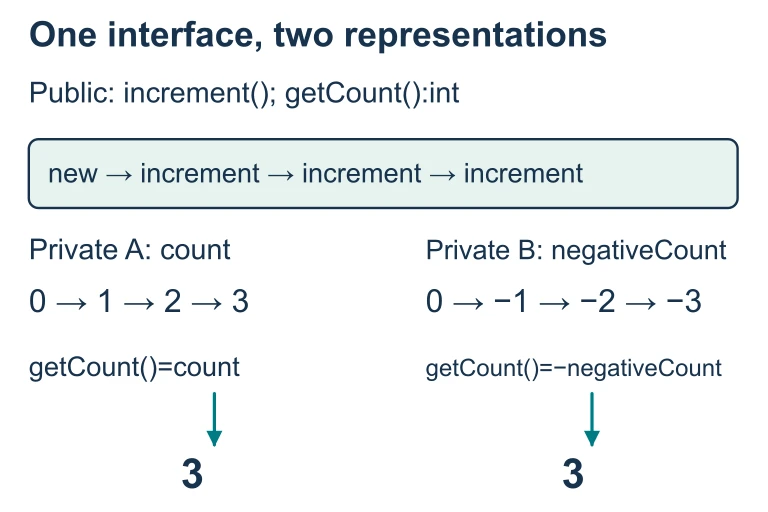 Starting at zero, one Counter stores count and increments it; another stores negativeCount and decrements it, returning its negation. Three increment calls make both getCount results 3. Their private representations differ while the public trace agrees.
SECTION 4
How Abstraction Works in Java Classes
Access Modifiers as the Enforcement Mechanism
In Java, abstraction is not merely a recommendation—it is enforced by the compiler through access modifiers. The AP Computer Science A exam focuses on two: public and private. Declaring an instance variable private means no code outside the class can read or modify it directly; any interaction must go through public methods. This is the mechanical basis of encapsulation.
Anatomy of a Well-Designed Class
A class designed with proper abstraction follows a consistent pattern. First, all instance variables are declared private. Second, one or more constructors initialize those variables, often performing validation. Third, accessor methods (getters) return state without altering it, and mutator methods (setters or domain-specific methods like deposit()) modify state in a controlled way. Finally, private helper methods break complex logic into manageable pieces, invisible to the outside world.
AP Exam Tip
private and accessed through public methods. If a question shows code that directly accesses obj.balance from outside the class, that code will not compile if balance is private.Procedural Abstraction via Methods
Every method you write is an act of procedural abstraction. Consider a method public double calculateGPA() inside a Student class. The caller asks for a GPA and receives a double; it does not know whether the method iterates through an array, queries a list of Course objects, or reads from a file. The method's signature (name, parameter types, return type) constitutes its abstract contract, while the body constitutes its concrete implementation.
 Two variables can provide access to one shared object. Copying a reference creates another access path; it does not duplicate the object.
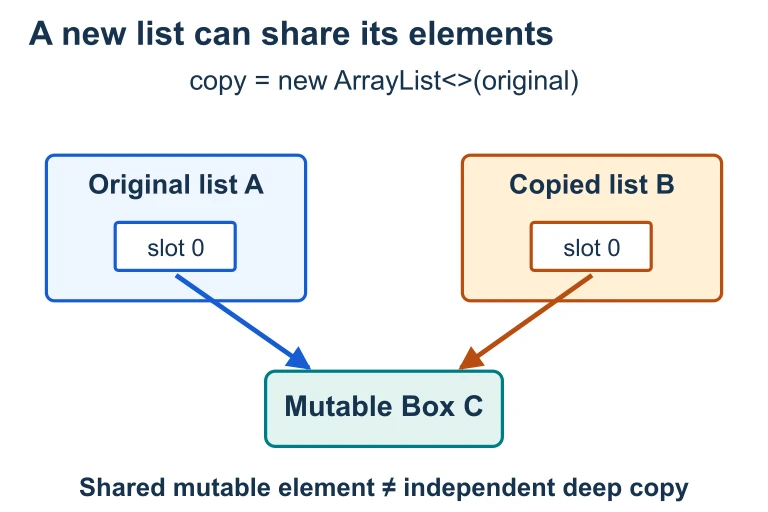 Copying the list creates a separate container while copying its element references. Both lists can still reach the same mutable Box. String and Integer values are immutable, so those elements cannot be mutated through either list.
SECTION 5
The Class Design Process
Designing a class from scratch requires a systematic approach. The AP exam tests your ability to read a problem description and translate it into fields, constructors, and methods. The following diagram illustrates a five-step workflow that mirrors the thinking expected on FRQ questions involving class creation.
| Step | Question to Ask | Output |
|---|---|---|
| 1 — Identify Entity | What real-world thing or concept am I modeling? | Class name (noun, singular, PascalCase) |
| 2 — Private Fields | What data must each object store? | private instance variables |
| 3 — Constructors | What information is needed to create a valid object? | Constructor(s) with parameters |
| 4 — Public Methods | What operations do clients need? | Accessors, mutators, and toString |
| 5 — Helpers | What internal logic can be factored out? | private helper methods |
Five-Step Class Design Checklist
SECTION 6
Worked Example: Designing a Student Class
Suppose you are asked to design a class that represents a student in a school. Each student has a name, a student ID, and a list of test scores. The class should support adding a score, computing the average, and determining whether the student is passing (average ≥ 60). Let us apply the five-step workflow.
Designing the Student Class
- 1
Step 1 — Identify the Entity
The entity is a student. The class name isStudent(noun, singular, PascalCase). - 2
Step 2 — Determine Private Instance Variables
We need three pieces of data:private String name,private int id, andprivate ArrayList<Integer> scores. All declared private to enforce encapsulation. - 3
Step 3 — Write the Constructor
The constructor accepts the student's name and ID, and initializes the scores list as empty:public Student(String name, int id) { this.name = name; this.id = id; this.scores = new ArrayList<Integer>(); }A valid Student object is created with an empty score list. - 4
Step 4 — Define Public Methods
Accessors:getName(),getId(). Mutator:addScore(int score). Domain methods:getAverage()returns the mean of all scores, andisPassing()returnsgetAverage() >= 60.0. - 5
Step 5 — Add Validation & Helpers
InsideaddScore(), we validate that the score is between 0 and 100 before adding it. InsidegetAverage(), we guard against division by zero if the list is empty, returning 0.0 by default. A private helperprivate int sumScores()iterates through the list and returns the total, keeping getAverage clean.Complete class with encapsulated fields, validated mutators, computed accessors, and a private helper.
Common Pitfall
scores is never assigned a new ArrayList, it remains null, and any call to scores.add() throws a NullPointerException.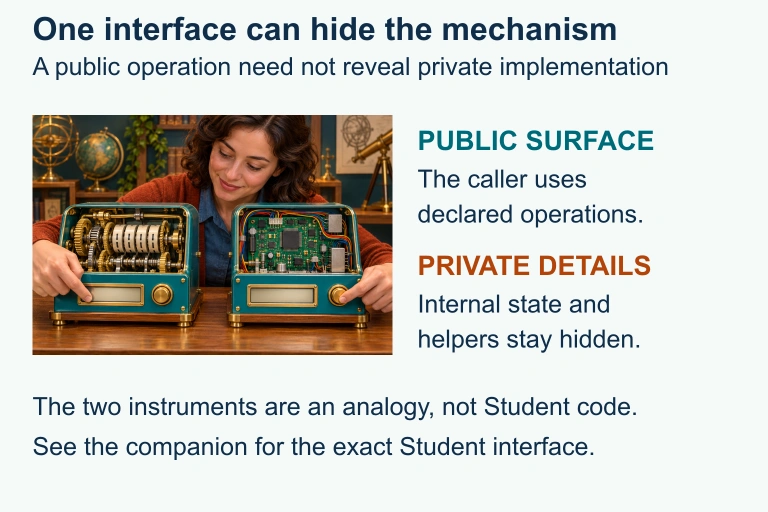 Two instruments illustrate public operation and private implementation. The Student companion names the public methods and private fields.
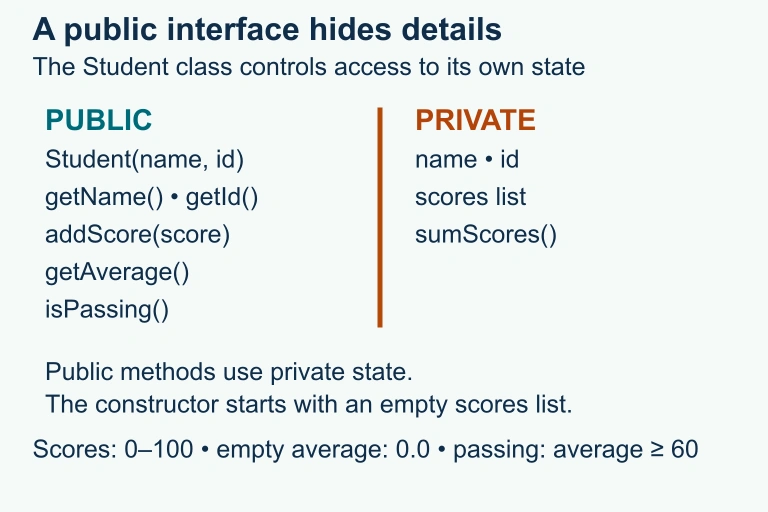 The exact public and private Student members.
SECTION 7
Strengths & Limitations of Abstraction
| Strengths | Limitations |
|---|---|
| Reduces cognitive load: developers work with interfaces, not raw data | Over-engineering: too many tiny classes can fragment logic and hinder readability |
| Facilitates code reuse: a well-designed class can be used across multiple projects | Performance overhead: accessor/mutator calls add indirection compared to direct field access (usually negligible) |
| Enables independent testing: each class can be unit-tested in isolation | Leaky abstractions: poorly designed interfaces can expose implementation details |
| Supports parallel development: teams can work on separate classes simultaneously | Learning curve: beginners may struggle to decide what belongs in a class vs. elsewhere |
Abstraction: Strengths vs. Limitations
KEY TAKEAWAY
SECTION 8
Connection to Inheritance & Polymorphism
Class-level abstraction is the foundation upon which the more advanced OOP pillars of inheritance and polymorphism are built. Once you can design a single well-encapsulated class, you can extend it to create hierarchies where shared behavior lives in a superclass and specialized behavior is added in subclasses. The following table contrasts what you have learned in this lesson with the next layer of abstraction you will encounter in AP Computer Science A.
| This Lesson: Class Abstraction | Next Step: Inheritance & Polymorphism |
|---|---|
| Single class with private fields, public methods | Superclass defines common fields; subclasses add or override methods |
| Procedural abstraction via methods | Polymorphic abstraction: a superclass reference can invoke subclass behavior at runtime |
| Client depends on one class's public interface | Client depends on a superclass/interface; concrete type can vary (Liskov Substitution) |
| Reuse via composition (one class holds another) | Reuse via inheritance (subclass inherits superclass code) |
From Class Abstraction to Inheritance
Mastering single-class design—choosing appropriate fields, writing clean constructors, and distinguishing between public contracts and private implementation—prepares you to think about is-a relationships and method overriding with confidence. Without a solid foundation in abstraction, inheritance hierarchies quickly become tangled and brittle.
SECTION 9
Practice Problems
Question 1: CONCEPTUAL
Thermostat has a private instance variable double currentTemp and a public method double getTemp(). Which of the following best describes why currentTemp is declared private?- A. It makes the program run faster by optimizing memory access.
- B. It reduces the amount of memory the Thermostat object uses.
- C. It prevents client code from directly modifying the field, ensuring changes go through validated methods.
- D. It ensures that no other code in the program can ever read the temperature value.
Show answer (C)
currentTemp private enforces encapsulation—client code cannot set the temperature to an invalid value (e.g., −500°) by directly assigning to the field. Access is funneled through public methods that can validate inputs. Option A is wrong because private does not improve runtime performance. Option B is wrong because the private modifier restricts access, not memory allocation. Option D is wrong because private variables can still be read indirectly through getter methods; the purpose is controlled access, not total inaccessibility.Question 2: BASIC CALCULATION
public class Counter {
  private int count;
  public Counter() { count = 0; }
  public void increment() { count++; }
  public int getCount() { return count; }
}
What is the output of the following code?
Counter c = new Counter();
c.increment();
c.increment();
c.increment();
System.out.println(c.getCount());- A. 0
- B. 3
- C. 4
- D. 5
Show answer (B)
Question 3: INTERMEDIATE
public class Temperature {
  private double tempF;
  public Temperature(double fahrenheit) { tempF = fahrenheit; }
  public double getCelsius() { return (tempF - 32) * 5.0 / 9.0; }
  public void setFahrenheit(double f) { tempF = f; }
}
Which change preserves the declared public interface and its behavior while changing only the private representation?- A. Storing temperature internally in Celsius, converting Fahrenheit inputs in the constructor and setFahrenheit, and returning the stored Celsius value in getCelsius
- B. Renaming getCelsius() to getC()
- C. Making tempF public instead of private
- D. Changing the return type of getCelsius() from double to int
Show answer (A)
Question 4: APPLIED
4 ptsGradeBook that stores a student's name and an array of exactly 5 assignment grades (integers 0–100). The class must include:
• A constructor that takes a name and a 5-element int array
• A method getAverage() that returns the average as a double
• A method getHighest() that returns the highest grade
• A method toString() that returns a String in the format "Name: [avg]".
Write the complete class. Ensure proper encapsulation.Show answer
public class GradeBook {
  private String name;
  private int[] grades;

  public GradeBook(String name, int[] grades) {
    this.name = name;
    this.grades = new int[grades.length];
    for (int i = 0; i < grades.length; i++)
      this.grades[i] = grades[i];
  }

  public double getAverage() {
    int sum = 0;
    for (int g : grades) sum += g;
    return (double) sum / grades.length;
  }

  public int getHighest() {
    int max = grades[0];
    for (int g : grades)
      if (g > max) max = g;
    return max;
  }

  public String toString() {
    return name + ": " + getAverage();
  }
}
Question 5: CRITICAL THINKING
3 ptsWallet with a private ArrayList<String> cards field and the following method:
public ArrayList<String> getCards() {
  return cards;
}
(a) Explain why this method violates the principle of encapsulation even though cards is declared private.
(b) Write a corrected version of getCards() that preserves encapsulation.
(c) Under what circumstances might returning the original reference be intentional?Show answer
public ArrayList<String> getCards() {
  return new ArrayList<String>(cards);
}
This defensive copy preserves the declared ArrayList<String> return type and prevents the caller from changing the original list through the returned reference.
Point 3 — Part (c) intentional scenarios: Returning the original reference is sometimes done for performance in tightly coupled internal code where copying is expensive and the caller is trusted (e.g., within the same package or in a framework's internal implementation). It can also be appropriate when the design intent is to share mutable state between collaborating objects.SUMMARY
Lesson Summary
Summary
Abstraction is the practice of separating what a class does from how it does it. In Java, this is enforced through access modifiers: instance variables are declared private and interactions happen through public methods (accessors, mutators, and constructors). This practice—called encapsulation—keeps internal implementation details hidden from client code.
Good class design follows a systematic process: identify the entity, choose private fields, write constructors that initialize them, define a minimal public interface, and factor complex logic into private helper methods. Both procedural abstraction (methods hide algorithm details) and data abstraction (objects hide internal state) combine to produce software that is modular, testable, and resilient to change—skills tested directly on the AP Computer Science A exam.