Types of
Chemical Reactions
Master the five fundamental reaction types that govern how matter transforms: synthesis, decomposition, single replacement, double replacement, and combustion.
What Is a Chemical Reaction?
A chemical reaction is a process in which one or more substances (the reactants) are converted into one or more different substances (the products). Bonds between atoms break and new bonds form, producing substances with new chemical properties.
The Five Fundamental Reaction Types
Why Classifying Reactions Matters
Synthesis Reactions
Two or more simple substances combine to form a single, more complex product. Think of it as chemical "building."
Decomposition Reactions
A single compound breaks down into two or more simpler substances. This is the reverse of synthesis.
Single Replacement Reactions
A free element replaces another element in a compound. The activity series determines which replacements are possible.
Double Replacement Reactions
The cations and anions of two ionic compounds switch partners, forming two new compounds. Often produces a precipitate, gas, or water.
Yellow lead iodide precipitate
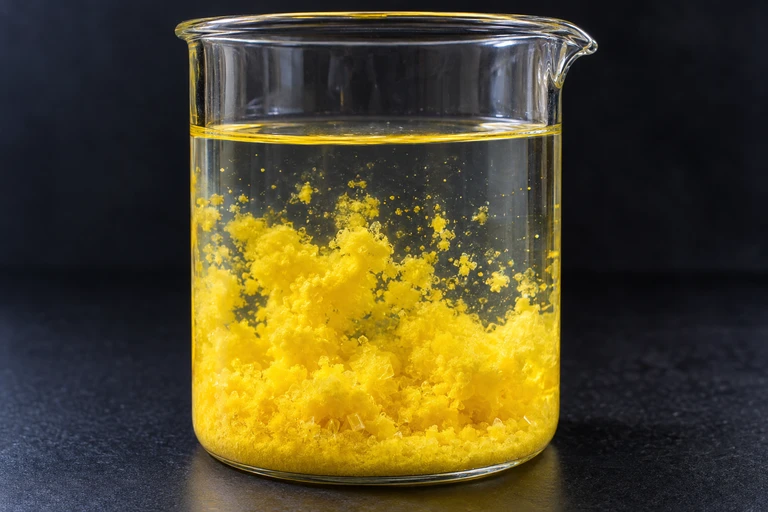 Lead ions and iodide ions combine to form a yellow lead iodide precipitate.
A white calcium carbonate precipitate
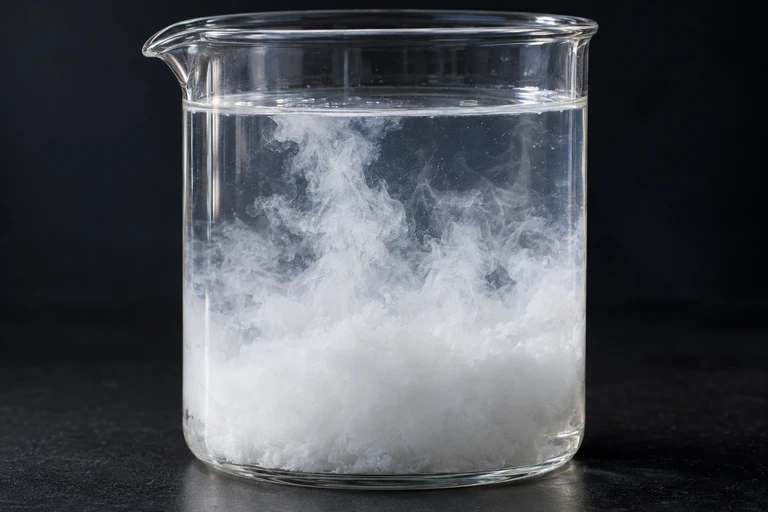 Calcium ions and carbonate ions can combine to form a white calcium carbonate precipitate.
Combustion Reactions
A hydrocarbon (or organic compound) reacts with oxygen gas to produce carbon dioxide and water, releasing energy as heat and light.
Synthesis vs. Decomposition
| Synthesis | Decomposition | |
|---|---|---|
| Direction | Many → One | One → Many |
| General Form | \( A + B \rightarrow AB \) | \( AB \rightarrow A + B \) |
| Energy | Often exothermic | Often endothermic |
| Number of Reactants | Two or more | Exactly one |
| Example | \( 2\text{H}_2 + \text{O}_2 \rightarrow 2\text{H}_2\text{O} \) | \( 2\text{HgO} \rightarrow 2\text{Hg} + \text{O}_2 \) |
Single vs. Double Replacement
| Single Replacement | Double Replacement | |
|---|---|---|
| Reactants | Element + Compound | Compound + Compound |
| General Form | \( A + BC \rightarrow AC + B \) | \( AB + CD \rightarrow AD + CB \) |
| What swaps | One element replaces another | Both cation-anion pairs swap |
| Driving force | Activity series (reactivity) | Precipitate, gas, or water forms |
| Example | \( \text{Fe} + \text{CuSO}_4 \rightarrow \text{FeSO}_4 + \text{Cu} \) | \( \text{BaCl}_2 + \text{Na}_2\text{SO}_4 \rightarrow \text{BaSO}_4 \downarrow + 2\text{NaCl} \) |
How to Classify a Reaction
Example 1: Classifying a Reaction
Example 2: Harder Classification
Example 3: Combustion in Action
Common Mistakes
Summary of All Five Types
| Type | General Form | Key Clue |
|---|---|---|
| Synthesis | \( A + B \rightarrow AB \) | Multiple → one product |
| Decomposition | \( AB \rightarrow A + B \) | One → multiple products |
| Single Replacement | \( A + BC \rightarrow AC + B \) | Element + compound |
| Double Replacement | \( AB + CD \rightarrow AD + CB \) | Two compounds swap ions |
| Combustion | \( \text{Fuel} + \text{O}_2 \rightarrow \text{CO}_2 + \text{H}_2\text{O} \) | Hydrocarbon + \( \text{O}_2 \) |
Question 1 of 5
What type of reaction is represented by:
\( 2\text{KClO}_3 \rightarrow 2\text{KCl} + 3\text{O}_2 \)?
Question 2 of 5
Which reaction is a single replacement?
Question 3 of 5
The reaction \( \text{C}_2\text{H}_6 + \frac{7}{2}\text{O}_2 \rightarrow 2\text{CO}_2 + 3\text{H}_2\text{O} \) is best classified as:
Question 4 of 5
In a double replacement reaction, what is the typical driving force that causes the reaction to proceed?
Question 5 of 5
A student observes that placing a strip of copper into a solution of \( \text{ZnSO}_4 \) produces no reaction. Which explanation is correct?