Types of
Chemical Bonds
Explore how atoms connect through ionic, covalent, and metallic bonds: the forces that hold all matter together.
What Is a Chemical Bond?
A chemical bond is an attractive force between two atoms that holds them together in a compound. Bonds form because the resulting arrangement is lower in energy than the separated atoms.
Understanding bond types lets you predict physical properties (melting point, conductivity), molecular geometry, and chemical reactivity.
Electronegativity Drives Bond Type
Electronegativity (\(\chi\)) measures an atom's ability to attract shared electrons. The difference in electronegativity between two bonded atoms (\(\Delta\chi\)) determines the bond character.
The Three Major Bond Types
Ionic Bonds: Electron Transfer
Covalent Bonds: Electron Sharing
Polar vs. Nonpolar Covalent
Metallic Bonds: Sea of Electrons
A copper crystal surface
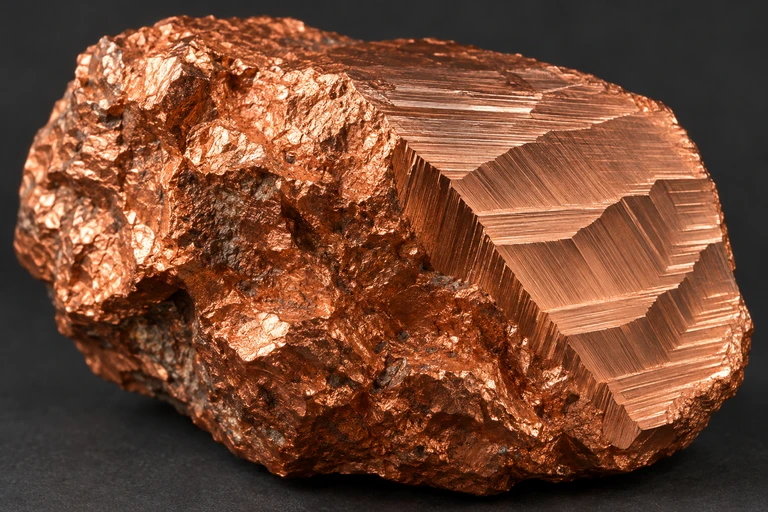 Copper is a metallic solid whose atoms form an ordered crystal structure.
Bond Energy and Length
Bond energy is the energy required to break one mole of bonds in the gas phase. Bond length is the equilibrium distance between bonded nuclei. As bond order increases:
| Property | Single Bond | Double Bond | Triple Bond |
|---|---|---|---|
| Bond Order | 1 | 2 | 3 |
| Bond Energy | Lowest | Medium | Highest |
| Bond Length | Longest | Medium | Shortest |
| C-C Example | 154 pm | 134 pm | 120 pm |
Lewis Structures and the Octet Rule
Most atoms bond to achieve 8 valence electrons (an octet), mimicking the electron configuration of a noble gas. Hydrogen is satisfied with 2 electrons (a duet).
Ionic vs. Covalent: Key Differences
| Feature | Ionic | Covalent |
|---|---|---|
| Electron behavior | Transferred | Shared |
| Typical atoms | Metal + Nonmetal | Nonmetal + Nonmetal |
| \(\Delta\chi\) | \(> 1.7\) | \(< 1.7\) |
| State at room temp | Crystalline solid | Gas, liquid, or solid |
| Melting point | High | Low to moderate |
| Conductivity (aq) | Yes (electrolyte) | No (usually) |
How to Identify Bond Type
Example 1: \(\text{NaCl}\)
Identify the bond type in sodium chloride (\(\text{NaCl}\)).
Example 2: \(\text{H}_2\text{O}\)
Identify the bond type in water (\(\text{H}_2\text{O}\)).
Example 3: \(\Delta H\) from Bond Energies
Estimate \(\Delta H_{\text{rxn}}\) for: \(\text{H}_2(g) + \text{Cl}_2(g) \rightarrow 2\text{HCl}(g)\)
Common Mistakes to Avoid
Summary: All Three Bond Types
| Property | Ionic | Covalent | Metallic |
|---|---|---|---|
| Electron behavior | Transferred | Shared | Delocalized |
| Structure | Crystal lattice | Discrete molecules | Metal lattice |
| Melting point | High | Low-moderate | Variable (often high) |
| Conductivity | In solution/melt | Poor | Excellent |
| Hardness | Hard, brittle | Soft to hard | Malleable, ductile |
| Example | \(\text{NaCl}\) | \(\text{H}_2\text{O}\) | \(\text{Cu}\) |
Question 1 of 5
Which of the following best describes the bonding in \(\text{MgO}\)?
Question 2 of 5
A substance has a high melting point, is brittle, and conducts electricity only when dissolved in water. What type of bonding does it most likely have?
Question 3 of 5
Which bond is the shortest and strongest?
Question 4 of 5
Given: \(\chi_{\text{H}} = 2.20\), \(\chi_{\text{F}} = 3.98\). What type of bond forms in \(\text{HF}\)?
Question 5 of 5
Using bond energies, estimate \(\Delta H\) for: \(\text{CH}_4 + 2\text{O}_2 \rightarrow \text{CO}_2 + 2\text{H}_2\text{O}\).
Given: \(\text{C-H} = 413\), \(\text{O=O} = 498\), \(\text{C=O} = 799\), \(\text{O-H} = 463\) (all in kJ/mol).