01 / 21

Thermodynamic &
Kinetic Control

Discover why reactions can yield different products depending on temperature and time: the battle between speed and stability.

AP Chemistry

Two Products, One Reaction

Many reactions can form more than one product. The product that forms depends on the reaction conditions. Two key categories emerge:

Kinetic Product
Forms faster because it has a lower activation energy \( E_a \). Favored at low temperatures and short reaction times.
Thermodynamic Product
More stable because it has a lower free energy \( \Delta G \). Favored at high temperatures and long reaction times.

The Energy Landscape

Reaction Coordinate Free Energy Reactants Kinetic Product Lower \( E_a \) Thermodynamic Product Higher \( E_a \) Smaller \( |\Delta G| \) Larger \( |\Delta G| \)

Why Does This Matter?

In organic synthesis and industrial chemistry, choosing the wrong conditions can yield the wrong product entirely. Understanding control lets chemists:

1
Tune selectivity: adjust temperature to favor the desired product.
2
Maximize yield: avoid wasteful side reactions by controlling reaction time.
3
Design processes: pharmaceuticals and polymers demand precise product control.

Core Principle: \( E_a \) vs. \( \Delta G \)

\( E_a \) : Activation Energy
The energy barrier from reactants to the transition state. Controls reaction rate. Lower \( E_a \) means faster formation.
\( \Delta G \) : Free Energy Change
The energy difference between reactants and products. Controls product stability. More negative \( \Delta G \) means more stable product.

The Role of Temperature

Low Temperature Molecules have less energy Only the lower barrier is accessible Kinetic Product High Temperature Molecules have more energy Both barriers accessible; equilibrium favors stability Thermodynamic Product

Reversibility and Reaction Time

The distinction between kinetic and thermodynamic control also depends on whether the reaction is reversible:

Irreversible
Once a product forms, it cannot revert. The first product to form (kinetic) is locked in permanently.
Reversible
Products can interconvert over time. Given enough time, the system reaches equilibrium and the thermodynamic product accumulates.

Freeze a product distribution by slowing exchange
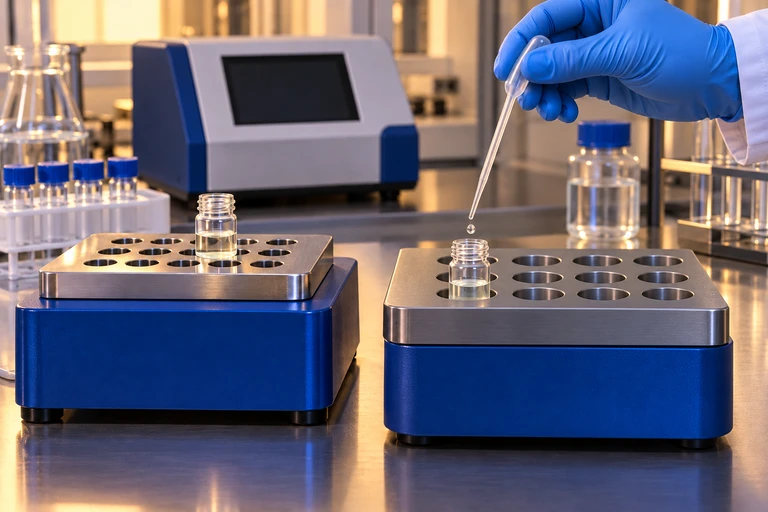
A pipette transfers a clear aliquot between two temperature-controlled blocks, with a separate blank analysis instrument; exact bars show four M/N distributions.At 400 K, the given product distribution changes from 50% N after 5 minutes to 80% N after 120 minutes. Cooling an aliquot can approximately preserve its distribution if interconversion becomes sufficiently slow.

Time and temperature: four observations
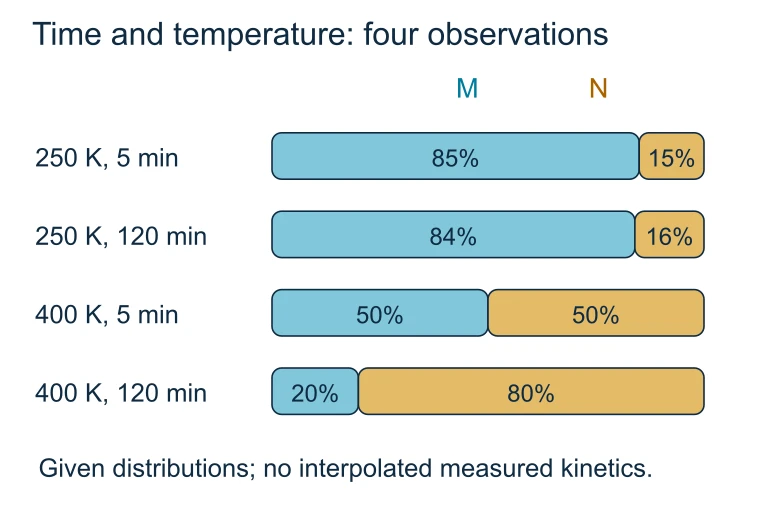
Time and temperature: four observations. At 400 K, the given product distribution changes from 50% N after 5 minutes to 80% N after 120 minutes. Cooling an aliquot can approximately preserve its distribution if interconversion becomes sufficiently slow.At 400 K, the given product distribution changes from 50% N after 5 minutes to 80% N after 120 minutes. Cooling an aliquot can approximately preserve its distribution if interconversion becomes sufficiently slow.

A quench slows exchange; it does not stop motion
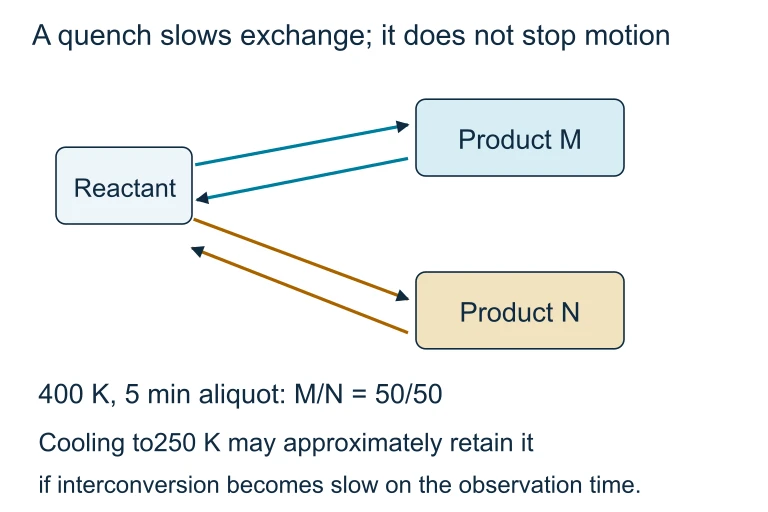
A quench slows exchange; it does not stop motion. A 400 K aliquot with a 50:50 M:N distribution may approximately retain that distribution on cooling to 250 K if interconversion slows sufficiently.A 400 K aliquot with a 50:50 M:N distribution may approximately retain that distribution on cooling to 250 K if interconversion slows sufficiently.

Kinetic vs. Thermodynamic

Kinetic Control Thermodynamic Control
Determined by \( E_a \) (rate) \( \Delta G \) (stability)
Temperature Low High
Reaction time Short Long
Reversibility Irreversible or quenched early Reversible, at equilibrium
Product Fastest to form Most stable

The Boltzmann Connection

The fraction of molecules with enough energy to overcome a barrier \( E_a \) at temperature \( T \) is given by the Boltzmann factor:

At low T, the exponential drops steeply with \( E_a \): even a small difference in activation energy causes a large difference in rate. At high T, both barriers become accessible and the rate difference shrinks, allowing equilibrium to dictate the outcome.

How to Identify the Product

1
Draw both products. Identify all possible products from the reaction.
2
Compare stability. The more stable product (more substituted, conjugated, or lower energy) is the thermodynamic product.
3
Compare activation energies. The product with the lower \( E_a \) (often less substituted, less sterically hindered) is the kinetic product.
4
Check conditions. Low T / short time / irreversible = kinetic. High T / long time / reversible = thermodynamic.
5
Predict the major product based on the match between conditions and product type.

Example 1: HBr + 1,3-Butadiene

Reactants CH₂=CH-CH=CH₂ + HBr Low T High T 1,2-Addition CH₃-CHBr-CH=CH₂ Kinetic Product 1,4-Addition CH₃-CH=CH-CH₂Br Thermodynamic Product Why faster? Carbocation forms at adjacent carbon Why more stable? More substituted alkene (internal)

Example 2: Enolate Alkylation

Consider a ketone with two possible deprotonation sites. The base and conditions determine which enolate forms:

Kinetic Enolate
Formed at the less substituted carbon using a strong, bulky base like LDA at \(-78^\circ\text{C}\). Deprotonation is fast and irreversible.
Thermodynamic Enolate
Formed at the more substituted carbon using a weaker base like NaOEt at room temperature. Equilibrium favors the more stable enolate.

Example 3: Sulfonation Revisited

Electrophilic aromatic substitution of naphthalene provides another classic illustration:

α-Naphthalenesulfonic Sulfonation at C-1 Kinetic Product Forms faster (less steric demand at transition state) β-Naphthalenesulfonic Sulfonation at C-2 Thermodynamic Product More stable (less peri- interaction in product)

Quantitative Energy Profile

We can express the product ratio using the Arrhenius equation. For two competing pathways A and B:

Notice that as \( T \to \infty \), the kinetic ratio approaches \( A_A / A_B \approx 1 \), washing out selectivity. Meanwhile, the thermodynamic ratio still favors the more stable product.

What About Catalysts?

Catalysts lower the activation energy but do not change the free energy of products. Their role in selectivity is nuanced:

1
A catalyst lowers \( E_a \) for both forward and reverse reactions equally, preserving \( \Delta G \).
2
By speeding up the reaction, a catalyst helps the system reach equilibrium faster, which favors thermodynamic control.
3
A selective catalyst can preferentially lower \( E_a \) for one pathway, shifting kinetic selectivity.

Common Mistakes

✕ Confusing Rate and Stability
Assuming the fastest product is also the most stable. They are governed by different energy parameters: \( E_a \) vs. \( \Delta G \).
✕ Ignoring Reversibility
Applying thermodynamic arguments to irreversible reactions. If the reaction cannot reverse, the kinetic product is locked in regardless of temperature.
✕ Temperature Backwards
Thinking high temperature always means faster = kinetic product. High T actually favors thermodynamic control by enabling equilibrium.

Question 1 of 5

The kinetic product of a reaction is the one that:

Question 2 of 5

In the addition of HBr to 1,3-butadiene, the 1,4-addition product is the:

Question 3 of 5

A catalyst is added to a reaction that was previously under kinetic control. What is the most likely effect on product distribution?

Question 4 of 5

At very high temperatures (\( T \to \infty \)), the Boltzmann factor \( e^{-E_a/RT} \) approaches:

Question 5 of 5

Which combination of conditions would most reliably produce the thermodynamic product in a reversible reaction?