Structure of Metals
and Alloys
Explore how metallic bonding, crystal packing, and alloy composition determine the physical properties of the materials that build our world.
What Is Metallic Bonding?
In metals, valence electrons are not localized between specific atoms. Instead, they form a delocalized "sea of electrons" that flows freely among a lattice of positively charged metal cations.
Properties from Metallic Bonding
Cleavage in a salt crystal
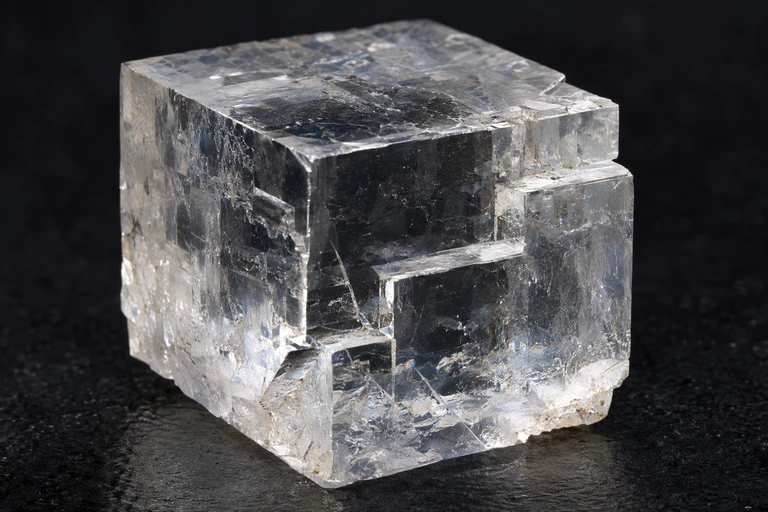 An ionic crystal can cleave when displacement brings like charges into neighboring positions.
Inside one copper conductor
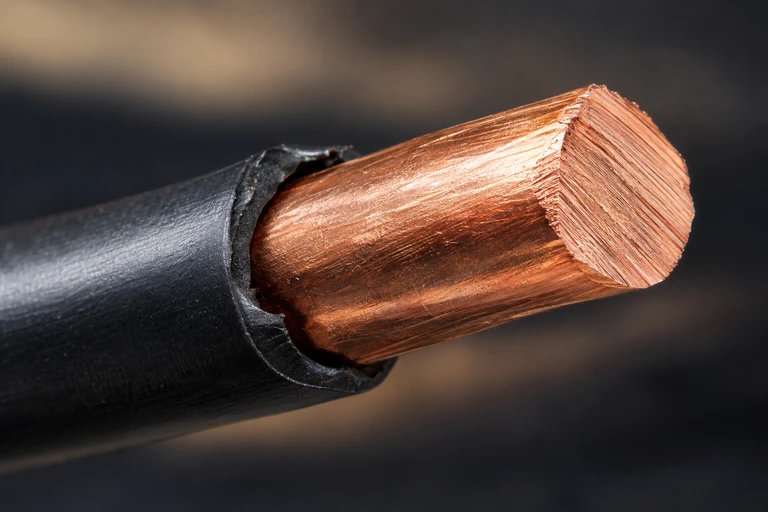 Mobile electrons in copper allow charge to move through the conductor.
Crystal Packing Structures
Metal atoms pack together as identical spheres in regular, repeating 3D patterns called crystal lattices. The three most common unit cells are:
Atoms per Unit Cell
Each atom is shared among neighboring unit cells. The fraction that "belongs" to one cell depends on its position:
Packing Efficiency and Edge Length
Packing efficiency measures what fraction of the unit cell volume is actually occupied by atoms. It depends on the relationship between the atomic radius \(r\) and the edge length \(a\).
BCC vs FCC: Key Differences
| Property | BCC | FCC |
|---|---|---|
| Atoms per unit cell | 2 | 4 |
| Coordination number | 8 | 12 |
| Packing efficiency | 68% | 74% |
| Edge-radius relation | \(a = \frac{4r}{\sqrt{3}}\) | \(a = 2\sqrt{2}\,r\) |
| Examples | Fe, W, Cr, Na | Cu, Al, Au, Ag |
What Are Alloys?
An alloy is a mixture of a metal with one or more other elements (metals or nonmetals). The added atoms disrupt the regular lattice, changing the material's properties.
One alloy microstructure reference
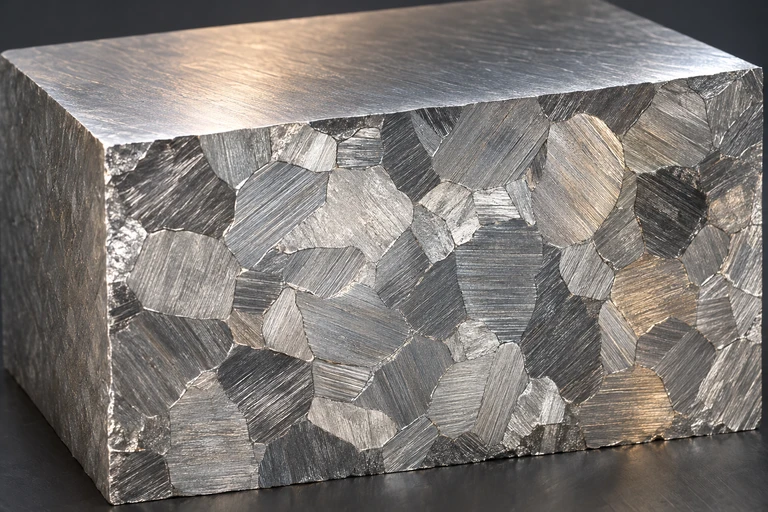 An alloy’s microstructure contains crystalline grains separated by grain boundaries.
Two Types of Alloys
How Alloys Change Properties
Introducing foreign atoms into a metal lattice disrupts the ability of atomic layers to slide over each other. This is the key mechanism behind alloy hardening.
How to Calculate Density from Unit Cells
A classic AP problem: given the crystal structure and atomic radius (or edge length), calculate the density of the metal.
Example 1: Copper Density
Copper crystallizes in an FCC structure with an atomic radius of \(r = 128\text{ pm}\). Calculate the density of copper. (\(M_{\text{Cu}} = 63.55\text{ g/mol}\))
Example 2: Iron Edge Length
Iron crystallizes in a BCC structure. If the atomic radius of Fe is \(r = 126\text{ pm}\), find the unit cell edge length.
Example 3: Identifying Structure from Density
A metal has molar mass \(M = 55.85\text{ g/mol}\), atomic radius \(r = 124\text{ pm}\), and a measured density of \(\rho = 7.87\text{ g/cm}^3\). Determine its crystal structure.
Common Mistakes to Avoid
Summary of Crystal Structures
| Property | SC | BCC | FCC/HCP |
|---|---|---|---|
| Atoms per cell | 1 | 2 | 4 |
| Coordination # | 6 | 8 | 12 |
| Packing % | 52.4% | 68.0% | 74.0% |
| Edge-radius | \(a = 2r\) | \(a = \frac{4r}{\sqrt{3}}\) | \(a = 2\sqrt{2}\,r\) |
| Examples | Po | Fe, W, Na | Cu, Al, Au |
Question 1 of 5
How many atoms are contained in one face-centered cubic (FCC) unit cell?
Question 2 of 5
Steel is an alloy of iron and carbon. Carbon atoms occupy the spaces between iron atoms. This makes steel a(n):
Question 3 of 5
In a BCC unit cell, the atoms touch along the body diagonal. If the atomic radius is \(r\), which expression gives the edge length \(a\)?
Question 4 of 5
Which property of metals is best explained by the delocalized electron sea model?
Question 5 of 5
A metal with molar mass \(M\), atomic radius \(r\), and FCC structure has edge length \(a = 2\sqrt{2}\,r\). Which expression correctly gives its density?