01 / 24

Structure of
Ionic Solids

Explore how cations and anions arrange into crystal lattices, and learn the rules that govern coordination number, lattice energy, and unit cell geometry.

AP Chemistry

What Is an Ionic Solid?

An ionic solid is a crystalline compound held together by electrostatic attractions between oppositely charged ions. Unlike molecular solids, there are no discrete molecules: the entire crystal is one continuous three-dimensional lattice.

Cations and Anions in the Lattice

\(\text{Na}^+\) \(\text{Cl}^-\) \(\text{Na}^+\) \(\text{Cl}^-\) \(\text{Na}^+\) \(\text{Cl}^-\) \(\text{Na}^+\) \(\text{Cl}^-\) \(\text{Na}^+\) \(\text{Na}^+\) \(\text{Cl}^-\) \(\text{Na}^+\) \(\text{Cl}^-\) \(\text{Na}^+\) Cation (smaller) Anion (larger)

Why Does Structure Matter?

Melting Point
Lattice arrangement determines how much energy is needed to break the crystal apart.
Solubility
Polar solvents like water can disrupt lattices with weaker ionic bonds more easily.
Hardness
The rigid lattice resists deformation, but shifting planes of like-charged ions causes cleavage.

Understanding the crystal structure lets us predict physical properties directly from ionic charges and radii: no experiments required.

Coulomb's Law and Lattice Energy

Larger charges
\( |q_1 \cdot q_2| \) increases, so \( |E| \) increases: stronger lattice.
Smaller ions
Smaller \( d \) means ions are closer: stronger lattice, higher melting point.

The Unit Cell: Building Block of a Crystal

FC a a Unit Cell The smallest repeating unit Corner ions Face-center ions

A unit cell is the smallest three-dimensional arrangement of ions that, when repeated in all directions, generates the entire crystal lattice. The edge length is labeled \( a \).

Counting Ions: Sharing Rules

1
Corner ion: shared by 8 unit cells, so each contributes \( \frac{1}{8} \) of an ion.
2
Edge ion: shared by 4 unit cells, each contributes \( \frac{1}{4} \) of an ion.
3
Face ion: shared by 2 unit cells, each contributes \( \frac{1}{2} \) of an ion.
4
Body-center ion: fully inside one cell, contributes 1 whole ion.

Coordination Number

The coordination number is the number of nearest-neighbor ions of opposite charge surrounding a given ion. It depends on the radius ratio \( \frac{r_{\text{cation}}}{r_{\text{anion}}} \).

+ − − − − − − CN = 6 Octahedral

The Radius Ratio Rule

Radius Ratio \( \frac{r^+}{r^-} \) Coordination # Geometry
\( < 0.155 \) 2 Linear
\( 0.155 - 0.225 \) 3 Trigonal planar
\( 0.225 - 0.414 \) 4 Tetrahedral
\( 0.414 - 0.732 \) 6 Octahedral
\( 0.732 - 1.000 \) 8 Cubic

NaCl vs CsCl vs ZnS

Property NaCl CsCl ZnS (zinc blende)
Coordination 6:6 8:8 4:4
Unit Cell FCC Simple Cubic FCC
Anion arrangement FCC lattice Simple cubic FCC lattice
Cation position Octahedral holes Body center Half the tetrahedral holes
\( \frac{r^+}{r^-} \) range 0.414 - 0.732 0.732 - 1.000 0.225 - 0.414

Lattice Energy Trends

Lattice Energy (kJ/mol) Compound 923 NaF 786 NaCl 747 NaBr 3850 MgO 3461 CaO

The Born-Haber Cycle

The Born-Haber cycle is a thermochemical cycle that uses Hess's Law to calculate lattice energy indirectly. It breaks the formation of an ionic solid into measurable steps.

\(\text{Na(s)} + \tfrac{1}{2}\text{Cl}_2\text{(g)}\) \(\text{Na(g)} + \tfrac{1}{2}\text{Cl}_2\text{(g)}\) \(\text{Na(g)} + \text{Cl(g)}\) \(\text{Na}^+\text{(g)} + \text{Cl(g)} + e^-\) \(\text{Na}^+\text{(g)} + \text{Cl}^-\text{(g)}\) \(\text{NaCl(s)}\) Sublimation Bond dissoc. IE EA Lattice E \(\Delta H^\circ_f\)

How to Determine an Ionic Structure

1
Identify the ions and their charges from the chemical formula.
2
Look up ionic radii for the cation (\( r^+ \)) and anion (\( r^- \)).
3
Calculate the radius ratio \( \frac{r^+}{r^-} \) and predict the coordination number from the table.
4
Assign the structure type (NaCl, CsCl, or ZnS) based on coordination and stoichiometry.
5
Count ions per unit cell using the sharing rules to verify the formula.

Example 1: Counting Ions in NaCl

\(\text{Cl}^-\) positions: 8 corners \(\times \frac{1}{8}\) = 1 6 faces \(\times \frac{1}{2}\) = 3 Total = 4 \(\text{Cl}^-\) \(\text{Na}^+\) positions: 12 edges \(\times \frac{1}{4}\) = 3 1 body center \(\times\) 1 = 1 Total = 4 \(\text{Na}^+\) Formula: 4 NaCl per cell

Example 2: The CsCl Unit Cell

\(\text{Cs}^+\) \(\text{Cl}^-\) at corners: \(8 \times \frac{1}{8} = 1\;\text{Cl}^-\) \(\text{Cs}^+\) at body center: \(1 \times 1 = 1\;\text{Cs}^+\) 1 CsCl per unit cell Coordination: 8:8

Example 3: Predicting the Structure of KBr

1
Identify ions: \( \text{K}^+ \) (cation) and \( \text{Br}^- \) (anion).
2
Look up radii: \( r_{\text{K}^+} = 138 \) pm, \( r_{\text{Br}^-} = 196 \) pm.
3
Calculate ratio: \( \frac{138}{196} = 0.704 \). This falls in the range \( 0.414 - 0.732 \).
4
Predict: Coordination number = 6, so KBr adopts the NaCl structure.
5
Verify: 4 formula units per unit cell, 6:6 octahedral coordination. ✓

Common Mistakes

✕ Calling CsCl "BCC"
CsCl has two different ions, so it cannot be body-centered cubic. BCC requires identical atoms at corners and center.
✕ Forgetting to share
Counting a corner atom as a full atom instead of \( \frac{1}{8} \) gives the wrong number of ions per unit cell.
✕ Confusing lattice energy sign
Lattice energy magnitude is always positive. A larger value means a more stable crystal. Be careful with sign conventions in Born-Haber calculations.

Summary of Key Concepts

Concept Key Idea Example
Unit Cell Smallest repeating block FCC for NaCl
Coordination # Nearest opposite-charge neighbors 6 for NaCl, 8 for CsCl
Radius Ratio \( \frac{r^+}{r^-} \) predicts geometry 0.414-0.732 → octahedral
Lattice Energy Increases with charge, decreases with size \(\text{MgO} \gg \text{NaCl}\)
Born-Haber Cycle Hess's Law applied to lattice energy Indirect calculation

Properties from Structure

High Melting Point
Strong electrostatic forces throughout the lattice require enormous energy to disrupt.
Brittle
Shifting the lattice aligns like charges, causing sudden repulsion and fracture along planes.
Conducts When Molten
Melting frees ions to move, carrying charge. Solid ionic compounds do not conduct.
Soluble in Polar Solvents
Water molecules surround and stabilize individual ions, overcoming lattice energy.

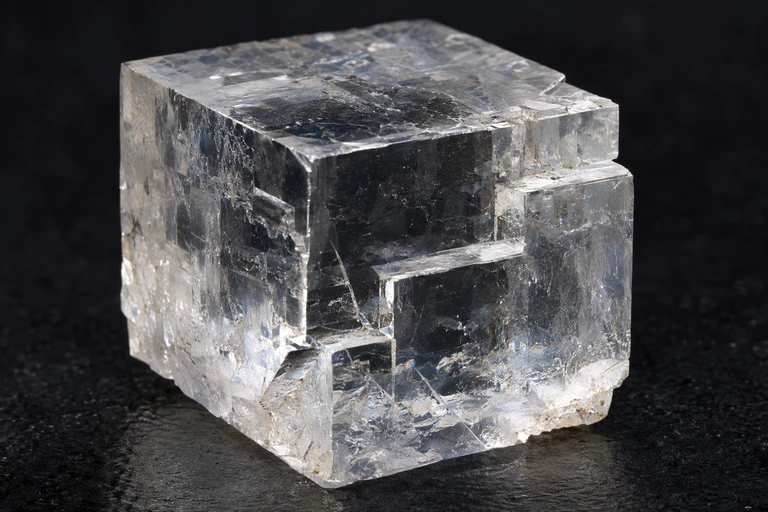
Cleavage in a salt crystal

Cleavage in a salt crystalAn ionic crystal can cleave when displacement brings like charges into neighboring positions.

Conductivity probe in saltwater
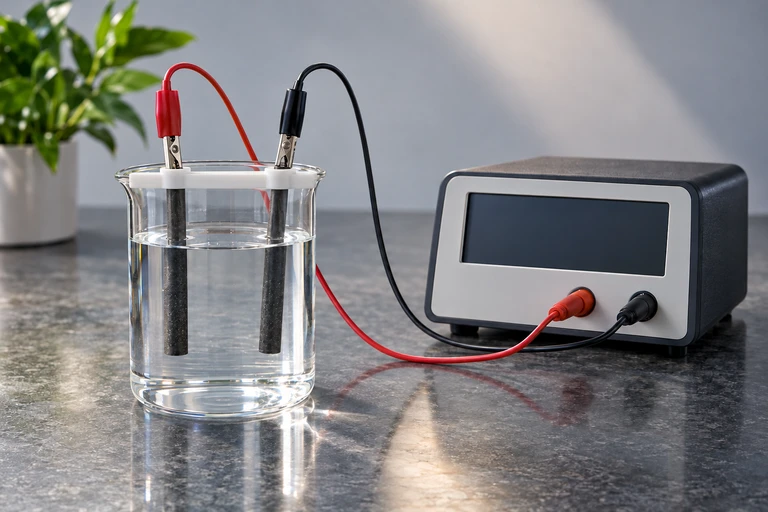
Conductivity probe in saltwaterDissolved ions carry charge through saltwater between immersed electrodes.

Question 1 of 5

How many formula units of NaCl are present in one unit cell of the NaCl crystal structure?

Question 2 of 5

Which compound would you expect to have the highest lattice energy?

Question 3 of 5

A corner atom in a cubic unit cell is shared among how many adjacent unit cells?

Question 4 of 5

The CsCl structure is often mislabeled. What is the correct description of its unit cell?

Question 5 of 5

If the radius ratio \( \frac{r^+}{r^-} \) for a compound is 0.35, which coordination geometry is predicted?