01 / 21

Spectroscopy & the
Electromagnetic Spectrum

Explore how light interacts with matter, the relationship between wavelength, frequency, and energy, and how spectroscopy reveals atomic structure.

AP Chemistry

What Is the Electromagnetic Spectrum?

The electromagnetic spectrum is the complete range of electromagnetic radiation, organized by wavelength and frequency. All EM radiation travels at the speed of light (\( c = 3.00 \times 10^8 \) m/s) and carries energy in discrete packets called photons.

The Spectrum: From Radio to Gamma

Radio Microwave Infrared Visible UV X-ray Gamma 380 nm – 700 nm Long \( \lambda \) Short \( \lambda \) Low frequency Low energy High frequency High energy > 1 m 1 mm–1 m 700 nm–1 mm 10–380 nm 0.01–10 nm < 0.01 nm Typical wavelength ranges

Why Spectroscopy Matters

Spectroscopy is the study of how matter absorbs and emits electromagnetic radiation. Each element and molecule produces a unique spectral fingerprint, making spectroscopy one of the most powerful analytical tools in chemistry.

Identify Elements
Each element emits specific wavelengths of light when excited, producing unique emission lines.
Determine Structure
IR and NMR spectroscopy reveal molecular bonds and functional groups.
Measure Concentrations
Beer-Lambert Law relates absorbance to concentration for quantitative analysis.

The Core Equations of Light

Speed of Light
$$ c = \lambda \nu $$
\( c \) = speed of light
\( \lambda \) = wavelength (m)
\( \nu \) = frequency (Hz)
Planck's Equation
$$ E = h\nu $$
\( E \) = energy (J)
\( h \) = \( 6.626 \times 10^{-34} \) J·s
\( \nu \) = frequency (Hz)
Combined
$$ E = \frac{hc}{\lambda} $$
Energy is inversely proportional to wavelength.

\( E \), \( \lambda \), and \( \nu \): The Triangle

\( E \) \( \lambda \) \( \nu \) \( E = \frac{hc}{\lambda} \) \( E = h\nu \) \( c = \lambda\nu \) Inversely related Direct Inverse

Emission vs. Absorption Spectra

Emission Spectrum
Bright colored lines on a dark background. Produced when excited atoms release photons as electrons fall to lower energy levels.
Absorption Spectrum
Dark lines on a continuous colored background. Produced when atoms absorb specific wavelengths from white light passing through a gas.
Emission Absorption Wavelength →

Quantized Energy and the Bohr Model

n=1 n=2 n=3 n=4 n=5 Absorb Emit ~ ~ High E Low E \( \Delta E = h\nu \)
\( = \frac{hc}{\lambda} \)

Hydrogen Emission Series

Lyman (UV)
Transitions to n = 1. Highest energy, shortest wavelength. Ultraviolet region.
Balmer (Visible)
Transitions to n = 2. Produces the visible hydrogen lines: red, blue-green, violet.
Paschen (IR)
Transitions to n = 3. Lower energy, longer wavelength. Infrared region.

Types of Spectroscopy

Type Region What It Probes AP Use
UV-Vis UV / Visible Electronic transitions Concentration via Beer-Lambert
IR Infrared Bond vibrations Functional group identification
Mass Spec N/A (mass/charge) Molecular mass & fragments Molecular formula
PES UV / X-ray Electron binding energy Electron configuration

One filter-based absorption photometer
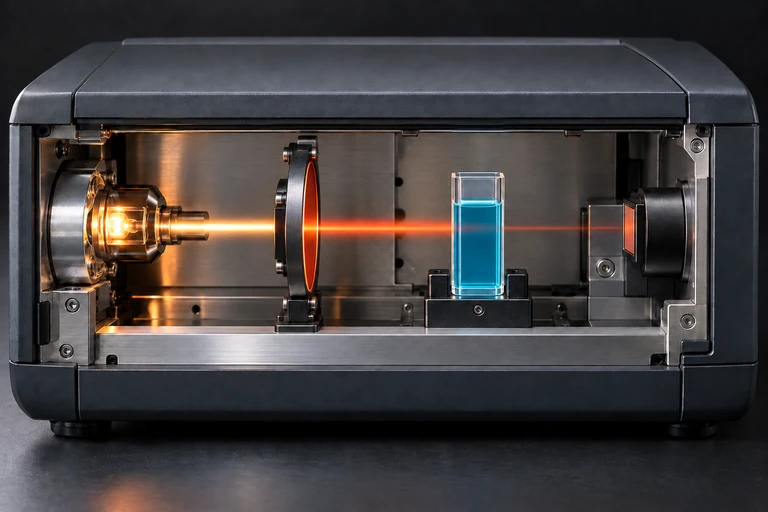
One filter-based absorption photometerA photometer directs selected light through a cuvette and measures the transmitted light at a detector.

Blue solution in an optical cuvette
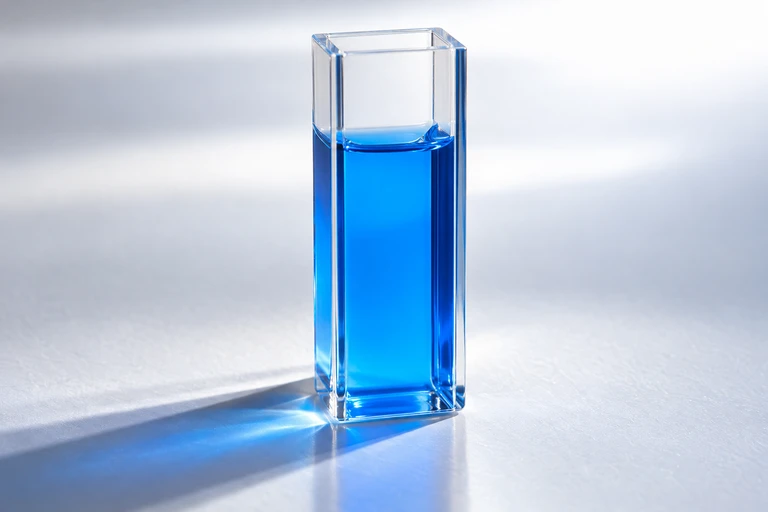
Blue solution in an optical cuvetteA blue solution transmits some visible wavelengths more strongly than others; its absorption depends on wavelength.

Photoelectron Spectroscopy (PES)

PES uses high-energy photons to eject electrons from atoms. By measuring the kinetic energy of ejected electrons, we can calculate their binding energy:

← Binding Energy (MJ/mol) Relative # of electrons 1s 40.2 2s 2.45 2p 1.40 (low BE) (high BE) N (Z=7)

How to Solve Spectroscopy Problems

1
Identify what's given. Wavelength (\( \lambda \)), frequency (\( \nu \)), or energy (\( E \))? Note the units.
2
Convert units if needed. Wavelength to meters (1 nm = \( 10^{-9} \) m), frequency to Hz.
3
Choose the right equation. Use \( c = \lambda\nu \) for wavelength-frequency conversions, \( E = h\nu \) or \( E = \frac{hc}{\lambda} \) for energy.
4
Plug in constants. \( c = 3.00 \times 10^8 \) m/s, \( h = 6.626 \times 10^{-34} \) J·s.
5
Check your answer. Does it make sense? Shorter wavelength should mean higher energy. Verify units cancel properly.

Example 1: Wavelength to Energy

Problem: A hydrogen atom emits a photon with wavelength 486 nm. What is the energy of this photon?

1
Convert wavelength: \( \lambda = 486 \text{ nm} = 486 \times 10^{-9} \text{ m} = 4.86 \times 10^{-7} \text{ m} \)
2
Apply the equation: \( E = \frac{hc}{\lambda} = \frac{(6.626 \times 10^{-34} \mathrm{J\,s})(3.00 \times 10^8 \text{ m/s})}{4.86 \times 10^{-7} \text{ m}} \)
3
Calculate: \( E = \frac{1.988 \times 10^{-25} \mathrm{J\,m}}{4.86 \times 10^{-7} \text{ m}} = 4.09 \times 10^{-19} \text{ J} \)

Example 2: Frequency to Wavelength

Problem: An FM radio station broadcasts at \( 9.47 \times 10^7 \) Hz. What is the wavelength? What region of the EM spectrum is this?

1
Apply: \( \lambda = \frac{c}{\nu} = \frac{3.00 \times 10^8 \text{ m/s}}{9.47 \times 10^7 \text{ Hz}} \)
2
Calculate: \( \lambda = 3.17 \text{ m} \)
3
Classify: A wavelength of 3.17 m is in the radio wave region (wavelengths > 1 m).

Example 3: Energy Level Transitions

Problem: Calculate the wavelength of light emitted when an electron in hydrogen falls from \( n=3 \) to \( n=2 \).

1
Use Rydberg & Substitute: \( \frac{1}{\lambda} = R_H \left( \frac{1}{n_1^2} - \frac{1}{n_2^2} \right) = (1.097 \times 10^7 \text{ m}^{-1}) \left( \frac{1}{2^2} - \frac{1}{3^2} \right) \)
2
Simplify fraction: \( \frac{1}{\lambda} = (1.097 \times 10^7 \text{ m}^{-1}) \left( \frac{1}{4} - \frac{1}{9} \right) = (1.097 \times 10^7 \text{ m}^{-1}) \left( \frac{5}{36} \right) \)
3
Calculate \( \frac{1}{\lambda} \): \( \frac{1}{\lambda} = 1.524 \times 10^6 \text{ m}^{-1} \)
4
Solve for \( \lambda \): \( \lambda = \frac{1}{1.524 \times 10^6 \text{ m}^{-1}} = 6.56 \times 10^{-7} \text{ m} = \) 656 nm (red light!)

Common Mistakes to Avoid

✕ Forgetting Unit Conversions
Wavelength must be in meters (not nm) when using \( c = \lambda\nu \) and \( E = hc/\lambda \). Always multiply nm by \( 10^{-9} \).
✕ Confusing Inverse Relationship
Students often claim higher wavelength means higher energy. Remember: shorter wavelength = higher energy.
✕ Wrong Rydberg Setup
In the Rydberg equation, \( n_1 \) is the lower level (destination) and \( n_2 \) is the higher level. Reversing them gives a negative value.

Question 1 of 5

A photon has a wavelength of 250 nm. In which region of the electromagnetic spectrum does it fall?

Question 2 of 5

Which equation correctly relates the energy of a photon to its wavelength?

Question 3 of 5

A photon has a frequency of \( 6.0 \times 10^{14} \) Hz. What is its energy?

Question 4 of 5

In a PES spectrum for oxygen (\( Z = 8 \)), which subshell peak would have the highest binding energy?

Question 5 of 5

An electron in a hydrogen atom transitions from \( n = 5 \) to \( n = 2 \). Which of the following is true about the emitted photon?