Solutions &
Mixtures
Master the chemistry of homogeneous and heterogeneous mixtures, understand concentration calculations, and apply colligative properties at the AP level.
What Is a Mixture?
A mixture is a physical combination of two or more substances where each substance retains its own chemical identity. Unlike compounds, mixtures can be separated by physical methods such as filtration, distillation, or chromatography.
A light beam scattered by a colloid
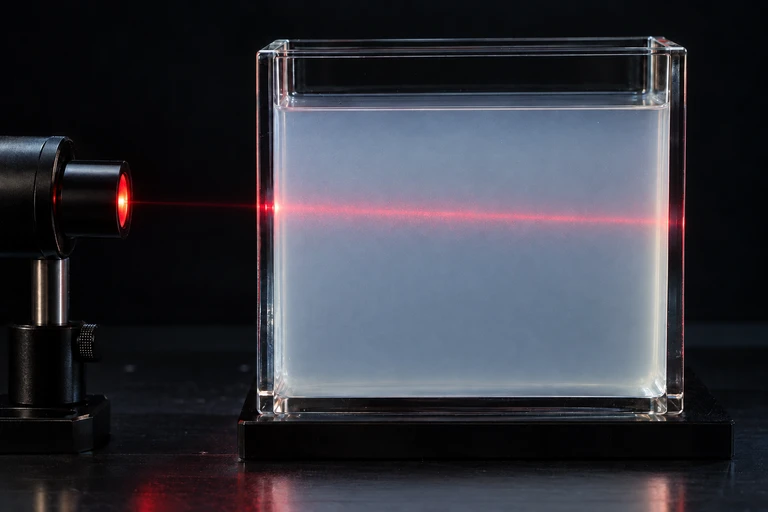 Particles in a colloid scatter light, making the beam visible through the mixture.
Anatomy of a Solution
A solution is a homogeneous mixture composed of a solute (the dissolved substance) and a solvent (the dissolving medium). The solvent is typically present in the greater amount.
Why Do Solutions Matter?
Most chemical reactions in biology, medicine, and industry occur in solution. Understanding solution behavior is essential for predicting reaction rates, equilibrium positions, and biological processes.
Molarity: The Core Unit
Molarity (\(M\)) is the most common concentration unit in AP Chemistry. It measures the moles of solute per liter of solution:
Other Concentration Units
Temperature-independent: uses mass, not volume
Unitless ratio, used in Raoult's Law and gas mixtures
Common for commercial reagents (e.g., \(37\%\) HCl)
The Dissolution Process
Dissolving a solute involves three energy steps. The overall enthalpy of solution, \(\Delta H_{\text{soln}}\), determines whether dissolution is endothermic or exothermic.
Water orientation around one sodium ion
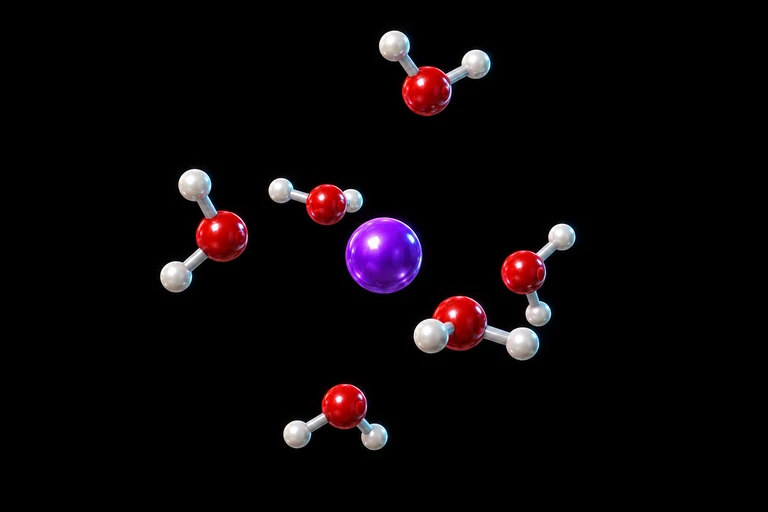 Water molecules orient their partially negative oxygen atoms toward a sodium ion.
"Like Dissolves Like"
The solubility rule: polar solvents dissolve polar and ionic solutes, while nonpolar solvents dissolve nonpolar solutes. This arises because similar intermolecular forces allow favorable solute-solvent interactions.
| Polar Solvent (\(H_2O\)) | Nonpolar Solvent (hexane) | |
|---|---|---|
| NaCl (ionic) | Soluble | Insoluble |
| Glucose (polar) | Soluble | Insoluble |
| Oil (nonpolar) | Insoluble | Soluble |
| \(I_2\) (nonpolar) | Slightly | Soluble |
Separated water and hexane layers
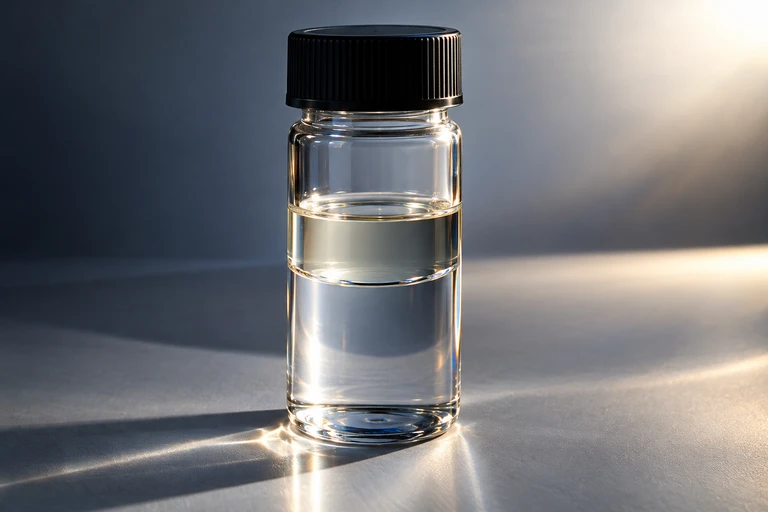 Water and hexane separate into layers because mixing their molecules is unfavorable under these conditions.
Saturated vs. Supersaturated
Solid and saturated solution in contact
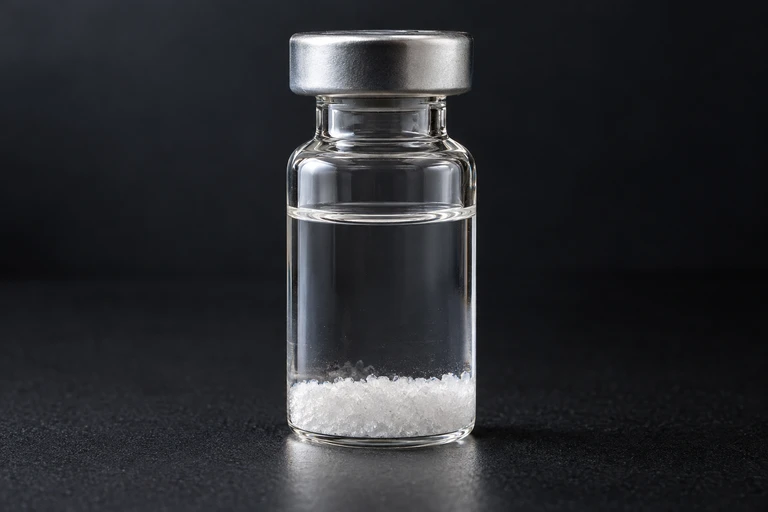 A saturated solution can remain in contact with undissolved solid while dissolution and crystallization continue.
The Dilution Equation
When you add solvent to a solution, the amount of solute stays constant. Only the volume changes. This gives the dilution equation:
Solution Stoichiometry Steps
Most AP Chemistry problems involve reacting species in solution. Here is your step-by-step approach:
Example: Calculating Molarity
Example: Dilution Calculation
Example: Stoichiometry in Solution
Colligative Properties
Colligative properties depend on the number of solute particles, not their identity. The van 't Hoff factor \(i\) accounts for dissociation of electrolytes.
Common Mistakes
Summary Comparison
| Molarity (\(M\)) | Molality (\(m\)) | Mole Fraction (\(\chi\)) | |
|---|---|---|---|
| Formula | \(\frac{\text{mol}}{L_{\text{soln}}}\) | \(\frac{\text{mol}}{kg_{\text{solvent}}}\) | \(\frac{n_A}{n_{\text{total}}}\) |
| Temp. Dependent? | Yes | No | No |
| Primary Use | Stoichiometry, dilution | Colligative properties | Raoult's Law, vapor pressure |
| Units | mol/L | mol/kg | Unitless |
Question 1 of 5
A student dissolves 4.00 g of NaOH (molar mass = 40.00 g/mol) in water to make 500.0 mL of solution. What is the molarity?
Question 2 of 5
Which concentration unit is independent of temperature?
Question 3 of 5
You need to prepare 100.0 mL of 0.25 M HCl from a 12.0 M stock solution. What volume of the stock do you need?
Question 4 of 5
A 0.50 m aqueous NaCl solution has a van 't Hoff factor of \(i = 2\). If \(K_f\) for water is 1.86 \(^\circ\text{C/m}\), what is the freezing point depression?
Question 5 of 5
Which of the following is a heterogeneous mixture?