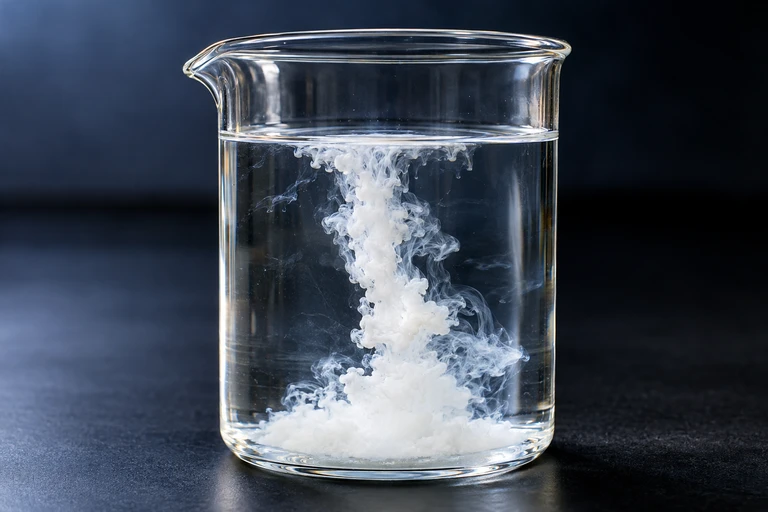
01 / 20

Solubility
in Aqueous Systems

Master the principles of dissolving, saturation, and solubility equilibria to predict when solids dissolve and when precipitates form.

AP Chemistry

What Is Solubility?

Solubility is the maximum amount of a solute that can dissolve in a given amount of solvent at a specific temperature to produce a saturated solution. It is typically expressed in grams of solute per 100 g of water, or in \(\text{mol/L}\) (molarity).

Solute
The substance being dissolved (e.g., NaCl)
Solvent
The substance doing the dissolving (e.g., water)
Solution
The homogeneous mixture that results

Unsaturated, Saturated, and Supersaturated

Unsaturated
Contains less solute than the maximum: more can dissolve.
Saturated
Contains the maximum solute at equilibrium: dissolved solute \(\rightleftharpoons\) undissolved solid.
Supersaturated
Contains more than the maximum: unstable, crystallizes on disturbance.

Solid and saturated solution in contact
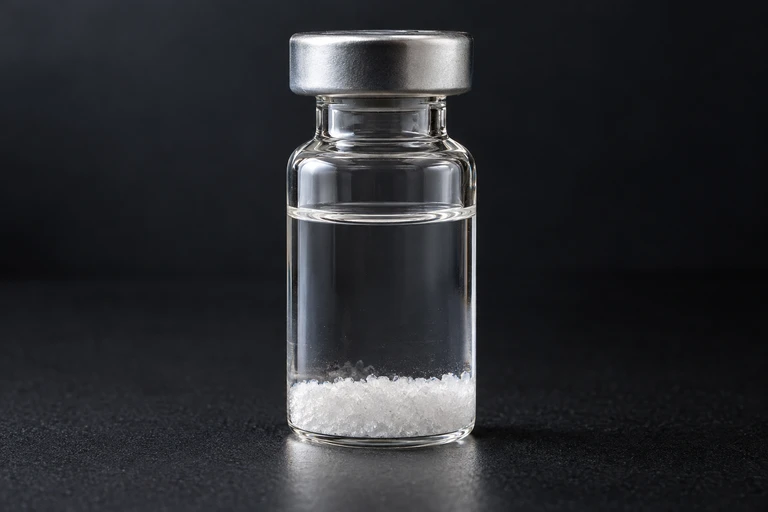
Solid and saturated solution in contactA saturated solution can remain in contact with undissolved solid while dissolution and crystallization continue.

Reading a Solubility Curve

Temperature (\(^{\circ}\text{C}\))
Solubility (g / 100 g \(\text{H}_2\text{O}\))
0 20 40 60 80 0 25 50 75 100
\(\text{KNO}_3\)
\(\text{NaCl}\)
\(\text{Ce}_2(\text{SO}_4)_3\)
Unsaturated (below curve)

The Solubility Product: \(K_{sp}\)

For a sparingly soluble ionic compound dissolving in water, the equilibrium expression is called the solubility product constant, \(K_{sp}\). It quantifies how much of the solid dissolves.

Writing \(K_{sp}\) Expressions

1
Write the balanced dissolution equation. Solid on the left, ions on the right.
2
Identify the ions and their coefficients. Each coefficient becomes an exponent.
3
Write the product of ion concentrations raised to their stoichiometric powers.
AgCl
\(\text{AgCl} \rightleftharpoons \text{Ag}^+ + \text{Cl}^-\)
\(K_{sp} = [\text{Ag}^+][\text{Cl}^-]\)
PbI₂
\(\text{PbI}_2 \rightleftharpoons \text{Pb}^{2+} + 2\,\text{I}^-\)
\(K_{sp} = [\text{Pb}^{2+}][\text{I}^-]^2\)
Ca₃(PO₄)₂
\(\text{Ca}_3(\text{PO}_4)_2 \rightleftharpoons 3\,\text{Ca}^{2+} + 2\,\text{PO}_4^{3-}\)
\(K_{sp} = [\text{Ca}^{2+}]^3[\text{PO}_4^{3-}]^2\)

\(K_{sp}\) vs. \(Q_{sp}\): Predicting Precipitation

The ion product \(Q_{sp}\) has the same form as \(K_{sp}\), but uses the current (non-equilibrium) ion concentrations. Comparing them tells you what happens next:

\(Q_{sp} < K_{sp}\)
Unsaturated: no precipitate forms. More solid can dissolve.
\(Q_{sp} = K_{sp}\)
Saturated: system is at equilibrium. No net change.
\(Q_{sp} > K_{sp}\)
Supersaturated: a precipitate forms until \(Q_{sp}\) drops to \(K_{sp}\).

Silver chloride precipitation context

Silver chloride precipitation contextSilver chloride forms a white precipitate when the dissolved ion product exceeds its solubility product.

Factors Affecting Solubility

1
Temperature: Most solids are more soluble at higher temperatures. Gases are less soluble at higher temperatures.
2
Common-Ion Effect: Adding an ion already present in the equilibrium decreases solubility (Le Chatelier's principle).
3
pH: Salts of weak acids are more soluble in acidic solutions. \(\text{H}^+\) reacts with the anion, pulling the equilibrium forward.
4
Complex-Ion Formation: Metal ions that form complex ions (e.g., \(\text{Ag(NH}_3)_2^+\)) show increased solubility in the complexing agent.

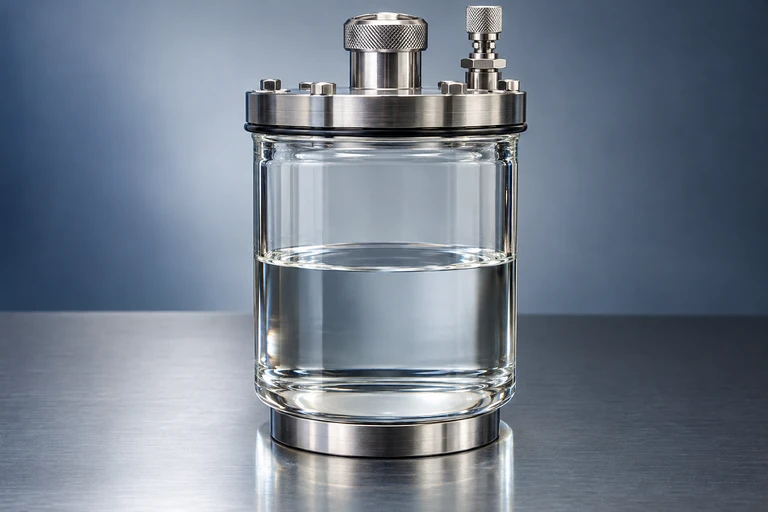
Gas and liquid in one sealed cell

Gas and liquid in one sealed cellIn a sealed vessel, gas exchanges between the liquid and the gas above it.

The Common-Ion Effect

Pure Water Ag⁺ Cl⁻ Ag⁺ Cl⁻ Ag⁺ Cl⁻ More AgCl dissolves Add NaCl NaCl Solution Cl⁻ Cl⁻ Cl⁻ Cl⁻ Cl⁻ Ag⁺ AgCl(s) Less AgCl dissolves Le Chatelier Extra Cl⁻ shifts equilibrium left: AgCl precipitates

How to Calculate Molar Solubility

1
Write the dissolution equation and identify the ion ratio from the stoichiometry.
2
Define molar solubility as \(s\). Express each ion concentration in terms of \(s\) using stoichiometric coefficients.
3
Substitute into the \(K_{sp}\) expression and solve for \(s\).
4
Check units: molar solubility is in \(\text{mol/L}\). Convert to grams if needed using molar mass.

Example 1: Molar Solubility of AgBr

Find the molar solubility of AgBr in pure water given \(K_{sp} = 5.0 \times 10^{-13}\).

1
Dissolution: \(\text{AgBr}(s) \rightleftharpoons \text{Ag}^+(aq) + \text{Br}^-(aq)\)
2
ICE table: Let molar solubility = \(s\). Then \([\text{Ag}^+] = s\) and \([\text{Br}^-] = s\).
3
Substitute: \(K_{sp} = s \cdot s = s^2 = 5.0 \times 10^{-13}\)
4
Solve: \(s = \sqrt{5.0 \times 10^{-13}} = 7.1 \times 10^{-7}\;\text{mol/L}\)

Example 2: PbI₂ with a 1:2 Ratio

Calculate the molar solubility of PbI₂ given \(K_{sp} = 9.8 \times 10^{-9}\).

1
Dissolution: \(\text{PbI}_2(s) \rightleftharpoons \text{Pb}^{2+}(aq) + 2\,\text{I}^-(aq)\)
2
ICE: If \(s\) mol dissolves, \([\text{Pb}^{2+}] = s\) and \([\text{I}^-] = 2s\).
3
Substitute: \(K_{sp} = (s)(2s)^2 = 4s^3 = 9.8 \times 10^{-9}\)
4
Solve: \(s^3 = 2.45 \times 10^{-9}\), so \(s = 1.35 \times 10^{-3}\;\text{mol/L}\)

Example 3: Will BaSO₄ Precipitate?

You mix 50.0 mL of \(1.0 \times 10^{-4}\) M Ba(NO₃)₂ with 50.0 mL of \(2.0 \times 10^{-4}\) M Na₂SO₄. Does BaSO₄ precipitate? \(K_{sp} = 1.1 \times 10^{-10}\).

1
Dilution: Total volume = 100 mL. \([\text{Ba}^{2+}] = \frac{1.0 \times 10^{-4} \times 50}{100} = 5.0 \times 10^{-5}\) M
2
\([\text{SO}_4^{2-}] = \frac{2.0 \times 10^{-4} \times 50}{100} = 1.0 \times 10^{-4}\) M
3
Calculate \(Q_{sp}\): \(Q_{sp} = (5.0 \times 10^{-5})(1.0 \times 10^{-4}) = 5.0 \times 10^{-9}\)
4
Compare: \(Q_{sp} = 5.0 \times 10^{-9} > K_{sp} = 1.1 \times 10^{-10}\) → Precipitate forms!

General Solubility Rules

Generally Soluble Exceptions (Insoluble)
Group 1 cations (Li⁺, Na⁺, K⁺...) None
NH₄⁺ salts None
NO₃⁻ and CH₃COO⁻ salts None
Cl⁻, Br⁻, I⁻ salts Ag⁺, Pb²⁺, Hg₂²⁺
SO₄²⁻ salts Ba²⁺, Pb²⁺, Ca²⁺, Sr²⁺
Generally Insoluble Exceptions (Soluble)
OH⁻ salts Group 1, Ba²⁺, Ca²⁺ (slightly)
CO₃²⁻, PO₄³⁻, S²⁻ salts Group 1, NH₄⁺

Common Mistakes to Avoid

✕ Forgetting Stoichiometric Coefficients
For PbI₂: writing \(K_{sp} = s^2\) instead of \(K_{sp} = 4s^3\). The coefficient of 2 on I⁻ must become an exponent and multiply \(s\).
✕ Including the Solid in \(K_{sp}\)
The solid reactant has activity = 1 and does not appear in the equilibrium expression. Only aqueous ions count.
✕ Ignoring Dilution When Mixing
When two solutions are mixed, the total volume changes. You must recalculate the concentrations before computing \(Q_{sp}\).

Question 1 of 5

What is the correct \(K_{sp}\) expression for \(\text{Ag}_2\text{CrO}_4\)?

Question 2 of 5

The \(K_{sp}\) of CaF₂ is \(3.9 \times 10^{-11}\). What is its molar solubility?

Question 3 of 5

If \(Q_{sp} > K_{sp}\) for a salt in solution, what will happen?

Question 4 of 5

How does adding NaCl to a saturated AgCl solution affect the molar solubility of AgCl?

Question 5 of 5

Which of the following compounds is most soluble in water based on general solubility rules?