Solids, Liquids,
and Gases
Explore the three states of matter, their molecular behavior, phase transitions, and the gas laws that govern them: from \( PV = nRT \) to intermolecular forces.
The Three States of Matter
All matter exists in one of three common phases: solid, liquid, or gas. Each state is defined by how its particles are arranged and how much kinetic energy they possess.
A Molecular Perspective
Watch the boundary move—or stay fixed
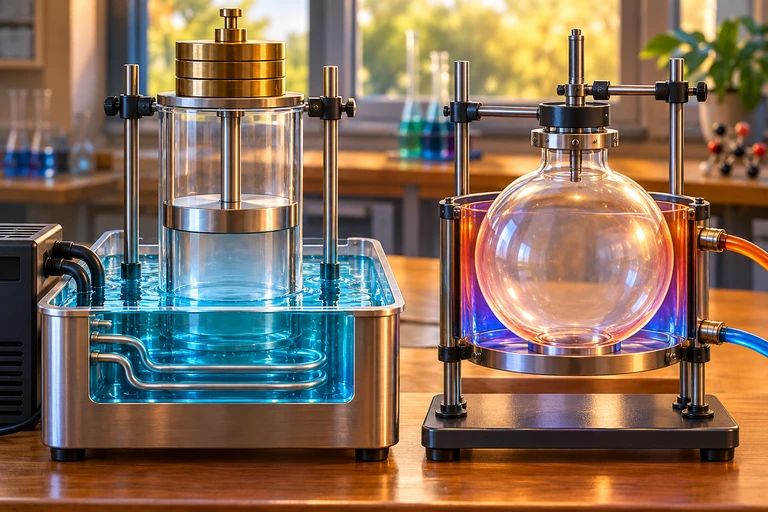 Solid, liquid and gas phases differ in particle arrangement and motion. Solid particles vibrate around ordered positions; liquids and gases permit particles to move past one another.
Particle arrangements differ across states
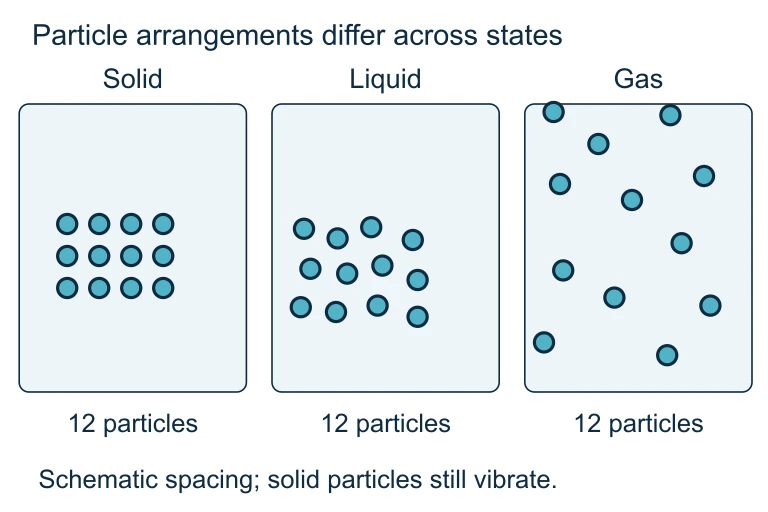 Solid particles vibrate around ordered positions, liquid particles remain close but mobile, and gas particles are more widely separated and mobile.
Intermolecular Forces and Phase
The state of a substance depends on the balance between kinetic energy (temperature) and intermolecular forces (IMFs). Stronger IMFs require more energy to overcome, resulting in higher melting and boiling points.
Phase Transitions and Energy
The meniscus disappears
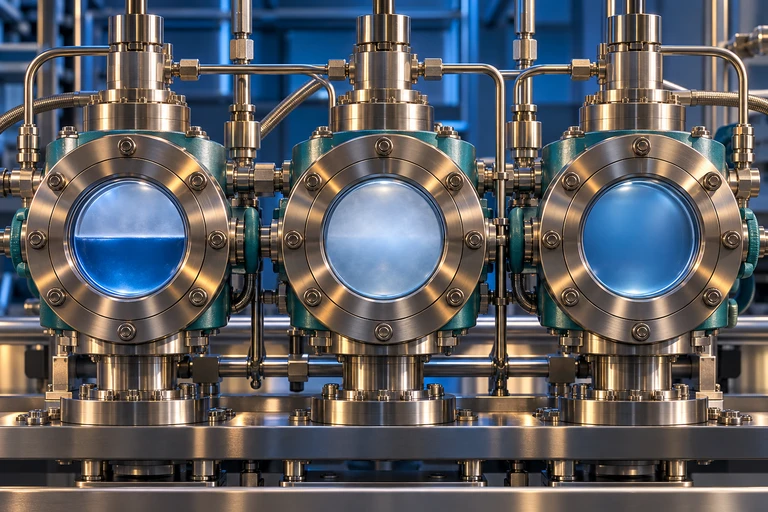 The liquid–gas coexistence curve ends at the critical point. Above both the critical temperature and critical pressure, the ordinary liquid–vapor boundary disappears.
The coexistence curve ends
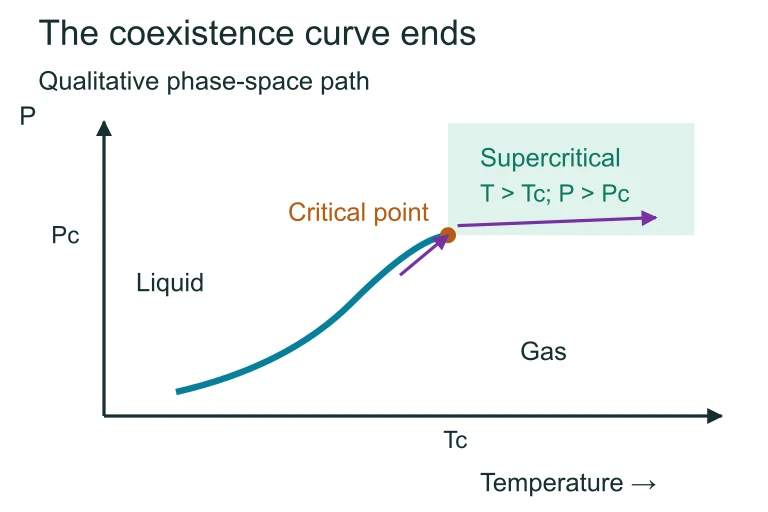 The liquid–gas coexistence curve ends at the critical point. Above both the critical temperature and critical pressure, the ordinary liquid–vapor boundary disappears.
The Heating Curve
The Ideal Gas Law
$$ PV = nRT $$
Special Cases of the Gas Laws
At constant \( T \) and \( n \): pressure and volume are inversely proportional.
At constant \( P \) and \( n \): volume and temperature are directly proportional.
At constant \( V \) and \( n \): pressure and temperature are directly proportional.
Ideal vs. Real Gases
| Ideal Gas | Real Gas | |
|---|---|---|
| Particle Volume | Negligible (point masses) | Finite volume matters at high \( P \) |
| IMFs | None assumed | Attractive forces exist |
| Collisions | Perfectly elastic | Some energy loss possible |
| Equation | \( PV = nRT \) | \( \left(P + \frac{an^2}{V^2}\right)(V - nb) = nRT \) |
| Best Conditions | High \( T \), low \( P \) | Low \( T \), high \( P \) show deviations |
Kinetic Molecular Theory
The KMT provides a model for ideal gas behavior and connects macroscopic properties (pressure, temperature) to molecular motion.
Dalton's Law of Partial Pressures
$$ P_{\text{total}} = P_1 + P_2 + P_3 + \cdots $$
The total pressure of a gas mixture equals the sum of the partial pressures of each individual gas. Each gas behaves independently as if it alone occupied the container.
How to Solve Gas Law Problems
Example 1: Ideal Gas Law
A balloon contains \( 0.50 \;\text{mol} \) of helium at \( 25\;{}^\circ\text{C} \) and \( 1.0 \;\text{atm} \). What is the volume of the balloon?
Example 2: Boyle's Law
A gas sample has a volume of \( 4.0 \;\text{L} \) at \( 2.0 \;\text{atm} \). If the temperature is held constant, what is the volume at \( 8.0 \;\text{atm} \)?
Example 3: Partial Pressures
A \( 10.0 \;\text{L} \) container at \( 300 \;\text{K} \) holds \( 0.40 \;\text{mol} \) \(\text{N}_2\) and \( 0.10 \;\text{mol} \) \(\text{O}_2\). Find the total pressure and the partial pressure of each gas.
Common Mistakes to Avoid
Summary of Gas Laws
| Law | Equation | Held Constant | Relationship |
|---|---|---|---|
| Boyle's | \( P_1V_1 = P_2V_2 \) | \( T, n \) | Inverse |
| Charles's | \( \frac{V_1}{T_1} = \frac{V_2}{T_2} \) | \( P, n \) | Direct |
| Gay-Lussac's | \( \frac{P_1}{T_1} = \frac{P_2}{T_2} \) | \( V, n \) | Direct |
| Avogadro's | \( \frac{V_1}{n_1} = \frac{V_2}{n_2} \) | \( T, P \) | Direct |
| Combined | \( \frac{P_1V_1}{T_1} = \frac{P_2V_2}{T_2} \) | \( n \) | Varies |
| Ideal | \( PV = nRT \) | None (general) | All variables |
Question 1 of 5
A gas at 2.0 atm occupies 6.0 L. If the temperature remains constant and the pressure increases to 6.0 atm, what is the new volume?
Question 2 of 5
During the melting phase of a heating curve, what happens to the temperature of the substance?
Question 3 of 5
Which conditions cause a real gas to deviate most from ideal behavior?
Question 4 of 5
A container holds 2.0 mol of \(\text{N}_2\) and 3.0 mol of \(\text{H}_2\). If the total pressure is 10.0 atm, what is the partial pressure of \(\text{H}_2\)?
Question 5 of 5
According to the Kinetic Molecular Theory, the average kinetic energy of gas particles depends only on: