Separations of
Solutions & Mixtures
Master the physical and chemical techniques used to separate components of mixtures based on differences in their physical properties.
What Is a Mixture?
A mixture is a physical combination of two or more substances where each substance retains its own chemical identity. Unlike compounds, the components of a mixture are not chemically bonded and can be separated by physical means.
Solutions vs. Other Mixtures
A solution is a special type of homogeneous mixture where a solute is dissolved in a solvent. The particles are molecular-scale and will not settle out or scatter light.
Why Separation Matters
Separation is foundational in chemistry: from purifying water to isolating products of a chemical reaction. Choosing the right technique depends on the physical properties of each component.
The Core Principle of Separation
Major Separation Techniques
Filtration & Evaporation
Gravity filtration of sand and saltwater
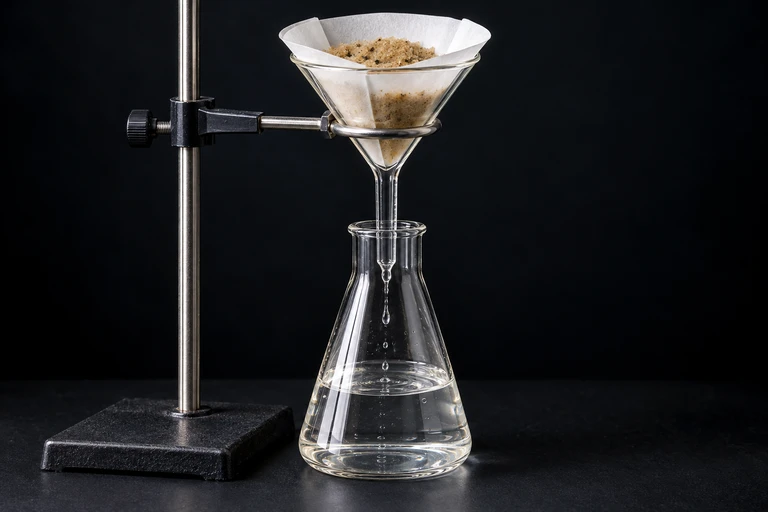 Filter paper retains suspended sand while water and dissolved salt pass into the receiving flask.
Crystals growing in mother liquor
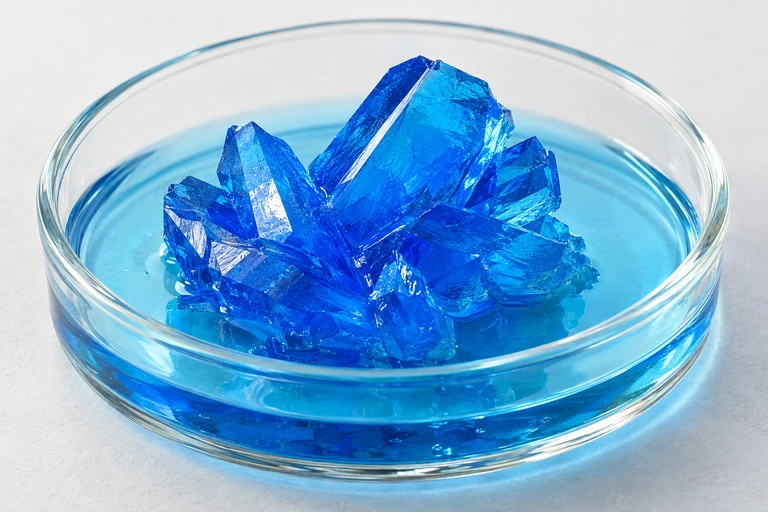 Crystals grow as dissolved material joins an ordered solid at the solution–crystal interface.
Distillation: Boiling Point Differences
Distillation separates liquids with different boiling points. The mixture is heated: the component with the lower boiling point vaporizes first, passes through a condenser, and is collected as a pure liquid (distillate).
One simple distillation apparatus
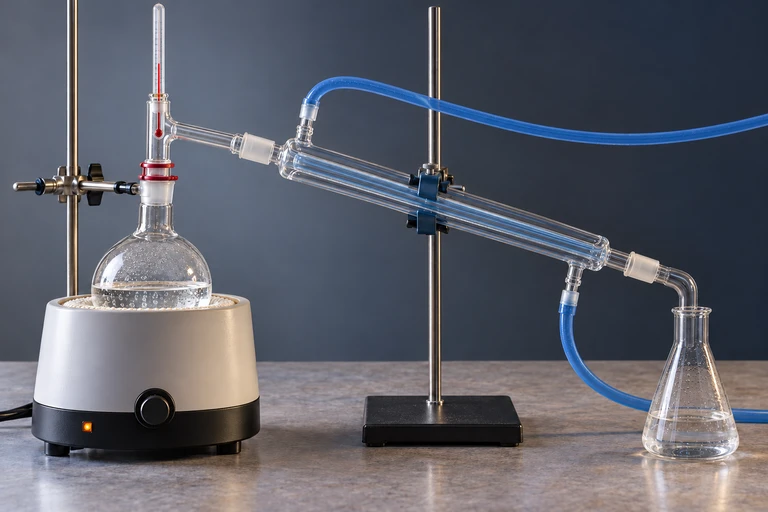 Distillation vaporizes a volatile component and condenses the vapor in a cooled tube.
Chromatography: Polarity & Affinity
Chromatography separates components based on their different rates of migration through a stationary phase driven by a mobile phase. More polar components stick longer to a polar stationary phase and travel less.
Distillation vs. Evaporation
| Distillation | Evaporation | |
|---|---|---|
| Goal | Collect the liquid (solvent/lower bp) | Collect the solid (dissolved solute) |
| Apparatus | Flask + condenser + collection vessel | Evaporating dish + heat source |
| Property Used | Boiling point difference | Volatility difference (liquid vs. solid) |
| Recovers Solvent? | Yes | No (lost to air) |
| Example | Ethanol from ethanol-water | Salt from saltwater |
How to Choose a Technique
Example 1: Sand & Salt
Problem: You have a mixture of sand (\(\text{SiO}_2\)) and table salt (NaCl). How do you separate them and recover both components?
Example 2: Ethanol & Water
Problem: Separate ethanol (\( \text{bp} = 78\,{}^\circ\text{C} \)) from water (\( \text{bp} = 100\,{}^\circ\text{C} \)) and collect pure ethanol.
Example 3: Ink Chromatography
Problem: Determine which dyes are present in a sample of black ink using paper chromatography.
Follow a sample through the development chamber
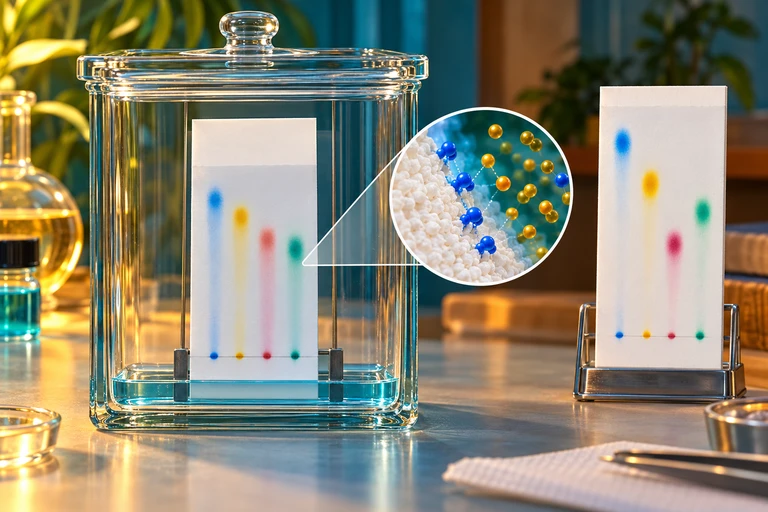 Measure every chromatography distance from the same origin. With an 8.0 cm solvent front, spot distances of 2.0, 5.6 and 7.2 cm give Rf values of 0.25, 0.70 and 0.90 under the same development conditions.
Measure every distance from the origin
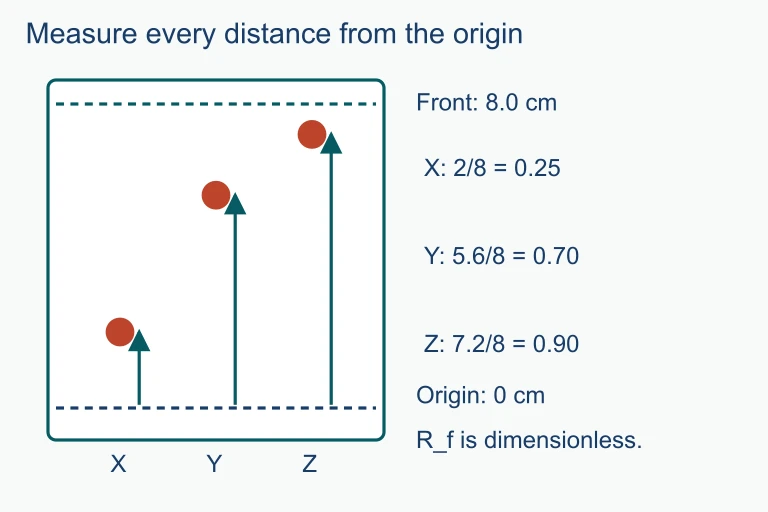 Measure every chromatography distance from the same origin. With an 8.0 cm solvent front, spot distances of 2.0, 5.6 and 7.2 cm give Rf values of 0.25, 0.70 and 0.90 under the same development conditions.
Common Mistakes to Avoid
Summary of Techniques
| Technique | Property Used | Best For |
|---|---|---|
| Filtration | Particle size | Insoluble solid + liquid |
| Evaporation | Volatility | Dissolved solid from solution |
| Simple Distillation | Boiling point (\( > 25\,{}^\circ\text{C} \) gap) | Liquid from solution |
| Fractional Distillation | Boiling point (close) | Miscible liquids |
| Chromatography | Polarity / affinity | Identify / separate dissolved mixtures |
| Separating Funnel | Immiscibility / density | Immiscible liquid-liquid |
| Centrifugation | Density | Fine suspended particles |
Question 1 of 5
A student needs to recover pure sodium chloride from a saltwater solution. Which technique is most appropriate?
Question 2 of 5
Fractional distillation is preferred over simple distillation when:
Question 3 of 5
In paper chromatography, a component with an \( R_f \) value of 0.9 compared to a component with an \( R_f \) of 0.2 is:
Question 4 of 5
A mixture contains sand, iron filings, and salt. What is the most efficient sequence of steps to separate all three?
Question 5 of 5
During distillation, the thermometer at the top of the apparatus reads a constant temperature. What does this indicate?