Representations of Solutions
Understand how to depict solute-solvent interactions at the particulate level, interpret concentration expressions, and connect macroscopic observations to molecular models.
What Is a Solution?
A solution is a homogeneous mixture in which one or more substances (the solute) are uniformly distributed throughout another substance (the solvent). At the particulate level, solute particles are dispersed among solvent particles so that the composition is identical in every region of the mixture.
Particulate-Level Diagrams
AP Chemistry requires you to interpret and draw particulate diagrams that show individual atoms, ions, or molecules. In a solution diagram, solute particles are evenly scattered among solvent particles with no clumps or layers.
Water orientation around one sodium ion
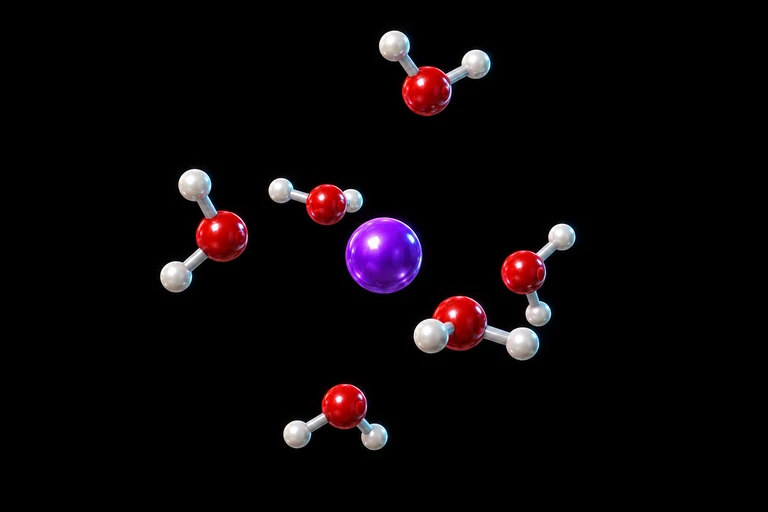 Water molecules orient their partially negative oxygen atoms toward a sodium ion.
Why Representations Matter
Chemistry operates on three interconnected levels. AP Chemistry expects you to move fluently among all three when discussing solutions:
Electrolytes vs. Nonelectrolytes
When dissolved in water, some solutes produce ions (electrolytes) while others remain as intact molecules (nonelectrolytes). Particulate diagrams must reflect this difference.
Key Concentration Expressions
Concentration quantifies how much solute is present relative to solvent or solution. The AP exam tests several expressions:
The Dilution Equation
When you add solvent to a solution, the amount of solute stays the same. This gives the dilution equation:
Molarity vs. Molality
| Molarity (M) | Molality (m) | |
|---|---|---|
| Formula | \( \dfrac{\text{mol solute}}{\text{L solution}} \) | \( \dfrac{\text{mol solute}}{\text{kg solvent}} \) |
| Units | mol/L (M) | mol/kg (m) |
| Denominator | Volume of solution | Mass of solvent |
| Temp. dependent? | Yes (volume changes) | No (mass is constant) |
| Common use | Stoichiometry, titrations | Colligative properties |
How to Draw a Particulate Diagram
Example 1: Calculating Molarity
A student dissolves 5.85 g of \( \text{NaCl} \) (molar mass = 58.44 g/mol) in enough water to make 250.0 mL of solution. What is the molarity?
Example 2: Dilution Problem
You need 500.0 mL of 0.100 M \( \text{HCl} \). Your stock solution is 6.00 M \( \text{HCl} \). What volume of stock do you need?
Example 3: Reading a Particulate Diagram
The diagram below represents 1.0 L of an aqueous solution of \( \text{CaCl}_2 \). Determine the molarity of \( \text{CaCl}_2 \) and the total ion concentration.
Connecting to Solubility Rules
Not all ionic compounds dissolve. Particulate diagrams must reflect whether a precipitate forms. If a solid is present, show an organized ionic lattice sitting at the bottom, not individual ions floating.
Ion Counting: the van 't Hoff Factor \( i \)
The van 't Hoff factor \( i \) counts the number of particles a solute produces when it dissolves. It directly affects colligative properties and determines how many particles you draw.
| Solute | Dissociation | Ideal \( i \) |
|---|---|---|
| \( \text{NaCl} \) | \( \text{Na}^+ + \text{Cl}^- \) | 2 |
| \( \text{CaCl}_2 \) | \( \text{Ca}^{2+} + 2\text{Cl}^- \) | 3 |
| \( \text{Al}_2(\text{SO}_4)_3 \) | \( 2\text{Al}^{3+} + 3\text{SO}_4^{2-} \) | 5 |
| \( \text{C}_6\text{H}_{12}\text{O}_6 \) | stays intact | 1 |
Common Mistakes
Summary of Solution Representations
| Representation | What It Shows | Key Check |
|---|---|---|
| Particulate Diagram | Individual ions or molecules in solvent | Correct ion ratio, uniform distribution |
| Chemical Equation | Dissolution or dissociation process | Balanced, correct phases (\(\text{aq}\), \(\text{s}\), \(\text{l}\)) |
| Concentration (M) | Moles per liter of solution | Denominator is solution, not solvent |
| Concentration (m) | Moles per kg of solvent | Denominator is solvent mass in kg |
| Mole Fraction | Fraction of total moles that are solute | Sum of all mole fractions = 1 |
Question 1 of 5
A particulate diagram of an aqueous solution of \( \text{Na}_2\text{SO}_4 \) should show which set of ions for each formula unit dissolved?
Question 2 of 5
What is the molarity of a solution prepared by dissolving 4.00 g of \( \text{NaOH} \) (molar mass \( = 40.00 \) g/mol) in water to a total volume of 200.0 mL?
Question 3 of 5
A student needs to prepare 250.0 mL of 0.200 M \( \text{KNO}_3 \) from a 2.00 M stock solution. What volume of stock is required?
Question 4 of 5
Which particulate diagram best represents a weak electrolyte dissolved in water?
Question 5 of 5
A solution is prepared by dissolving 3 formula units of \( \text{AlCl}_3 \) in water. How many total ions should appear in the particulate diagram?