Representations of
Chemical Reactions
Master how to write, interpret, and balance chemical equations, understand particulate diagrams, and connect macroscopic observations to molecular-level events.
What is a Chemical Reaction?
A chemical reaction is a process in which one or more reactants are transformed into one or more products through the breaking and forming of chemical bonds. We represent these transformations using chemical equations.
Anatomy of a Chemical Equation
Three Levels of Representation
Chemists think about reactions at three interconnected levels. The AP exam expects you to move fluently between all three.
Yellow lead iodide precipitate
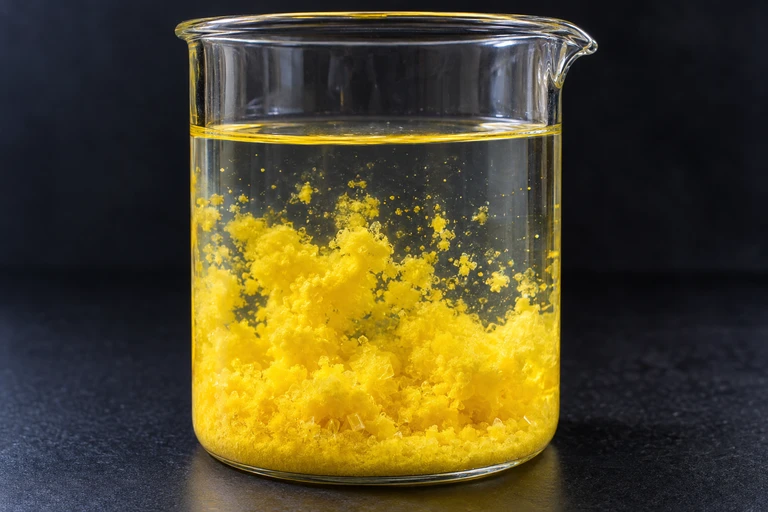 Lead ions and iodide ions combine to form a yellow lead iodide precipitate.
The Law of Conservation of Mass
Count every atom: 4 H atoms and 2 O atoms on each side. The atoms are conserved: that is why we balance equations.
Balancing Chemical Equations
Balancing ensures the same number of each type of atom appears on both sides. You may only change coefficients (never subscripts) to achieve balance.
Coefficients vs. Subscripts
| Coefficients | Subscripts | |
|---|---|---|
| Position | Before the formula | Within the formula |
| Meaning | Number of molecules/formula units | Number of atoms in one molecule |
| Can you change it? | ✓ Yes (to balance) | ✕ No (changes the substance) |
| Example in \( 2\text{H}_2\text{O} \) | 2 = two molecules of water | 2 = two H atoms per molecule |
| Total H atoms | \( 2 \times 2 = 4 \) hydrogen atoms total | |
Types of Chemical Reactions
Two or more substances combine into one product
One compound breaks into simpler substances
One element displaces another in a compound
Two compounds exchange partners
Carbon dioxide evolving from an acidic carbonate mixture
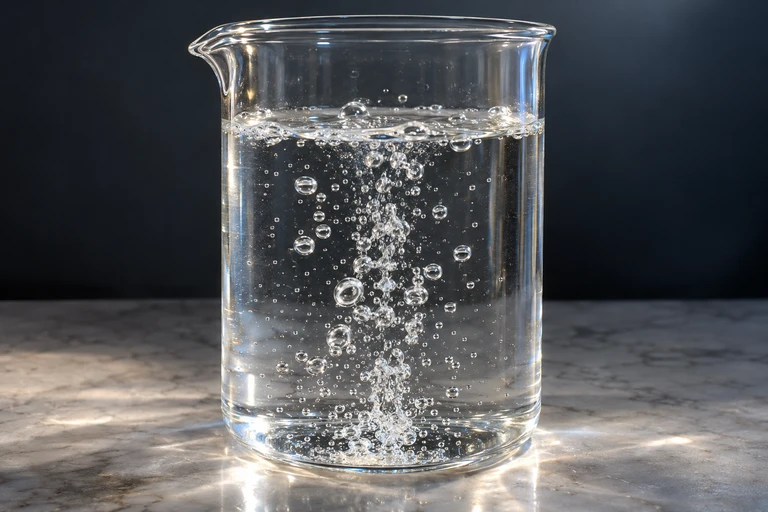 An acid–carbonate reaction produces carbon dioxide bubbles.
Reading Particulate Diagrams
Particulate diagrams show molecules as groups of colored circles. Each color represents a different element. Count individual molecules to determine coefficients and atom groupings to identify formulas.
Net Ionic Equations
For reactions in aqueous solution, we can write equations at three levels of detail. The net ionic equation shows only the species that actually change during the reaction.
\( \text{AgNO}_3\text{(aq)} + \text{NaCl(aq)} \rightarrow \text{AgCl(s)} + \text{NaNO}_3\text{(aq)} \)
\( \text{Ag}^+\text{(aq)} + \text{NO}_3^-\text{(aq)} + \text{Na}^+\text{(aq)} + \text{Cl}^-\text{(aq)} \rightarrow \text{AgCl(s)} + \text{Na}^+\text{(aq)} + \text{NO}_3^-\text{(aq)} \)
\( \text{Ag}^+\text{(aq)} + \text{Cl}^-\text{(aq)} \rightarrow \text{AgCl(s)} \)
How to Write a Net Ionic Equation
Example 1: Balancing Combustion
Problem: Balance the combustion of propane:
\( \text{C}_3\text{H}_8 + \text{O}_2 \rightarrow \text{CO}_2 + \text{H}_2\text{O} \)
\( \text{C}_3\text{H}_8 + \text{O}_2 \rightarrow \textbf{3}\,\text{CO}_2 + \text{H}_2\text{O} \)
\( \text{C}_3\text{H}_8 + \text{O}_2 \rightarrow 3\,\text{CO}_2 + \textbf{4}\,\text{H}_2\text{O} \)
\( \text{C}_3\text{H}_8 + \textbf{5}\,\text{O}_2 \rightarrow 3\,\text{CO}_2 + 4\,\text{H}_2\text{O} \)
Example 2: Particulate to Symbolic
Problem: Given the particulate diagram below, write the balanced equation.
Example 3: Writing a Net Ionic Equation
Problem: Write the net ionic equation when \( \text{Pb(NO}_3\text{)}_2\text{(aq)} \) is mixed with \( \text{KI(aq)} \).
\( \text{Pb}^{2+}\text{(aq)} + 2\,\text{I}^-\text{(aq)} \rightarrow \text{PbI}_2\text{(s)} \)
Common Mistakes
Summary of Reaction Representations
| Representation | Shows | Key Feature |
|---|---|---|
| Balanced Molecular | Complete formulas of all species | Mole ratios via coefficients |
| Complete Ionic | All ions individually | Reveals spectator ions |
| Net Ionic | Only reacting species | Shows the "real" reaction |
| Particulate Diagram | Individual atoms/molecules | Visual atom conservation |
| Macroscopic Observation | What you see in the lab | Color change, precipitate, gas |
Question 1 of 5
When balancing a chemical equation, which of the following may you change?
Question 2 of 5
What are the correct coefficients (in order) for the balanced equation?
\( \_\;\text{Fe} + \_\;\text{O}_2 \rightarrow \_\;\text{Fe}_2\text{O}_3 \)
Question 3 of 5
In the reaction \( \text{BaCl}_2\text{(aq)} + \text{Na}_2\text{SO}_4\text{(aq)} \rightarrow \text{BaSO}_4\text{(s)} + 2\,\text{NaCl(aq)} \), which ions are spectator ions?
Question 4 of 5
A particulate diagram shows 3 molecules of AB₂ as reactants and 3 molecules of A plus 3 molecules of B₂ as products. What type of reaction is this?
Question 5 of 5
For the complete combustion of methane: \( \text{CH}_4 + 2\,\text{O}_2 \rightarrow \text{CO}_2 + 2\,\text{H}_2\text{O} \), how many total oxygen atoms are on the product side?