Reaction
Rates
Understand how fast chemical reactions proceed, the factors that influence speed, and how to express rate using concentration changes over time.
What Is a Reaction Rate?
A reaction rate measures how quickly a reactant is consumed or a product is formed over time. It tells us the speed of a chemical transformation.
Rates are always positive values. For reactants (whose concentrations decrease), we include a negative sign so the overall rate is positive.
Expressing Rates for a Reaction
For the generic reaction \( aA + bB \rightarrow cC + dD \), the rate can be written in terms of any species:
Concentration vs. Time
Gas collection with a movable syringe
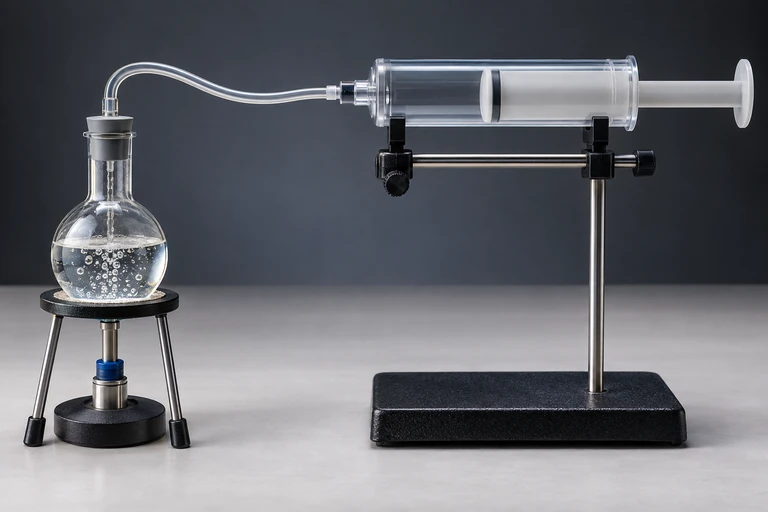 A gas syringe collects gas from a reaction, allowing its volume to be followed over time.
Average vs. Instantaneous Rate
| Average Rate | Instantaneous Rate | |
|---|---|---|
| Definition | Change over a finite time interval | Rate at a single instant |
| Formula | \( \frac{\Delta[A]}{\Delta t} \) | \( \lim_{\Delta t \to 0}\frac{\Delta[A]}{\Delta t} \) |
| Graphically | Slope of the secant line | Slope of the tangent line |
| When used | Comparing intervals | Finding rate at \( t = 0 \) (initial rate) |
The Rate Law
The rate law is an experimentally determined equation that relates the reaction rate to the concentrations of reactants raised to their respective orders.
Understanding Reaction Orders
Factors Affecting Reaction Rate
Accessible surfaces of a fragmented solid
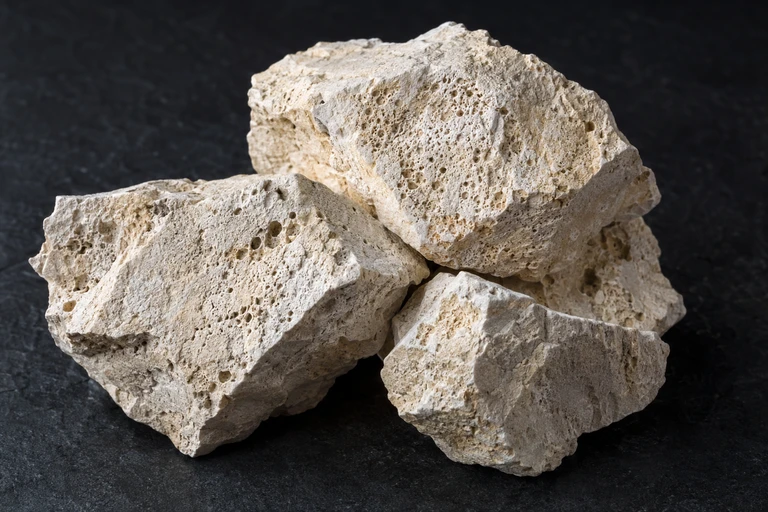 Breaking a solid into fragments exposes more surface to surrounding reactants.
Collision Theory and Activation Energy
Rate vs. Rate Constant
| Rate | Rate Constant \( k \) | |
|---|---|---|
| Symbol | \(\text{Rate}\) or \( r \) | \( k \) |
| Depends on [conc]? | Yes: changes as reaction proceeds | No: fixed at given temperature |
| Depends on \( T \)? | Indirectly (through \( k \)) | Yes: increases with temperature |
| Units | Always \(\text{M/s}\) (or \(\text{mol L}^{-1}\text{s}^{-1}\)) | Depend on overall order |
How to Find the Rate Law
The method of initial rates uses experimental data from multiple trials to determine the order with respect to each reactant.
Example: Average Rate Calculation
For the reaction \( 2\text{N}_2\text{O}_5 \rightarrow 4\text{NO}_2 + \text{O}_2 \), the concentration of \(\text{N}_2\text{O}_5\) drops from 0.100 M to 0.060 M over 200 s. Find the average rate of decomposition and the average rate of \(\text{NO}_2\) formation.
Example: Method of Initial Rates
Given data for \( A + B \rightarrow C \):
| Trial | [A] (M) | [B] (M) | Initial Rate (M/s) |
|---|---|---|---|
| 1 | 0.10 | 0.10 | \(2.0 \times 10^{-3}\) |
| 2 | 0.20 | 0.10 | \(8.0 \times 10^{-3}\) |
| 3 | 0.10 | 0.30 | \(6.0 \times 10^{-3}\) |
Example continued: Solving for \( n \) and \( k \)
Integrated Rate Laws
| Zero Order | First Order | Second Order | |
|---|---|---|---|
| Rate law | \(\text{Rate} = k\) | \(\text{Rate} = k[A]\) | \(\text{Rate} = k[A]^2\) |
| Integrated | \([A] = -kt + [A]_0\) | \(\ln[A] = -kt + \ln[A]_0\) | \(\frac{1}{[A]} = kt + \frac{1}{[A]_0}\) |
| Linear plot | [A] vs. \( t \) | \(\ln[A]\) vs. \( t \) | \(\frac{1}{[A]}\) vs. \( t \) |
| Half-life | \(\frac{[A]_0}{2k}\) | \(\frac{\ln 2}{k} = \frac{0.693}{k}\) | \(\frac{1}{k[A]_0}\) |
Common Mistakes
Question 1 of 5
For the reaction \( 2A + B \rightarrow C \), if the rate law is \( \text{Rate} = k[A][B]^2 \), what is the overall order of the reaction?
Question 2 of 5
A first-order reaction has a rate constant \( k = 0.020\;\text{s}^{-1} \). What is its half-life?
Question 3 of 5
If tripling the concentration of reactant X causes the rate to increase by a factor of 9, what is the order of the reaction with respect to X?
Question 4 of 5
Which graph would produce a straight line for a zero-order reaction?
Question 5 of 5
A catalyst increases the rate of a reaction by: