Properties of the
Equilibrium Constant
Master how \( K \) behaves when you reverse, scale, or combine reactions: the algebraic rules that connect every equilibrium expression.
What is the Equilibrium Constant?
For a generic reversible reaction at equilibrium, the equilibrium constant \( K \) is the ratio of product concentrations to reactant concentrations, each raised to the power of its stoichiometric coefficient.
\( K \) is dimensionless when activities are used and depends only on temperature: not on initial concentrations or the presence of a catalyst.
Why \( K \) Matters in Chemistry
Three Key Operations on \( K \)
Rule 1: Reversing a Reaction
When you write a reaction in the reverse direction, products become reactants and vice versa. The equilibrium constant for the reversed reaction is the reciprocal of the original.
Rule 2: Scaling by a Factor \( n \)
When every stoichiometric coefficient in a balanced equation is multiplied by a factor \( n \), the new equilibrium constant is the original constant raised to the \( n \)-th power.
Rule 3: Adding Reactions Together
When two (or more) reactions are added to produce an overall reaction, the equilibrium constant for the overall reaction is the product of the individual constants.
This extends to any number of steps: \( K_{\text{overall}} = K_1 \times K_2 \times K_3 \times \cdots \)
\( K_c \) vs. \( K_p \): A Key Distinction
| \( K_c \) | \( K_p \) | |
|---|---|---|
| Measures | Molar concentrations | Partial pressures |
| Units (formal) | \( \text{mol/L} \) terms | \( \text{atm} \) terms |
| Applies to | Any phase (usually aq/gas) | Gas-phase reactions only |
| Relationship | \( K_p = K_c(RT)^{\Delta n} \) | |
Solid phases and gas in an equilibrium vessel
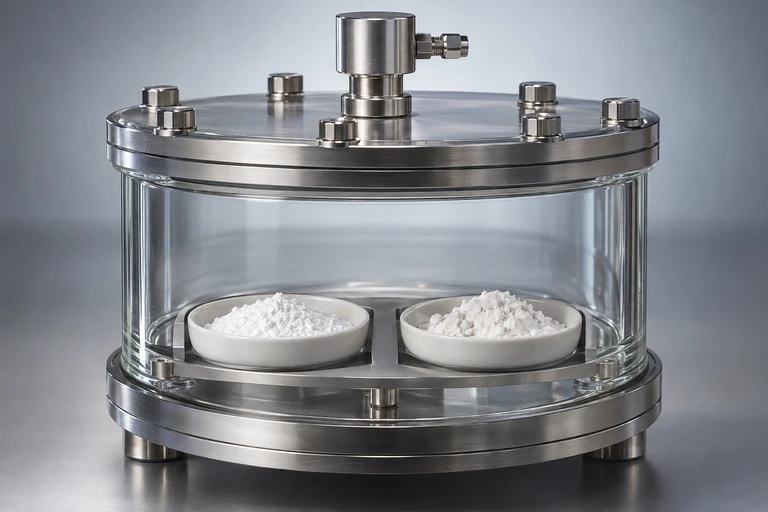 Solid phases can coexist with a gas in a closed heterogeneous-equilibrium system.
What \( K \) Does Not Depend On
How to Derive \( K \) for a Target Reaction
Example 1: Reversing a Reaction
Given: \(\; \text{N}_2\text{O}_4(g) \rightleftharpoons 2\,\text{NO}_2(g) \;\) with \( K = 4.6 \times 10^{-3} \) at \( 25^\circ\text{C} \).
Find \( K \) for: \(\; 2\,\text{NO}_2(g) \rightleftharpoons \text{N}_2\text{O}_4(g) \;\)
Example 2: Halving a Reaction
Given: \(\; 2\,\text{SO}_2(g) + \text{O}_2(g) \rightleftharpoons 2\,\text{SO}_3(g) \;\) with \( K = 2.8 \times 10^{2} \).
Find \( K \) for: \(\; \text{SO}_2(g) + \tfrac{1}{2}\,\text{O}_2(g) \rightleftharpoons \text{SO}_3(g) \;\)
Example 3: Combining Two Reactions
Given:
Find \( K \) for: \(\; \text{A} \rightleftharpoons \text{C} \;\)
Example 4: Reverse + Scale + Add
Given:
Find \( K \) for: \(\; 2\text{W} \rightleftharpoons \text{X} + 2\text{Z} \;\)
Common Mistakes to Avoid
Summary of \( K \) Properties
| Operation on Reaction | Effect on \( K \) | Example |
|---|---|---|
| Reverse | \( K' = \frac{1}{K} \) | \( K = 10 \rightarrow K' = 0.1 \) |
| Multiply coefficients by \( n \) | \( K' = K^{n} \) | \( n=2,\; K=10 \rightarrow K'=100 \) |
| Add two reactions | \( K' = K_1 \times K_2 \) | \( K_1=10,\; K_2=5 \rightarrow K'=50 \) |
| Reverse + Scale by \( n \) | \( K' = \left(\frac{1}{K}\right)^{n} = K^{-n} \) | \( n=2,\; K=10 \rightarrow K'=0.01 \) |
Question 1 of 5
If \(\; \text{A} \rightleftharpoons \text{B} \;\) has \( K = 6.0 \times 10^{3} \), what is \( K \) for \(\; \text{B} \rightleftharpoons \text{A} \;\)?
Question 2 of 5
Given \(\; \text{H}_2(g) + \text{I}_2(g) \rightleftharpoons 2\,\text{HI}(g) \;\) with \( K = 49 \). What is \( K \) for \(\; \frac{1}{2}\text{H}_2(g) + \frac{1}{2}\text{I}_2(g) \rightleftharpoons \text{HI}(g) \;\)?
Question 3 of 5
Reaction 1: \(\; \text{A} \rightleftharpoons \text{B} \;\), \( K_1 = 20 \). Reaction 2: \(\; \text{B} \rightleftharpoons \text{C} \;\), \( K_2 = 5 \). What is \( K \) for \(\; \text{A} \rightleftharpoons \text{C} \;\)?
Question 4 of 5
For \(\; 2\,\text{NO}(g) + \text{O}_2(g) \rightleftharpoons 2\,\text{NO}_2(g) \;\) with \( K = 1.0 \times 10^{6} \), what is \( K \) for \(\; \text{NO}_2(g) \rightleftharpoons \text{NO}(g) + \frac{1}{2}\text{O}_2(g) \;\)?
Question 5 of 5
Which of the following changes will alter the value of the equilibrium constant \( K \)?