Properties of
Solids
Explore crystalline and amorphous solids, their bonding forces, lattice structures, and how intermolecular interactions dictate macroscopic properties.
What Makes a Solid a Solid?
A solid is a state of matter with a definite shape and volume. Its particles are packed closely together and vibrate in fixed positions rather than flowing freely. The strength and type of interparticle forces determine everything: melting point, hardness, conductivity, and solubility.
Crystalline vs. Amorphous Solids
Quartz and silica glass: order revealed inside
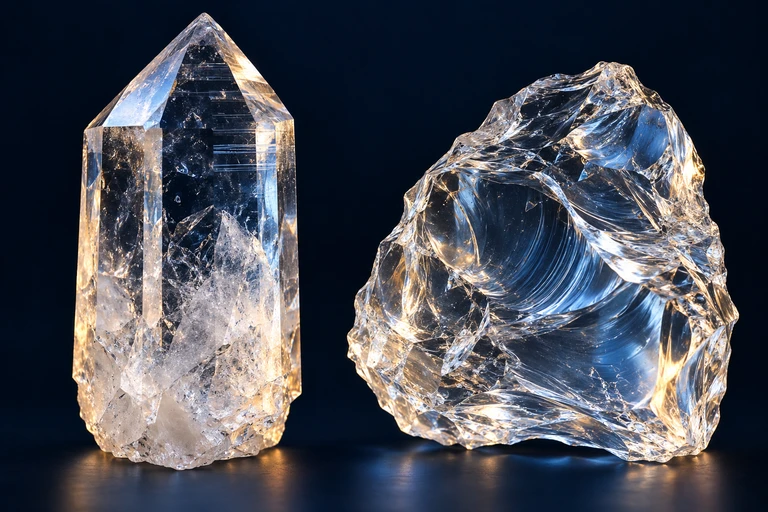 Quartz and silica glass share local SiO₄ coordination but differ in long-range order. Glass retains a connected nonperiodic network, produces broad scattering and softens through a glass-transition interval.
Same local coordination, different order
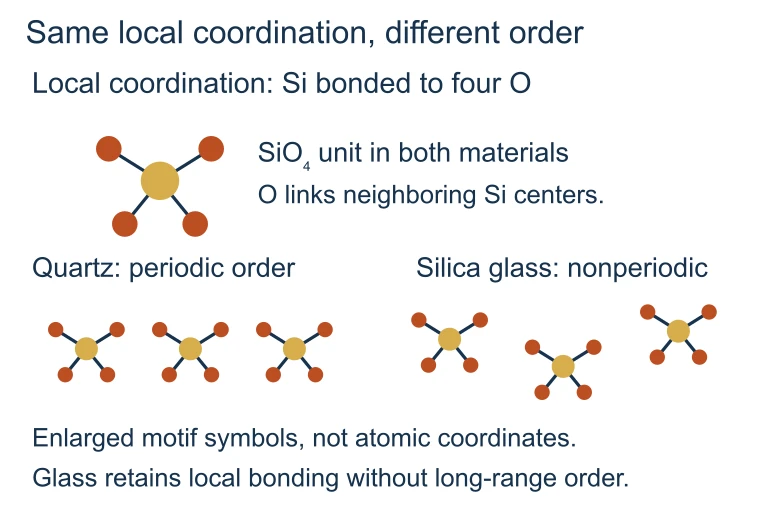 Quartz and silica glass share local SiO₄ coordination but differ in long-range order. Glass retains a connected nonperiodic network, produces broad scattering and softens through a glass-transition interval.
Order changes the scattering pattern
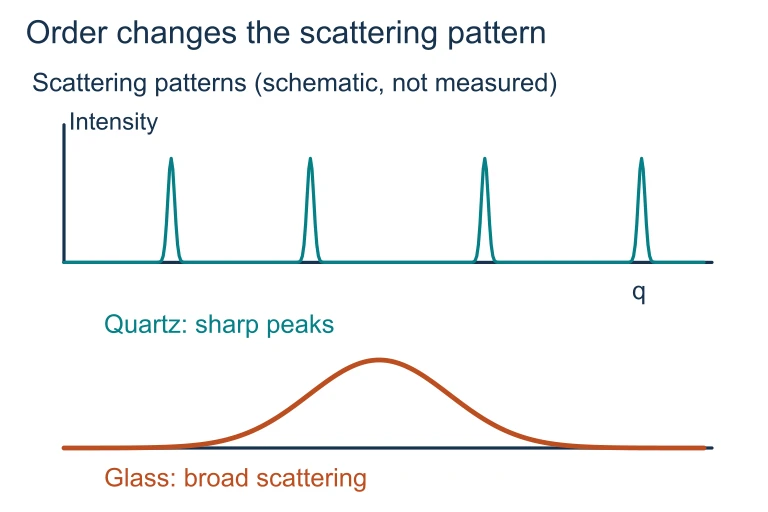 Periodic order in quartz produces sharp scattering peaks; the absence of long-range periodic order in silica glass produces broad scattering.
Melting differs from glass transition
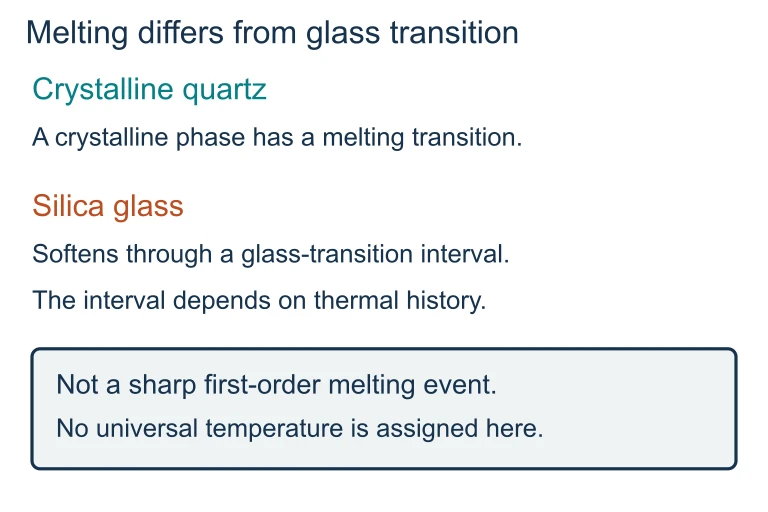 A crystalline solid has a melting transition, while glass softens through a glass-transition interval that depends on thermal history.
The Unit Cell: Building Block of Crystals
Four Types of Crystalline Solids
Conductivity probe in saltwater
 Dissolved ions carry charge through saltwater between immersed electrodes.
Ionic Solids and Lattice Energy
Cleavage in a salt crystal
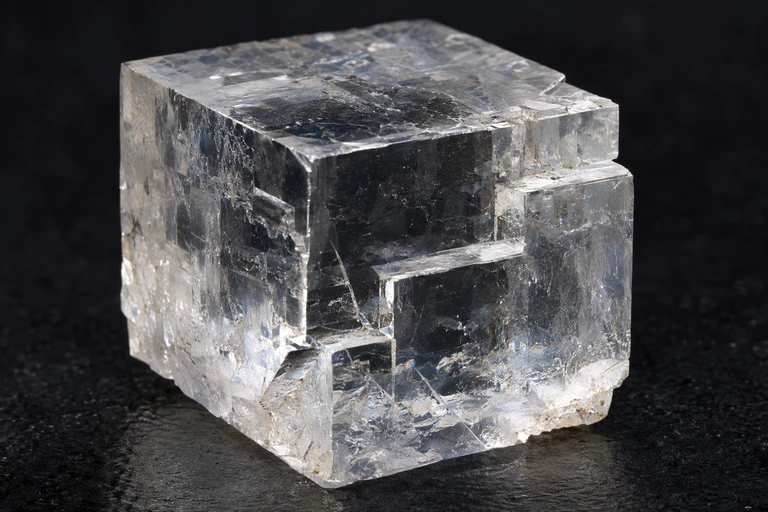 An ionic crystal can cleave when displacement brings like charges into neighboring positions.
Coulomb's Law and Lattice Strength
Molecular Solids: The Role of IMFs
In molecular solids, discrete molecules are held in place by intermolecular forces, not ionic or covalent bonds. The type and strength of IMF determines the solid's properties.
Metallic vs. Covalent Network
| Metallic | Covalent Network | |
|---|---|---|
| Particles | Metal cations + \(e^-\) sea | Atoms linked by covalent bonds |
| Melting Point | Variable (Hg low, W very high) | Very high (diamond: \(3550\,{}^{\circ}\text{C}\)) |
| Hardness | Variable: soft (Na) to hard (Cr) | Extremely hard |
| Conductivity | Excellent (delocalized \(e^-\)) | Usually insulator (exception: graphite) |
| Malleability | Malleable and ductile | Brittle |
| Examples | Fe, Cu, Au, Na | Diamond, SiC, quartz (\(\text{SiO}_2\)) |
A copper crystal surface
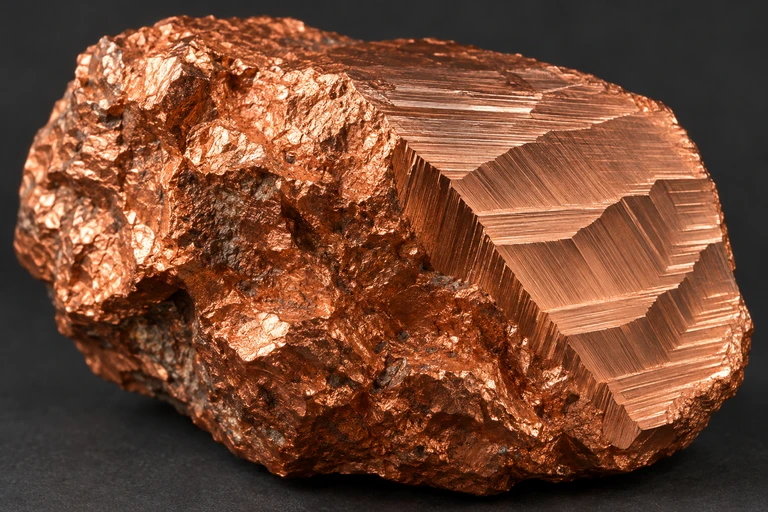 Copper is a metallic solid whose atoms form an ordered crystal structure.
Bond Type vs. Intermolecular Force
When a molecular solid melts, intermolecular forces are overcome, not the covalent bonds within molecules. This is a critical distinction:
How to Identify a Solid's Type
Example 1: Classify \(\text{NaCl}\)
Example 2: Why Does \(\text{MgO}\) Melt Higher Than \(\text{NaCl}\)?
Both are ionic solids with the same crystal structure (rock salt). Apply Coulomb's law:
Example 3: Diamond vs. Graphite
Diamond's three-dimensional carbon network
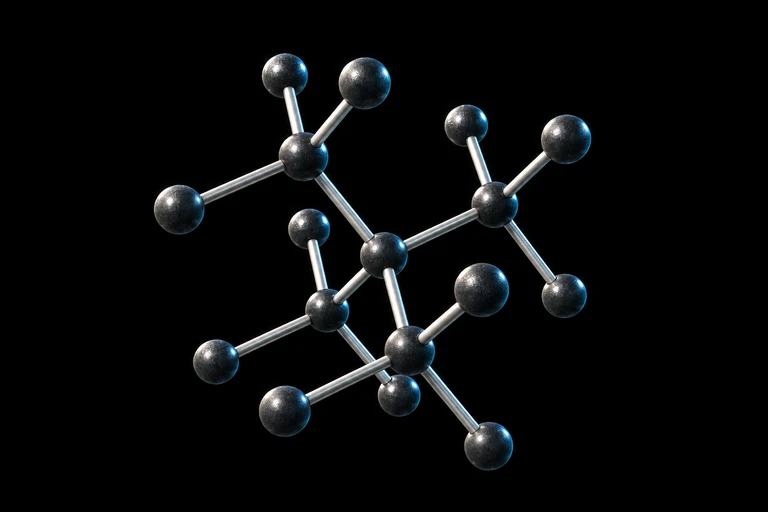 In diamond, carbon atoms form a three-dimensional network of tetrahedral covalent bonds.
Common Mistakes with Solids
Summary: Solid Types at a Glance
| Property | Ionic | Molecular | Metallic | Network |
|---|---|---|---|---|
| Particles | Ions | Molecules | Cations + \(e^-\) | Atoms (covalent) |
| Forces | Coulombic | IMFs | Metallic bond | Covalent bonds |
| Melting Pt | High | Low | Variable | Very high |
| Hardness | Hard, brittle | Soft | Variable | Very hard |
| Conducts? | Molten/dissolved | No | Yes (solid) | Usually no |
Question 1 of 5
Which type of solid is hard, has a very high melting point, and does not conduct electricity?
Question 2 of 5
Which compound would you expect to have the highest lattice energy?
Question 3 of 5
When ice melts at \(0\,{}^{\circ}\text{C}\), which forces are being overcome?
Question 4 of 5
A solid is malleable, conducts electricity, and has a moderately high melting point. It is most likely a:
Question 5 of 5
Graphite conducts electricity but diamond does not. Which best explains this difference?