Properties of
Photons
Explore the dual nature of light, the energy and momentum of photons, and how \( E = h\nu \) connects frequency to energy at the quantum scale.
What Is a Photon?
A photon is the smallest discrete unit (quantum) of electromagnetic radiation. It has no mass and always travels at the speed of light, \( c = 3.00 \times 10^8 \) m/s, in a vacuum.
The Electromagnetic Spectrum
Why Photons Matter in Chemistry
Photons are the messengers of atomic structure. When electrons transition between energy levels, they absorb or emit photons of specific energies, producing line spectra unique to each element.
The Planck-Einstein Relation
\( c = \lambda\nu \) : Connecting Wavelength and Frequency
Wavelength vs Frequency vs Energy
| Property | Wavelength (\(\lambda\)) | Frequency (\(\nu\)) | Energy (\(E\)) |
|---|---|---|---|
| Units | m (or nm) | Hz (s\(^{-1}\)) | J (or eV) |
| Relationship | \(\lambda = c / \nu\) | \(\nu = c / \lambda\) | \(E = h\nu\) |
| As \(\nu\) increases | Decreases | Increases | Increases |
| Gamma ray | < 0.01 nm | > \(10^{19}\) Hz | Very high |
| Radio wave | > 1 m | < \(10^{9}\) Hz | Very low |
Photon Momentum
Even though photons are massless, they carry momentum. This is derived from Einstein's relativity and is given by:
How to Solve Photon Problems
Example 1: Energy from Wavelength
Problem: A photon of yellow light has a wavelength of 589 nm. What is its energy?
Example 2: Frequency from Energy
Problem: A photon has energy \( E = 4.0 \times 10^{-19} \) J. What is its frequency?
Example 3: Total Energy of Multiple Photons
Problem: A laser emits light at \(\lambda = 450\) nm. How much energy is carried by \(2.50 \times 10^{18}\) photons?
The Photoelectric Effect
Energy Level Transitions
Hydrogen discharge tube and spectrometer
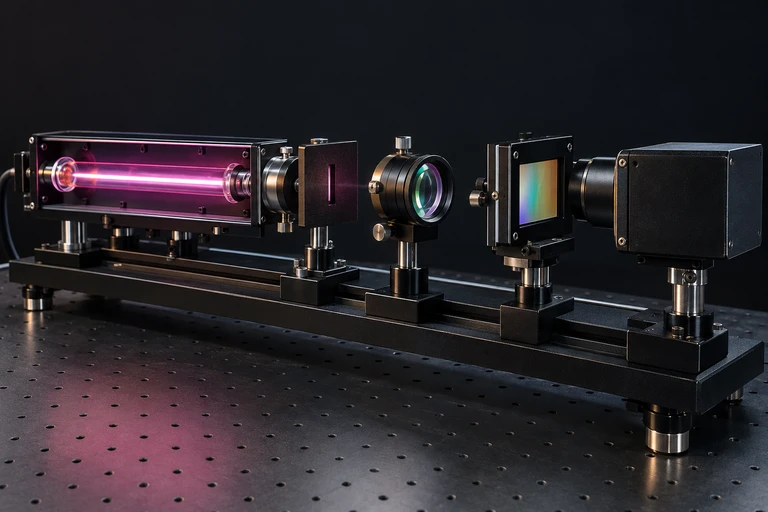 Light from a hydrogen discharge tube enters a spectrometer, where its component wavelengths can be separated.
Common Mistakes
Key Equations Summary
| Equation | Formula | Use When |
|---|---|---|
| Planck-Einstein | \( E = h\nu \) | Frequency is given |
| Combined form | \( E = hc / \lambda \) | Wavelength is given |
| Speed of light | \( c = \lambda\nu \) | Converting between \(\lambda\) and \(\nu\) |
| Photon momentum | \( p = h / \lambda \) | Momentum or de Broglie problems |
| Photoelectric | \( KE = h\nu - \Phi \) | Electron ejection from metal |
| Energy transition | \( \Delta E = h\nu \) | Electron jumps between levels |
Question 1 of 5
What is the energy of a photon with a frequency of \( 5.0 \times 10^{14} \) Hz?
Question 2 of 5
A photon has a wavelength of 250 nm. What is its frequency?
Question 3 of 5
Which change will increase the energy of an individual photon?
Question 4 of 5
The work function of sodium is \( \Phi = 3.65 \times 10^{-19} \) J. A photon with energy \( 5.00 \times 10^{-19} \) J strikes the surface. What is the kinetic energy of the ejected electron?
Question 5 of 5
An electron in a hydrogen atom drops from \( n = 3 \) to \( n = 1 \), emitting a photon. Which statement is true?