Properties of
Buffers
Discover how weak acid-conjugate base pairs resist changes in pH, master the Henderson-Hasselbalch equation, and learn to design effective buffer systems.
What Is a Buffer?
A buffer is an aqueous solution that resists significant changes in \(\text{pH}\) when small amounts of strong acid or strong base are added. Buffers are essential in biological systems, industrial processes, and laboratory chemistry.
How Buffers Work
Why Buffers Matter
Buffers are not just a classroom concept: they are critical to life and to technology. Without buffers, small metabolic changes would cause lethal \(\text{pH}\) shifts in your blood.
The Henderson-Hasselbalch Equation
Visualizing Buffer pH
Buffer Capacity
Buffer capacity is the amount of strong acid or base a buffer can neutralize before the \(\text{pH}\) changes significantly. It depends on two factors:
Two buffers look alike until the challenge
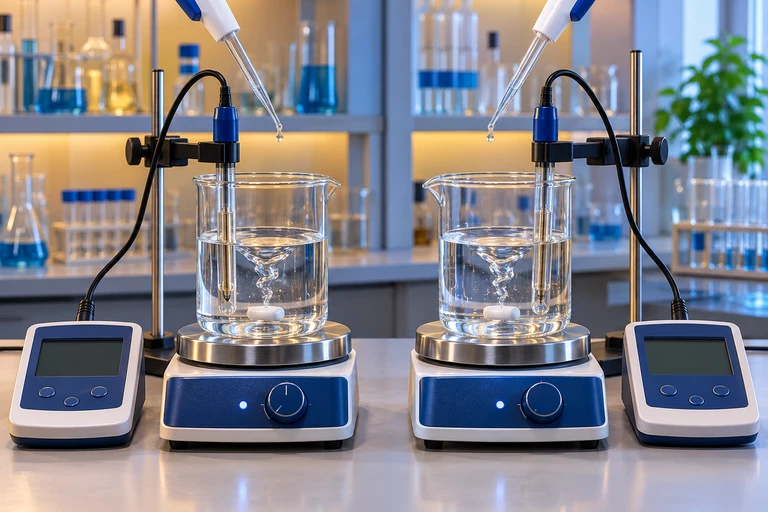 Compare two 100 mL acetic-acid buffers with pKa = 4.76 and a tenfold difference in total concentration. Adding 0.50 mmol HCl changes their pH from about 4.76 to 4.72 and 4.29, respectively, when the added volume is negligible.
Equal pH is not equal reserve
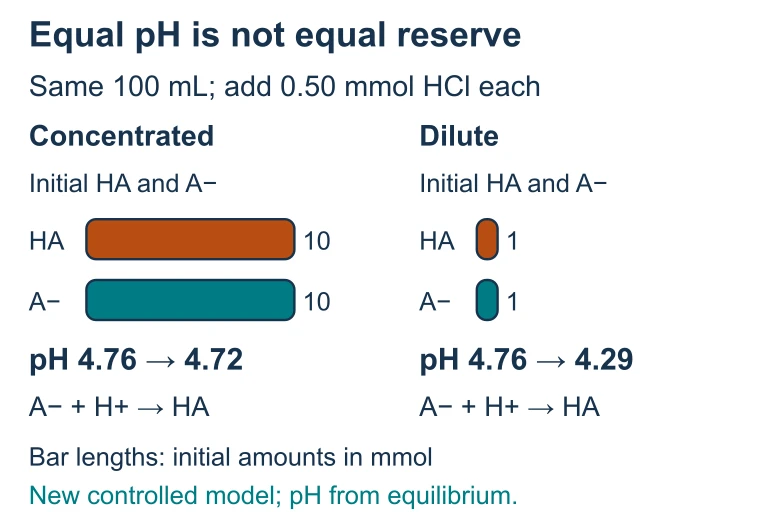 Compare two 100 mL acetic-acid buffers with pKa = 4.76 and a tenfold difference in total concentration. Adding 0.50 mmol HCl changes their pH from about 4.76 to 4.72 and 4.29, respectively, when the added volume is negligible.
Buffers vs. Non-Buffered Solutions
| Buffer Solution | Pure Water / Non-Buffered | |
|---|---|---|
| Composition | Weak acid + conjugate base | Water or strong acid/base only |
| Add 0.01 mol HCl | \(\text{pH}\) changes < 0.1 | \(\text{pH}\) drops to ~2 |
| Add 0.01 mol NaOH | \(\text{pH}\) changes < 0.1 | \(\text{pH}\) rises to ~12 |
| Equilibrium | Dynamic: \(\text{HA} \rightleftharpoons \text{H}^+ + \text{A}^-\) | No reservoir of weak acid/base |
| Effective Range | \(\text{p}K_a \pm 1\) | No stable range |
Solving Buffer Problems
Example 1: Finding Buffer pH
A buffer contains 0.25 M acetic acid (\(\text{CH}_3\text{COOH}\)) and 0.35 M sodium acetate (\(\text{CH}_3\text{COONa}\)). The \(K_a\) of acetic acid is \(1.8 \times 10^{-5}\). Find the \(\text{pH}\).
Example 2: Adding Strong Acid
To the buffer from Example 1 (500 mL total), we add 0.01 mol \(\text{HCl}\). What is the new \(\text{pH}\)?
Example 3: Designing a Buffer
Design a buffer with \(\text{pH} = 9.25\). You have \(\text{NH}_3\) (\(K_b = 1.8 \times 10^{-5}\)) and \(\text{NH}_4\text{Cl}\).
Common Mistakes
Buffer Summary
| Property | Details |
|---|---|
| Composition | Weak acid + conjugate base (or weak base + conjugate acid) |
| Key Equation | \(\text{pH} = \text{p}K_a + \log\!\left(\frac{[\text{A}^-]}{[\text{HA}]}\right)\) |
| Effective Range | \(\text{p}K_a \pm 1\) |
| Max Capacity At | \([\text{A}^-] = [\text{HA}]\) (ratio = 1:1) |
| Increasing Capacity | Increase total concentrations of both components |
| Buffer Broken When | All \(\text{HA}\) or all \(\text{A}^-\) consumed by added acid/base |
Key Concepts Review
Question 1 of 5
Which of the following mixtures would form an effective buffer at \(\text{pH}\) 4.5?
Question 2 of 5
A buffer contains 0.40 M \(\text{HF}\) and 0.40 M \(\text{NaF}\). The \(\text{p}K_a\) of HF is 3.17. What is the \(\text{pH}\) of this buffer?
Question 3 of 5
If 0.02 mol of \(\text{NaOH}\) is added to a buffer containing 0.10 mol \(\text{HA}\) and 0.10 mol \(\text{A}^-\) what are the new moles of each component?
Question 4 of 5
Which change would increase the buffer capacity of an acetic acid/acetate buffer without significantly changing its \(\text{pH}\)?
Question 5 of 5
At the half-equivalence point of a weak acid titration, which statement is true?