Physical & Chemical
Changes
Learn to distinguish between changes that alter appearance and those that create entirely new substances at the molecular level.
What Is a Physical Change?
A physical change alters the form or appearance of matter without changing its chemical composition. The molecules remain the same: only their arrangement, energy, or state changes.
What Is a Chemical Change?
A chemical change (chemical reaction) produces one or more new substances with different chemical properties. Bonds break and new bonds form, resulting in products whose formulas differ from the reactants.
Zinc reacting in an acidic solution
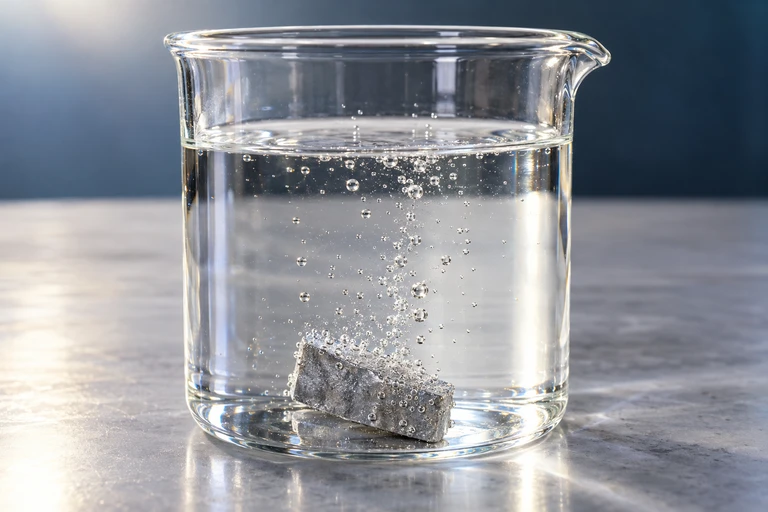 Zinc reacts with acid, forming dissolved zinc ions and hydrogen gas.
Why Does This Matter?
Distinguishing physical from chemical changes is foundational to chemistry. It determines how we purify mixtures, design industrial processes, and predict energy changes.
The Core Principle
Evidence of a Chemical Change
Several observable clues suggest a chemical reaction has occurred. However, none of these alone is proof: always check whether a new substance has formed.
Physical vs. Chemical: Side by Side
| Physical Change | Chemical Change | |
|---|---|---|
| Composition | Same substance | New substance(s) |
| Reversibility | Usually easily reversed | Generally irreversible |
| Energy | Small \(\Delta H\) (phase changes) | Often large \(\Delta H\) |
| Bonds | Intermolecular forces change | Covalent/ionic bonds break and form |
| Example | Boiling water | Burning wood |
How to Classify a Change
Example 1: Dissolving Sugar
You stir a spoonful of table sugar (\(\text{C}_{12}\text{H}_{22}\text{O}_{11}\)) into warm water. The sugar disappears. Is this a physical or chemical change?
Example 2: Baking Soda + Vinegar
Mixing baking soda (\(\text{NaHCO}_3\)) with vinegar (\(\text{CH}_3\text{COOH}\)) produces vigorous bubbling. Physical or chemical?
Example 3: Phase Diagram of Water
Water transitions among solid, liquid, and gas phases. Every transition is a physical change because the molecular formula remains \(\text{H}_2\text{O}\).
Energy: \(\Delta H\) in Both Types
Both physical and chemical changes involve energy. The distinction is what changes: intermolecular forces vs. chemical bonds.
Conservation of Mass
In both physical and chemical changes, total mass is conserved. For chemical changes, this is expressed through balanced equations.
A vented crucible after carbonate heating
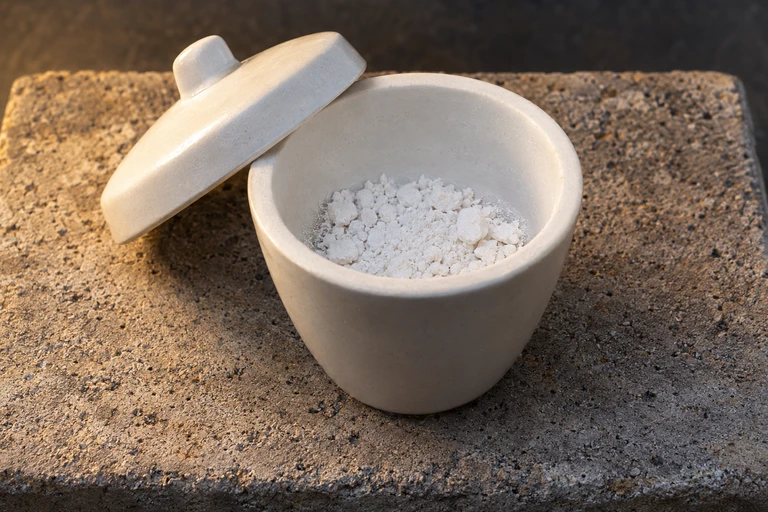 A heated carbonate can release carbon dioxide through an open crucible, decreasing the mass left in the vessel.
Tricky Cases
Some processes look like one type of change but are actually the other. Always return to the core question: did a new substance form?
Common Mistakes
Dye dissolving without a new reaction product
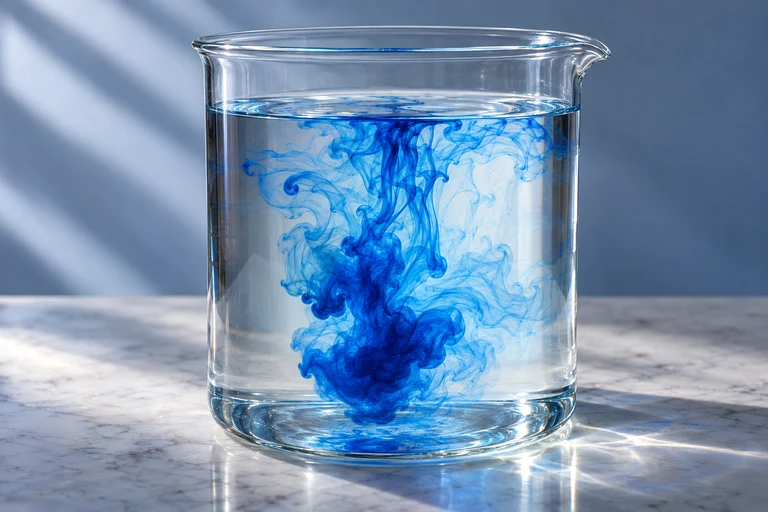 A dye can disperse through water and change its color without forming a new reaction product.
Summary Comparison
| Feature | Physical | Chemical |
|---|---|---|
| New substance? | No | Yes |
| Bonds broken? | Intermolecular only | Intramolecular (covalent/ionic) |
| Reversibility | Usually easy | Usually difficult |
| \(\Delta H\) magnitude | Smaller (\(\text{kJ/mol}\)) | Larger (\(\text{kJ/mol}\)) |
| Mass conserved? | Yes | Yes |
| Examples | Melting, dissolving, cutting | Rusting, combustion, cooking |
Question 1 of 5
Which of the following is a chemical change?
Question 2 of 5
A student observes bubbles forming when a substance is added to water. Which conclusion is most accurate?
Question 3 of 5
In the reaction \(2\text{H}_2\text{O} \rightarrow 2\text{H}_2 + \text{O}_2\), what type of change occurs and what bonds are broken?
Question 4 of 5
If \(50.0 \text{ g}\) of calcium carbonate decomposes according to \(\text{CaCO}_3 \rightarrow \text{CaO} + \text{CO}_2\), what is the total mass of products?
Question 5 of 5
Which of the following is not evidence of a chemical change?