pH and
Solubility
Explore how hydrogen ion concentration shifts equilibrium and controls whether ionic compounds dissolve or precipitate in aqueous solutions.
What Is Solubility?
Solubility is the maximum amount of solute that dissolves in a given volume of solvent at a specific temperature to form a saturated solution. For sparingly soluble ionic compounds, we express this using the solubility product constant, \( K_{sp} \).
Reviewing pH
The pH scale measures the hydrogen ion concentration in solution. It is defined as:
Why Does pH Affect Solubility?
When a sparingly soluble salt contains the conjugate base of a weak acid, adding \( \text{H}^+ \) ions removes that base from solution via reaction. By Le Chatelier's principle, the equilibrium shifts to dissolve more solid.
The Core Principle
Writing the \( K_{sp} \) Expression
For a generic salt \( M_aX_b \) that dissolves as:
Affected vs. Unaffected by pH
| More soluble at low pH | Not affected by pH | |
|---|---|---|
| Anion type | Conjugate base of weak acid | Conjugate base of strong acid |
| Examples | \( \text{F}^- \), \( \text{CO}_3^{2-} \), \( \text{S}^{2-} \), \( \text{OH}^- \) | \( \text{Cl}^- \), \( \text{Br}^- \), \( \text{NO}_3^- \) |
| Why? | \( \text{H}^+ \) protonates the anion | \( \text{H}^+ \) does not react |
| Salt example | \( \text{CaF}_2 \), \( \text{CaCO}_3 \) | \( \text{AgCl} \), \( \text{AgBr} \) |
Metal Hydroxides and pH
Metal hydroxides like \( \text{Fe(OH)}_3 \) are a special case. The hydroxide ion \( \text{OH}^- \) is directly neutralized by \( \text{H}^+ \):
One precipitate, two routes back to solution
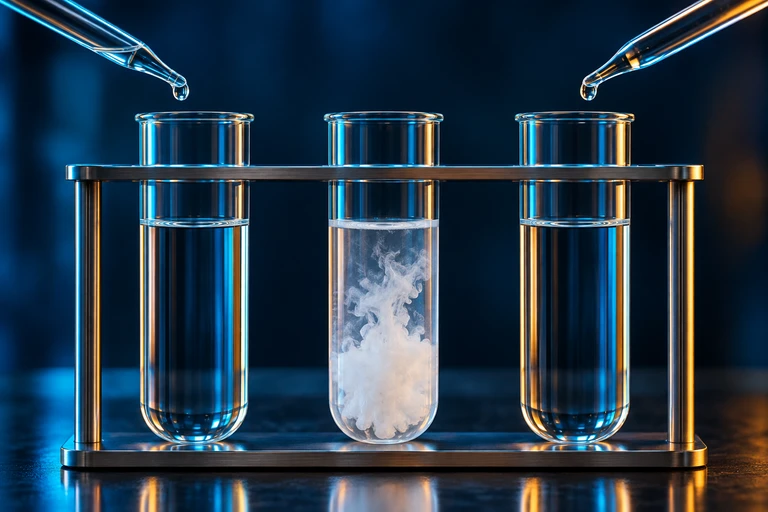 Aluminum hydroxide is amphoteric: acid dissolves it by forming water and hydrated dissolved aluminum, while excess strong base forms soluble Al(OH)₄⁻.
One solid, two dissolution routes
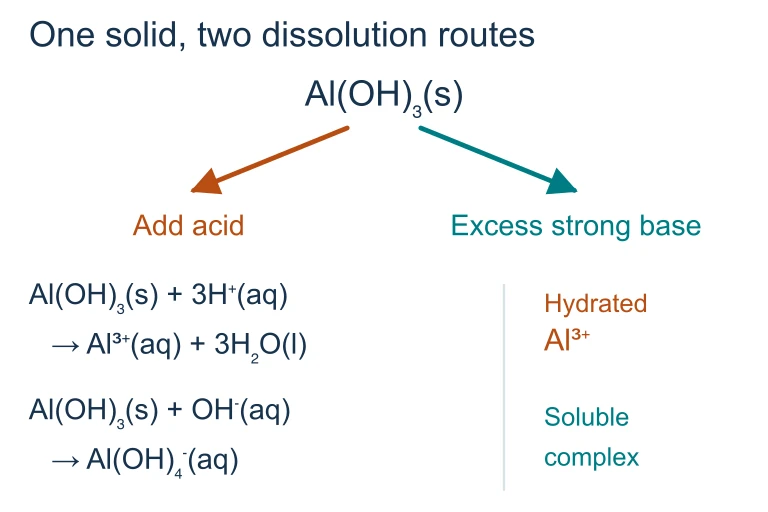 Aluminum hydroxide is amphoteric: acid dissolves it by forming water and hydrated dissolved aluminum, while excess strong base forms soluble Al(OH)₄⁻.
How to Analyze pH Effects
Example 1: \( \text{CaCO}_3 \) in Acid
Question: Is calcium carbonate more soluble in acidic solution or pure water?
Example 2: \( \text{AgCl} \) in Acid
Question: Is silver chloride more soluble in acidic solution or pure water?
Example 3: Molar Solubility of \( \text{CaF}_2 \)
Given: \( K_{sp}(\text{CaF}_2) = 3.9 \times 10^{-11} \). Find the molar solubility in pure water.
Fluorite at a solution interface
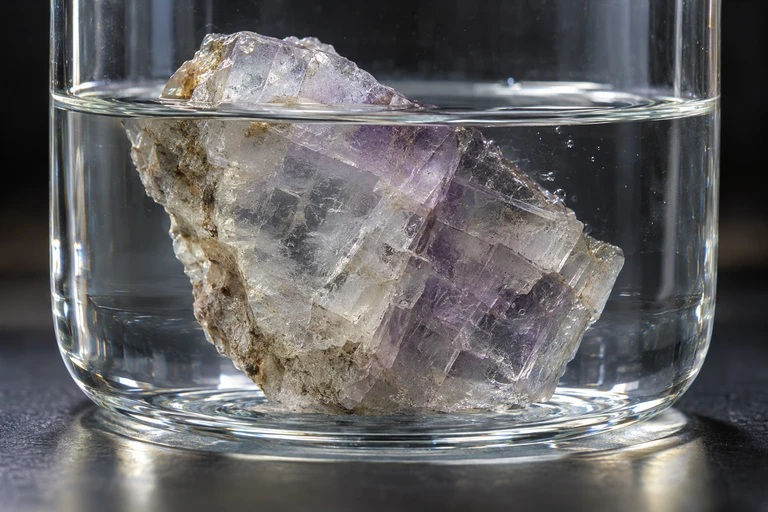 Fluorite, calcium fluoride, contacts a solution in which dissolved fluoride can participate in acid–base equilibria.
Solubility vs. pH Graph
Connection to the Common Ion Effect
The pH effect on solubility is related to, but distinct from, the common ion effect. Both involve Le Chatelier's principle, but the mechanism differs:
Common Mistakes
Summary Table
| Salt | Anion | Conjugate Acid | pH Effect? |
|---|---|---|---|
| \( \text{CaCO}_3 \) | \( \text{CO}_3^{2-} \) | \( \text{HCO}_3^- \) (weak) | Yes |
| \( \text{CaF}_2 \) | \( \text{F}^- \) | HF (weak) | Yes |
| \( \text{Fe(OH)}_3 \) | \( \text{OH}^- \) | \( \text{H}_2\text{O} \) (weak) | Yes |
| \( \text{AgCl} \) | \( \text{Cl}^- \) | HCl (strong) | No |
| \( \text{BaSO}_4 \) | \( \text{SO}_4^{2-} \) | \( \text{HSO}_4^- \) (moderate) | Slight |
Question 1 of 5
Which of the following salts would be more soluble in a solution of \( \text{pH} = 2 \) than in pure water?
Question 2 of 5
When \( \text{HCl} \) is added to a saturated solution of \( \text{CaF}_2 \), what happens to the molar solubility and \( K_{sp} \)?
Question 3 of 5
Which principle best explains why lowering pH increases the solubility of \( \text{Mg(OH)}_2 \)?
Question 4 of 5
The molar solubility of \( \text{CaF}_2 \) in pure water is \( s \). The \( K_{sp} \) expression in terms of \( s \) is:
Question 5 of 5
A student claims that adding \( \text{HNO}_3 \) to a saturated \( \text{AgCl} \) solution will dissolve more \( \text{AgCl} \). Is the student correct?