01 / 20
\(e^-\)

Oxidation-Reduction
Redox Reactions

Master the electron transfer reactions that power batteries, corrosion, metabolism, and electrochemistry on the AP Chemistry exam.

AP Chemistry

What Are Redox Reactions?

Redox reactions are chemical reactions involving the transfer of electrons between species. Every redox reaction has two simultaneous half-processes: one species loses electrons (oxidation) while another gains electrons (reduction).

Oxidation
Loss of electrons. The oxidation state increases.
Reduction
Gain of electrons. The oxidation state decreases.

Assigning Oxidation States

Oxidation states (or oxidation numbers) are the bookkeeping tool for tracking electron transfer. They represent the hypothetical charge an atom would have if all bonds were purely ionic.

1
Free elements have an oxidation state of 0 (e.g., \(\text{Na}\), \(\text{O}_2\), \(\text{Fe}\)).
2
Monatomic ions equal their charge: \(\text{Na}^+ = +1\), \(\text{Cl}^- = -1\).
3
Oxygen is typically \(-2\) (except in peroxides: \(-1\)).
4
Hydrogen is \(+1\) with nonmetals, \(-1\) with metals (hydrides).
5
Sum rule: oxidation states in a neutral compound sum to 0; in a polyatomic ion, they sum to the ion charge.

Visualizing Electron Transfer

Consider the classic reaction of zinc metal with copper(II) sulfate. Zinc atoms lose electrons while copper ions gain them:

\(\text{Zn}\)
\(0\)
\(\text{Cu}^{2+}\)
\(+2\)
\(2 e^-\)
\(\text{Zn}^{2+}\)
\(+2\)
\(\text{Cu}\)
\(0\)
Oxidized Reduced

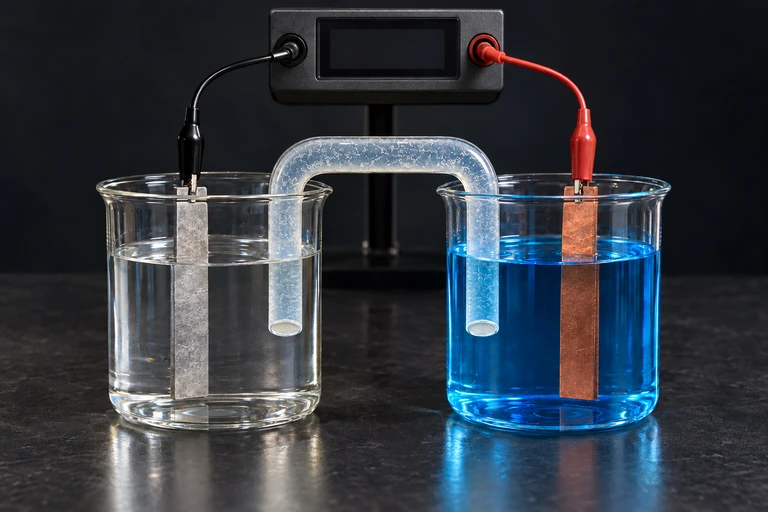
One connected zinc-copper cell

One connected zinc-copper cellA zinc–copper cell connects two half-cells through an external circuit and a salt bridge.

Copper deposited on a zinc strip
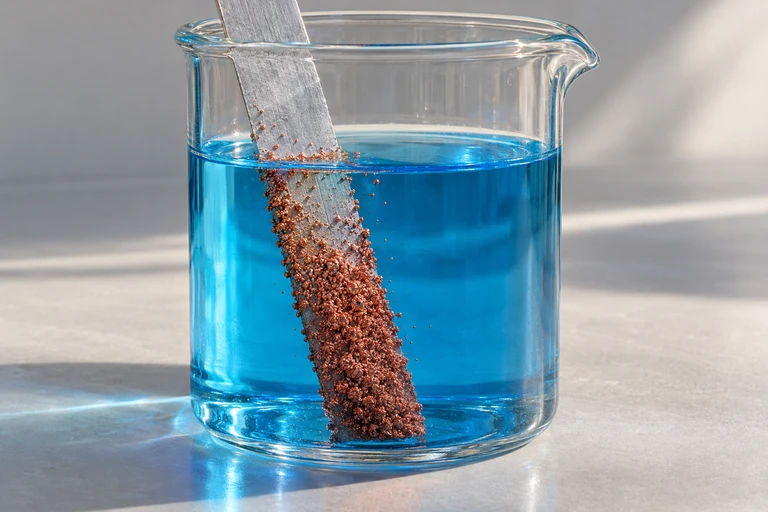
Copper deposited on a zinc stripZinc reduces dissolved copper ions, depositing copper metal on the zinc surface.

Oxidizing and Reducing Agents

The names of these agents are counterintuitive: each agent is named for what it causes in the other species, not what happens to itself.

Oxidizing Agent
Causes oxidation in another species. It gains electrons and is itself reduced.
Reducing Agent
Causes reduction in another species. It loses electrons and is itself oxidized.

The Half-Reaction Method

Every redox reaction can be split into two half-reactions: one showing oxidation and one showing reduction. This is the foundation for balancing redox equations.

Oxidation Half-Reaction
\(\text{Zn} \rightarrow \text{Zn}^{2+} + 2e^-\)
Reduction Half-Reaction
\(\text{Cu}^{2+} + 2e^- \rightarrow \text{Cu}\)
Overall Balanced Equation
\(\text{Zn} + \text{Cu}^{2+} \rightarrow \text{Zn}^{2+} + \text{Cu}\)

Oxidation vs. Reduction

Oxidation Reduction
Electron change Loses electrons Gains electrons
Oxidation state Increases Decreases
Acts as Reducing agent Oxidizing agent
Mnemonic LEO (Lose Electrons) GER (Gain Electrons)
At the anode/cathode Anode Cathode

Balancing in Acidic Solution

1
Assign oxidation states and identify which atoms are oxidized and reduced.
2
Write separate half-reactions for oxidation and reduction.
3
Balance atoms other than O and H in each half-reaction.
4
Balance oxygen by adding \(\text{H}_2\text{O}\) molecules.
5
Balance hydrogen by adding \(\text{H}^+\) ions.
6
Balance charge by adding electrons (\(e^-\)).
7
Equalize electrons between half-reactions and add them together. Cancel species appearing on both sides.

Balancing in Basic Solution

For basic solutions, follow all 7 steps for acidic solutions first, then add one extra step:

Acidic
Uses \(\text{H}^+\) and \(\text{H}_2\text{O}\) to balance O and H.
Basic
Converts \(\text{H}^+\) to \(\text{H}_2\text{O}\) and \(\text{OH}^-\) at the end.

Example 1: Iron and Oxygen

Identify the oxidation and reduction in the rusting reaction:

\(\text{Fe}\): Oxidized
Oxidation state: \(0 \rightarrow +3\). Each Fe atom loses 3 electrons.
\(\text{O}\): Reduced
Oxidation state: \(0 \rightarrow -2\). Each O atom gains 2 electrons.

Example 2: Balancing \(\text{MnO}_4^-\) in Acid

Balance in acidic solution: \(\text{MnO}_4^-(aq) + \text{Fe}^{2+}(aq) \rightarrow \text{Mn}^{2+}(aq) + \text{Fe}^{3+}(aq)\)

1
Reduction: \(\text{MnO}_4^- \rightarrow \text{Mn}^{2+}\). Mn goes from \(+7 \rightarrow +2\) (gains 5 e⁻).
2
Balance O: add 4 \(\text{H}_2\text{O}\) to the right. Balance H: add 8 \(\text{H}^+\) to the left.
3
Balance charge: \(\text{MnO}_4^- + 8\text{H}^+ + 5e^- \rightarrow \text{Mn}^{2+} + 4\text{H}_2\text{O}\)
4
Oxidation: \(\text{Fe}^{2+} \rightarrow \text{Fe}^{3+} + e^-\). Multiply by 5.
5
Add: \(\text{MnO}_4^- + 8\text{H}^+ + 5\text{Fe}^{2+} \rightarrow \text{Mn}^{2+} + 4\text{H}_2\text{O} + 5\text{Fe}^{3+}\)

Example 3: Balancing in Basic Solution

Balance: \(\text{Cr(OH)}_3(s) + \text{ClO}^-(aq) \rightarrow \text{CrO}_4^{2-}(aq) + \text{Cl}^-(aq)\) in basic solution.

1
Oxidation: \(\text{Cr(OH)}_3 \rightarrow \text{CrO}_4^{2-}\). Cr: \(+3 \rightarrow +6\), loses 3 e⁻.
2
Reduction: \(\text{ClO}^- \rightarrow \text{Cl}^-\). Cl: \(+1 \rightarrow -1\), gains 2 e⁻.
3
Equalize electrons: multiply oxidation by 2, reduction by 3 (LCM = 6).
4
Convert to basic: Replace \(\text{H}^+\) with \(\text{OH}^-\) and \(\text{H}_2\text{O}\). Cancel duplicates.

The Activity Series

The activity series ranks metals by their tendency to be oxidized. A metal higher in the series can displace one lower from its compound.

More Less Reactivity Li, K, Ba, Ca, Na React with cold water Mg, Al, Zn, Fe React with steam/acid Ni, Sn, Pb React with acid only
\(\text{H}_2\)
Reference line Cu, Ag, Pt, Au Do not react with acid Metals above H₂ can dissolve in acid Metals below H₂ are "noble": resist oxidation

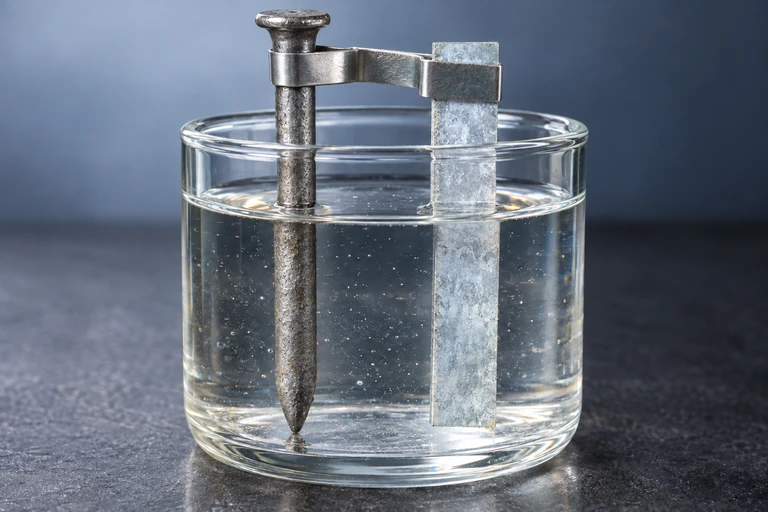
Zinc in electrical contact with iron

Zinc in electrical contact with ironElectrically connected zinc can oxidize preferentially and help protect iron from corrosion.

Types of Redox Reactions

Combination
\(A + B \rightarrow AB\). Two elements or compounds combine. Example: \(2\text{Mg} + \text{O}_2 \rightarrow 2\text{MgO}\)
Decomposition
\(AB \rightarrow A + B\). A compound breaks down. Example: \(2\text{H}_2\text{O} \rightarrow 2\text{H}_2 + \text{O}_2\)
Single Replacement
\(A + BC \rightarrow AC + B\). A more active element displaces a less active one. Example: \(\text{Zn} + \text{CuSO}_4 \rightarrow \text{ZnSO}_4 + \text{Cu}\)
Combustion
A substance reacts with \(\text{O}_2\), releasing heat and light. Example: \(\text{CH}_4 + 2\text{O}_2 \rightarrow \text{CO}_2 + 2\text{H}_2\text{O}\)

Common Mistakes

✕ Confusing Agent Names
The reducing agent is oxidized (not reduced). The oxidizing agent is reduced. Remember: the agent name describes what it does to others.
✕ Forgetting Electron Balance
Electrons lost must equal electrons gained. Always multiply half-reactions by the correct factor before adding.
✕ Wrong Oxidation State for O
Oxygen is \(-2\) in most compounds, but \(-1\) in peroxides like \(\text{H}_2\text{O}_2\) and \(+2\) in \(\text{OF}_2\). Always check.

Summary of Key Concepts

Concept Key Idea Example
Oxidation Loss of e⁻, state increases \(\text{Zn} \rightarrow \text{Zn}^{2+} + 2e^-\)
Reduction Gain of e⁻, state decreases \(\text{Cu}^{2+} + 2e^- \rightarrow \text{Cu}\)
Oxidizing Agent Gets reduced itself \(\text{O}_2\), \(\text{MnO}_4^-\), \(\text{Cr}_2\text{O}_7^{2-}\)
Reducing Agent Gets oxidized itself \(\text{Zn}\), \(\text{Fe}\), \(\text{C}\)
Activity Series Predicts spontaneity Higher metal displaces lower

Question 1 of 5

In the reaction \(2\text{Na}(s) + \text{Cl}_2(g) \rightarrow 2\text{NaCl}(s)\), which species is oxidized?

Question 2 of 5

What is the oxidation state of \(\text{Mn}\) in \(\text{MnO}_4^-\)?

Question 3 of 5

In the reaction \(\text{Zn}(s) + \text{Cu}^{2+}(aq) \rightarrow \text{Zn}^{2+}(aq) + \text{Cu}(s)\), what is the oxidizing agent?

Question 4 of 5

When balancing a redox reaction in acidic solution, what species is used to balance hydrogen atoms?

Question 5 of 5

According to the activity series, which of the following metals can displace hydrogen from an acid?