Net Ionic
Equations
Learn to identify spectator ions, write complete ionic equations, and reduce them to reveal the essential chemistry of aqueous reactions.
What Are Ionic Equations?
When ionic compounds dissolve in water, they dissociate into ions. A molecular equation shows the full formulas, but it hides the fact that many species exist as separate ions in solution.
Electrolytes and Dissociation
Only strong electrolytes are written in dissociated (ionic) form. Weak electrolytes, molecular compounds, gases, and solids stay as complete formulas.
Meet the Spectator Ions
Spectator ions appear on both sides of the complete ionic equation in identical form. They do not participate in the reaction: they are merely "watching."
White silver chloride in its remaining solution
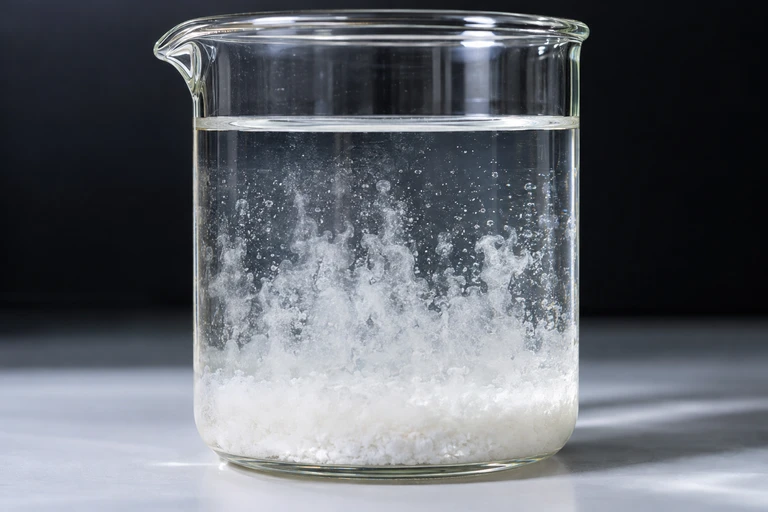 Silver chloride precipitates while dissolved spectator ions remain in the surrounding solution.
From Molecular to Net Ionic
Molecular vs. Complete Ionic vs. Net Ionic
| Molecular | Complete Ionic | Net Ionic | |
|---|---|---|---|
| Formulas shown | Full compounds | All ions + undissociated species | Only reacting species |
| Spectator ions | Hidden inside formulas | Present on both sides | Removed |
| Best reveals | Stoichiometry of compounds | What is actually in solution | The essential chemistry |
| When to use | Balancing, stoichiometry | Identifying spectators | Predicting reactions, AP exam |
Essential Solubility Rules
To write net ionic equations for precipitation reactions, you must know which products are insoluble (s) and which stay dissolved (aq).
How to Write Net Ionic Equations
Copper deposited on a zinc strip
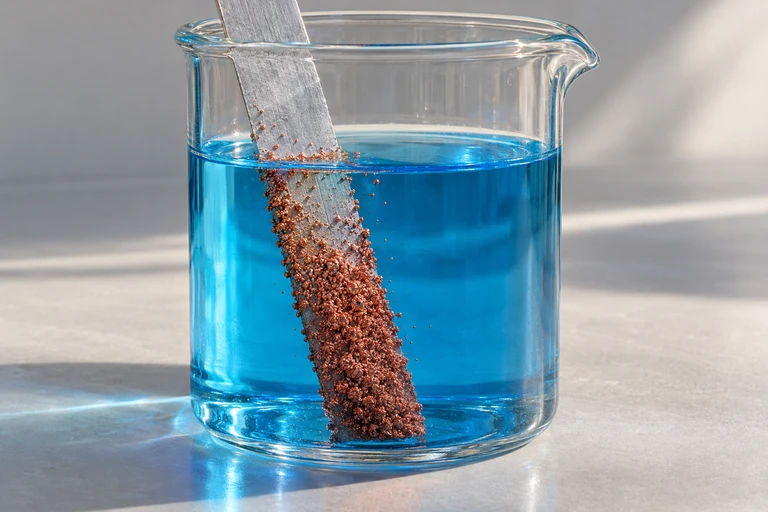 Zinc reduces dissolved copper ions, depositing copper metal on the zinc surface.
Example 1: Precipitation Reaction
Example 2: Acid-Base Neutralization
Example 3: Weak Acid Neutralization
Three Driving Forces
Net ionic equations exist because something is removed from solution. There are three driving forces that cause aqueous reactions to proceed:
Checking Charge Balance
A correct net ionic equation must be balanced in both atoms and charge. The total charge on the left must equal the total charge on the right.
Atoms: 1 Pb, 2 I
Atoms: 1 Pb, 2 I
Gas-Forming Net Ionic Equations
Common Mistakes
Summary: What to Dissociate
| Species Type | Dissociate? | Examples |
|---|---|---|
| Strong acid (aq) | Yes | \(\text{HCl, HNO}_3, \text{H}_2\text{SO}_4\) |
| Strong base (aq) | Yes | \(\text{NaOH, KOH, Ba(OH)}_2\) |
| Soluble salt (aq) | Yes | \(\text{NaCl, KNO}_3\) |
| Weak acid (aq) | No | \(\text{CH}_3\text{COOH, HF}\) |
| Weak base (aq) | No | \(\text{NH}_3, \text{CH}_3\text{NH}_2\) |
| Insoluble solid (s) | No | \(\text{AgCl, PbI}_2, \text{BaSO}_4\) |
| Pure liquid (l) | No | \(\text{H}_2\text{O}\) |
| Gas (g) | No | \(\text{CO}_2, \text{SO}_2\) |
Question 1 of 5
What is the net ionic equation for the reaction between \(\text{BaCl}_2\text{(aq)}\) and \(\text{Na}_2\text{SO}_4\text{(aq)}\)?
Question 2 of 5
Which species should not be dissociated when writing a complete ionic equation?
Question 3 of 5
The net ionic equation for every strong acid + strong base neutralization in water is:
Question 4 of 5
What is the net ionic equation for \(\text{Na}_2\text{CO}_3\text{(aq)} + 2\,\text{HCl(aq)}\)?
Question 5 of 5
When acetic acid \(\text{CH}_3\text{COOH(aq)}\) reacts with \(\text{KOH(aq)}\), which of the following correctly represents the net ionic equation?