Moles &
Molar Mass
Master the chemist's counting unit: connect atoms, grams, and \( 6.022 \times 10^{23} \) particles with confidence.
What Is a Mole?
A mole (symbol: mol) is the SI unit for the amount of substance. Just as a "dozen" means 12, a mole means a very specific, incredibly large number of particles.
Why such a huge number? Atoms are unimaginably small. The mole bridges the gap between the atomic scale and quantities you can weigh on a lab balance.
Avogadro's Number: How Big?
Why Do Moles Matter?
Defining Molar Mass
The molar mass of a substance is the mass (in grams) of one mole of that substance. Its units are \( \text{g/mol} \).
For compounds, add up the molar masses of every atom in the formula. Water, \( \text{H}_2\text{O} \):
A crystalline salt sample as a counting context
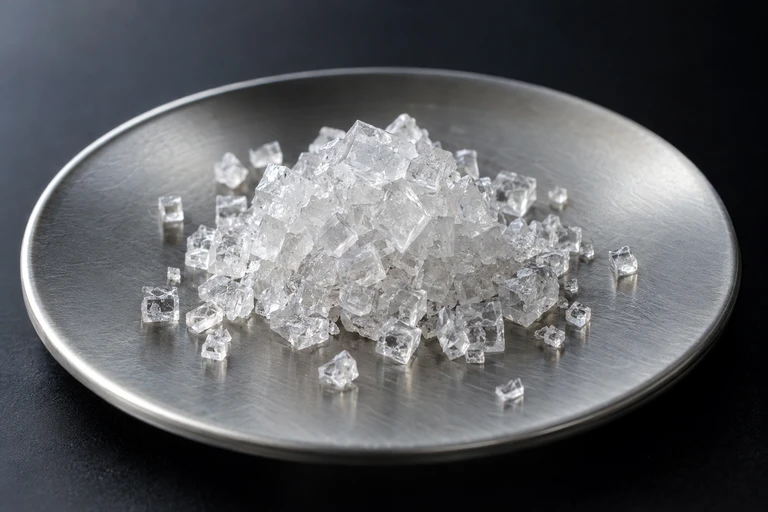 A crystalline salt sample contains formula units whose amount can be related to mass through molar mass.
The Core Mole Equation
Moles to Particles
Atomic Mass vs Molar Mass
| Atomic Mass | Molar Mass | |
|---|---|---|
| Unit | \( \text{amu} \) (atomic mass units) | \( \text{g/mol} \) |
| Scale | 1 atom or molecule | 1 mole (\( 6.022 \times 10^{23} \)) |
| Numerical Value | Same number, different units | |
| Example: Carbon | \( 12.01 \, \text{amu} \) | \( 12.01 \, \text{g/mol} \) |
| Found On | Periodic table | Periodic table (same value) |
Step-by-Step Conversion
Example 1: Grams to Moles
Problem: How many moles are in 36.04 g of water (\( \text{H}_2\text{O} \))?
Example 2: Moles to Molecules
Problem: How many molecules are in 0.500 mol of \( \text{CO}_2 \)?
Example 3: Grams to Atoms
Problem: How many atoms are in 27.0 g of aluminum (\(\text{Al}\))?
Calculating Compound Molar Mass
Problem: Find the molar mass of glucose, \( \text{C}_6\text{H}_{12}\text{O}_6 \).
The Complete Mole Map
One volumetric flask at final dilution
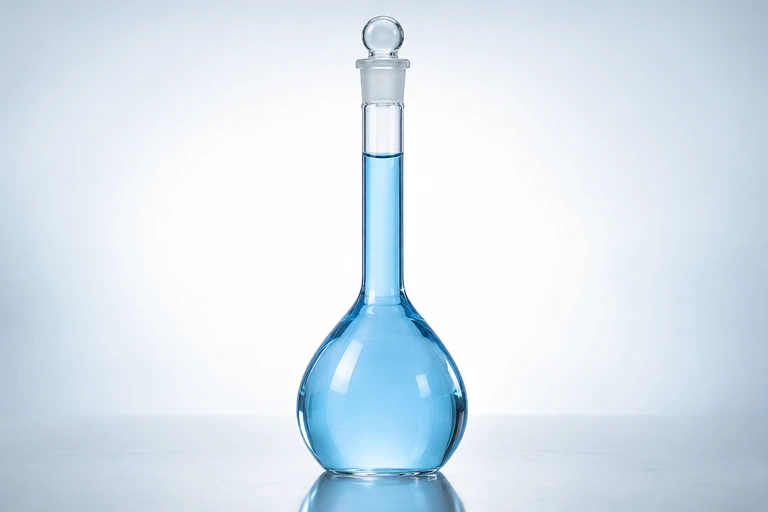 A volumetric flask is filled to its calibration mark to establish the final solution volume.
Common Mistakes
Quick Reference Summary
| Conversion | Formula | Key Value |
|---|---|---|
| Grams → Moles | \( n = \dfrac{m}{M} \) | \( M \) from periodic table |
| Moles → Grams | \( m = n \times M \) | \( M \) in g/mol |
| Moles → Particles | \( N = n \times N_A \) | \( 6.022 \times 10^{23} \) |
| Particles → Moles | \( n = \dfrac{N}{N_A} \) | \( 6.022 \times 10^{23} \) |
| Moles → Volume (gas, STP) | \( V = n \times 22.4 \) | \( 22.4 \, \text{L/mol} \) at STP |
Question 1 of 5
What is the molar mass of \( \text{NaCl} \)?
(\( \text{Na} = 22.99 \, \text{g/mol} \), \( \text{Cl} = 35.45 \, \text{g/mol} \))
Question 2 of 5
How many moles are in 88.0 g of \( \text{CO}_2 \)?
(\( \text{C} = 12.01 \), \( \text{O} = 16.00 \))
Question 3 of 5
How many molecules are in 2.50 mol of \( \text{H}_2\text{O} \)?
Question 4 of 5
A sample contains \( 3.011 \times 10^{23} \) atoms of iron (\(\text{Fe}\)). What is the mass of this sample?
(\( \text{Fe} = 55.85 \, \text{g/mol} \))
Question 5 of 5
How many oxygen atoms are in 1 mole of \( \text{Ca(NO}_3\text{)}_2 \)?