Kinetic Molecular
Theory
Understand how gas particles move, collide, and transfer energy: the microscopic foundation of pressure, temperature, and the ideal gas law.
What Is Kinetic Molecular Theory?
Kinetic Molecular Theory (KMT) is a model that describes the behavior of gas particles at the molecular level. It explains macroscopic properties like pressure, temperature, and volume by analyzing the motion and energy of individual molecules.
The Five Postulates of KMT
Visualizing Gas Particle Motion
The Core Equation: \( KE_{avg} \) and \( T \)
The average kinetic energy of gas particles is directly proportional to the absolute temperature:
Root-Mean-Square Speed
Since \( KE_{avg} = \frac{1}{2}m v_{rms}^2 \), we can derive the rms speed of a gas:
Maxwell-Boltzmann Distribution
How KMT Explains Pressure
Pressure is the result of gas particles colliding with the walls of their container. KMT provides the microscopic explanation:
Ideal vs. Real Gases
| Ideal Gas (KMT) | Real Gas | |
|---|---|---|
| Particle volume | Zero (negligible) | Finite (molecules have size) |
| Intermolecular forces | None | Present (attraction and repulsion) |
| Collisions | Perfectly elastic | Nearly elastic (small energy loss) |
| Best conditions | High \( T \), low \( P \) | Low \( T \), high \( P \) (deviates) |
| Equation | \( PV = nRT \) | \( (P + \tfrac{an^2}{V^2})(V - nb) = nRT \) |
KMT Explains the Gas Laws
How to Apply KMT
Example 1: Calculating \( KE_{avg} \)
Problem: What is the average kinetic energy of a gas particle at 300 K?
Example 2: \( v_{rms} \) of \( \text{N}_2 \) at 300 K
Problem: Find the root-mean-square speed of nitrogen gas (\( \text{N}_2 \), \( M = 28.02 \; \text{g/mol} \)) at 300 K.
Example 3: Comparing \( v_{rms} \) of Different Gases
Problem: At the same temperature, which gas moves faster: \( \text{He} \) (\( M = 4.00 \)) or \( \text{O}_2 \) (\( M = 32.00 \))?
A gas reservoir opens into a vacuum
 Effusion occurs through an aperture much smaller than the mean free path into near vacuum. At equal temperature, hydrogen and oxygen have equal mean translational kinetic energy, while hydrogen effuses about 3.98 times faster.
Effusion: individual molecules escape
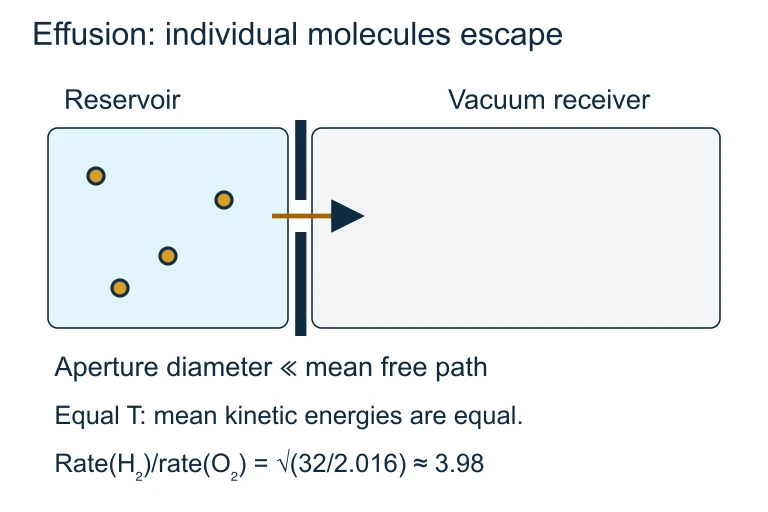 Effusion occurs through an aperture much smaller than the mean free path into near vacuum. At equal temperature, hydrogen and oxygen have equal mean translational kinetic energy, while hydrogen effuses about 3.98 times faster.
Common Mistakes
KMT Summary
| Concept | Equation | Key Relationship |
|---|---|---|
| Average KE | \( KE_{avg} = \frac{3}{2}k_BT \) | \( KE_{avg} \propto T \) |
| RMS Speed | \( v_{rms} = \sqrt{\frac{3RT}{M}} \) | \( v_{rms} \propto \sqrt{T/M} \) |
| Pressure | \( P = \frac{nRT}{V} \) | Collision force and frequency |
| Effusion Rate | \( \frac{r_1}{r_2} = \sqrt{\frac{M_2}{M_1}} \) | Lighter = faster (Graham's Law) |
| Real Gas | Van der Waals | Deviates at low \( T \), high \( P \) |
Question 1 of 5
According to KMT, the average kinetic energy of gas particles depends on which of the following?
Question 2 of 5
A container of gas is heated from 300 K to 600 K at constant volume. What happens to the rms speed of the molecules?
Question 3 of 5
Which postulate of KMT is most directly violated when a real gas is compressed to very high pressure?
Question 4 of 5
At the same temperature, which gas has the highest \( v_{rms} \)?
Question 5 of 5
On a Maxwell-Boltzmann distribution curve, what happens to the peak when the temperature is increased?