Introduction to
Titration
Master the technique of quantitative analysis by learning how to determine the concentration of an unknown solution using a solution of known concentration.
What Is Titration?
Titration is a laboratory technique used to determine the concentration of an unknown solution (called the analyte) by reacting it with a solution of known concentration (called the titrant or standard solution).
The Titration Setup
One complete titration setup
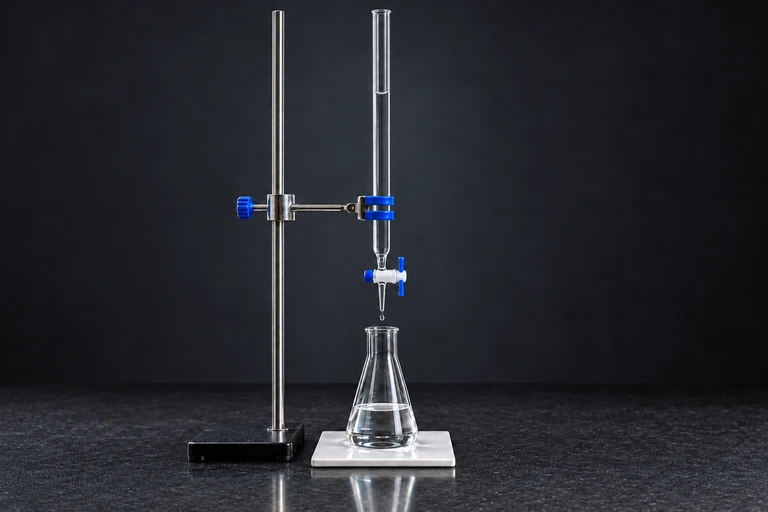 A buret delivers measured titrant into a flask containing the solution being analyzed.
Why Titration Matters
Titration is one of the most fundamental analytical techniques in chemistry. It allows chemists to precisely determine concentrations and is used across many fields:
The Core Titration Equation
At the equivalence point, the moles of acid equal the moles of base. For a 1:1 stoichiometry:
Adjusting for Stoichiometry
For reactions without a 1:1 ratio, like \( aA + bB \rightarrow \text{products} \), you must use the mole ratio. The core relationship at the equivalence point is:
For example, when sulfuric acid reacts with sodium hydroxide:
Equivalence Point vs Endpoint
| Equivalence Point | Endpoint | |
|---|---|---|
| Definition | Moles of acid = moles of base (exact stoichiometric point) | Point where the indicator changes color |
| Determined by | Calculation or pH curve analysis | Visual observation of color change |
| Precision | Theoretical, exact value | Experimental approximation |
| Goal | Make endpoint match this as closely as possible | Choose indicator whose transition range includes the equivalence pH |
The Titration Curve
How to Perform a Titration
Worked Example: Simple Titration
Problem: A 25.0 mL sample of HCl is titrated with 0.100 M NaOH. The endpoint is reached after 18.5 mL of NaOH is added. Find the molarity of HCl.
Worked Example: Diprotic Acid
Problem: 20.0 mL of \( \text{H}_2\text{SO}_4 \) is titrated with 0.150 M NaOH. It takes 32.0 mL of NaOH to reach the equivalence point. Find \( [\text{H}_2\text{SO}_4] \).
Worked Example: Finding Volume
Problem: How many mL of 0.250 M KOH are needed to neutralize 35.0 mL of 0.180 M \( \text{HNO}_3 \)?
Choosing the Right Indicator
The indicator must change color in a pH range that includes the equivalence point pH. Different titration types have different equivalence pH values:
| Titration Type | Equivalence pH | Good Indicator |
|---|---|---|
| Strong acid + Strong base | 7.0 | Bromothymol blue |
| Weak acid + Strong base | \( > 7 \) (basic) | Phenolphthalein |
| Strong acid + Weak base | \( < 7 \) (acidic) | Methyl orange |
Common Mistakes in Titration
An air bubble trapped in a buret tip
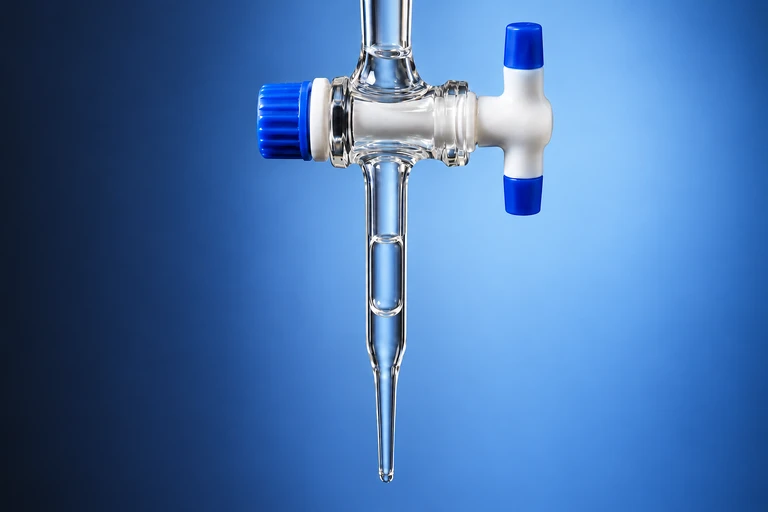 An air bubble in a buret tip can make the indicated delivery differ from the liquid volume that reaches the flask.
Titration Summary
| Concept | Key Detail |
|---|---|
| Core Equation (1:1) | \( M_a V_a = M_b V_b \) |
| General Equation | \( \dfrac{M_a V_a}{a} = \dfrac{M_b V_b}{b} \) |
| Equivalence Point | Moles acid = Moles base (exact) |
| Endpoint | Indicator color change (experimental) |
| Titrant | Known concentration, in burette |
| Analyte | Unknown concentration, in flask |
| Best Practice | Add drop by drop near endpoint |
Question 1 of 5
In a titration, 25.0 mL of 0.200 M NaOH is needed to neutralize 50.0 mL of an HCl solution. What is the molarity of HCl?
Question 2 of 5
What is the equivalence point in a titration?
Question 3 of 5
When titrating a weak acid with a strong base, the equivalence point pH will be:
Question 4 of 5
30.0 mL of \( \text{H}_2\text{SO}_4 \) is titrated with 0.200 M NaOH. If 48.0 mL of NaOH is needed, what is the concentration of \( \text{H}_2\text{SO}_4 \)?
Question 5 of 5
Which indicator would be most appropriate for a titration of a strong acid with a weak base (equivalence pH around 5)?