Solubility
Equilibria
Understand the equilibrium between dissolved ions and undissolved solids, and master the \( K_{sp} \) expression to predict precipitation.
What Is Solubility?
Solubility is the maximum amount of a substance that can dissolve in a given quantity of solvent at a specific temperature. When a solution holds the maximum amount of dissolved solute, it is called a saturated solution.
The Dissolution Equilibrium
When a sparingly soluble ionic compound is placed in water, it establishes a dynamic equilibrium between the solid phase and its dissolved ions.
Solid and saturated solution in contact
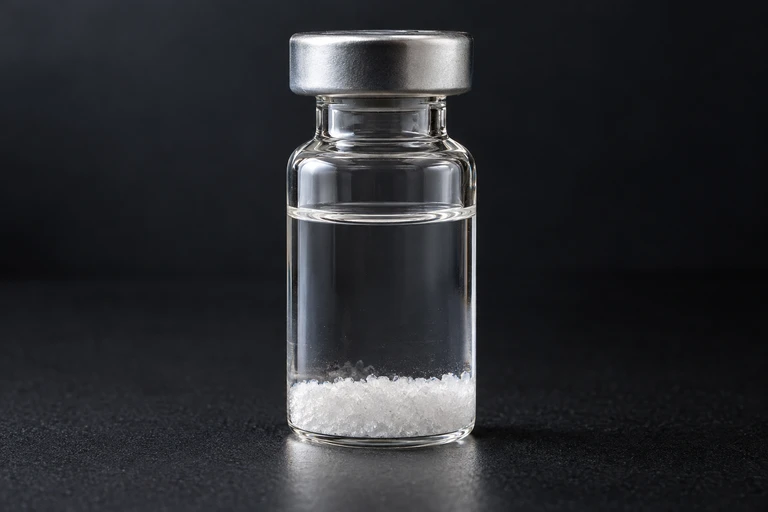 A saturated solution can remain in contact with undissolved solid while dissolution and crystallization continue.
Why Solubility Equilibria Matter
Solubility equilibria control real-world phenomena from water treatment to kidney stone formation. If you can predict whether a precipitate forms, you can design processes to remove contaminants or prevent unwanted deposits.
The \( K_{sp} \) Expression
For a general ionic compound \( A_aB_b \) that dissolves according to:
The solubility product constant is written as:
Writing \( K_{sp} \) Expressions
\( K_{sp} = [\text{Ag}^+][\text{Cl}^-] \)
\( K_{sp} = [\text{Pb}^{2+}][\text{I}^-]^2 \)
\( K_{sp} = [\text{Ca}^{2+}]^3[\text{PO}_4^{3-}]^2 \)
\( K_{sp} \) vs \( Q_{sp} \): Key Distinction
| \( K_{sp} \) | \( Q_{sp} \) | |
|---|---|---|
| Definition | Equilibrium constant | Reaction quotient (any moment) |
| When measured | At equilibrium only | At any point in time |
| Value | Fixed at given \( T \) | Changes with ion concentrations |
| Use | Reference threshold | Predict precipitation |
Predicting Precipitation
Silver chloride precipitation context
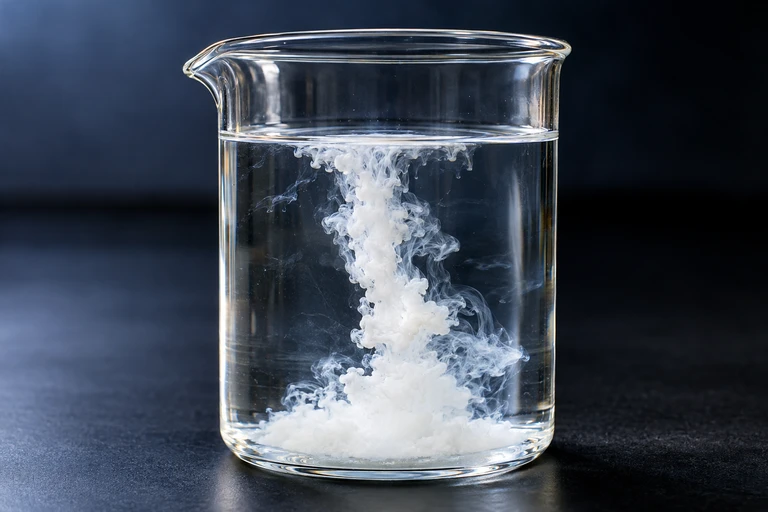 Silver chloride forms a white precipitate when the dissolved ion product exceeds its solubility product.
How to Calculate \( K_{sp} \) from Solubility
Example 1: AgCl
Problem: The molar solubility of AgCl at \(25^\circ\text{C}\) is \( 1.34 \times 10^{-5} \) M. Find \( K_{sp} \).
Example 2: \(\text{PbI}_2\)
Problem: Given \( K_{sp}(\text{PbI}_2) = 9.8 \times 10^{-9} \), find the molar solubility.
Example 3: Will It Precipitate?
Problem: 50 mL of \( 0.0020 \) M \(\text{Pb(NO}_3)_2\) is mixed with 50 mL of \( 0.0040 \) M KI. Does \(\text{PbI}_2\) precipitate? (\( K_{sp} = 9.8 \times 10^{-9} \))
The Common-Ion Effect
When a common ion is already present in solution, it shifts the equilibrium toward the solid, decreasing the molar solubility of the compound.
Factors Affecting Solubility
A precipitate disappears when the dissolved species changes
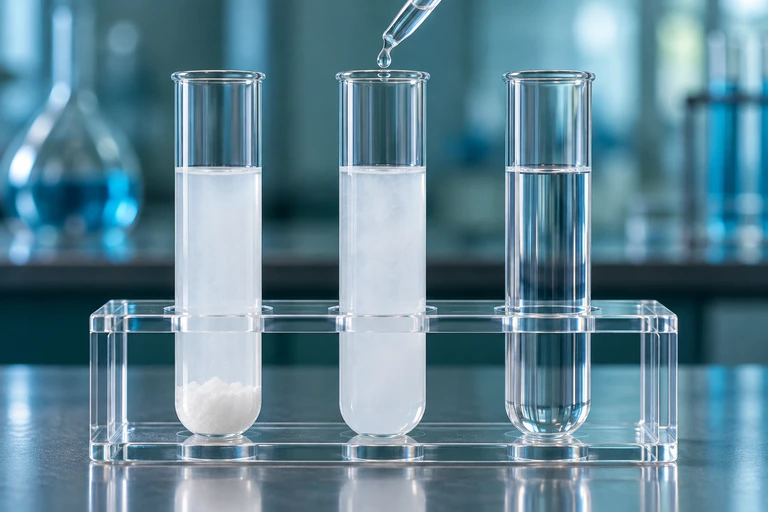 With sufficient ammonia, AgCl can dissolve as silver forms [Ag(NH₃)₂]⁺. The solubility product uses free Ag⁺ concentration, while total dissolved silver includes both free and complexed silver.
Clear solution still contains silver
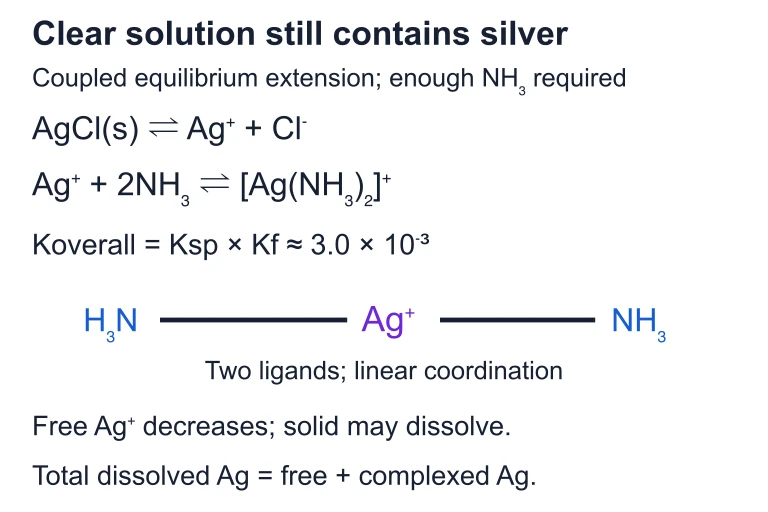 With sufficient ammonia, AgCl can dissolve as silver forms [Ag(NH₃)₂]⁺. The solubility product uses free Ag⁺ concentration, while total dissolved silver includes both free and complexed silver.
Common Mistakes
Summary Table
| Compound Type | \( K_{sp} \) Expression | \( K_{sp} \) in terms of \( s \) |
|---|---|---|
| AB (1:1) | \( [A^+][B^-] \) | \( s^2 \) |
| AB\(_2\) (1:2) | \( [A^{2+}][B^-]^2 \) | \( 4s^3 \) |
| A\(_2\)B (2:1) | \( [A^+]^2[B^{2-}] \) | \( 4s^3 \) |
| A\(_3\)B\(_2\) (3:2) | \( [A^{2+}]^3[B^{3-}]^2 \) | \( 108s^5 \) |
Question 1 of 5
What is the correct \( K_{sp} \) expression for \(\text{Ag}_2\text{CrO}_4\)?
\( \text{Ag}_2\text{CrO}_4(s) \rightleftharpoons 2\text{Ag}^+(aq) + \text{CrO}_4^{2-}(aq) \)
Question 2 of 5
The molar solubility of \(\text{BaSO}_4\) is \( 1.05 \times 10^{-5} \) M. What is \( K_{sp} \)?
Question 3 of 5
If \( Q_{sp} > K_{sp} \) for a solution containing \(\text{Pb}^{2+}\) and \(\text{Cl}^-\), what happens?
Question 4 of 5
How does adding NaCl to a saturated AgCl solution affect the solubility of AgCl?
Question 5 of 5
For \(\text{Ca}_3(\text{PO}_4)_2\) with molar solubility \( s \), what is \( K_{sp} \) in terms of \( s \)?