Introduction to
Chemical Equilibrium
Explore how reactions reach a dynamic balance, master the equilibrium constant \( K \), and learn to predict the direction of change using Le Chatelier's Principle.
What Is Chemical Equilibrium?
Most chemical reactions don't go to completion. Instead, they reach a state where the forward reaction and the reverse reaction occur at equal rates. At this point, the concentrations of reactants and products remain constant over time: this is chemical equilibrium.
Gas escaping an open reaction vessel
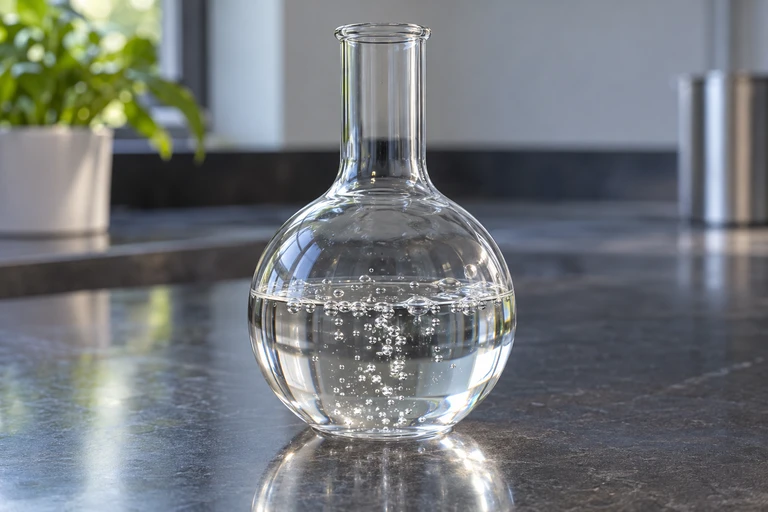 Gas escaping an open vessel removes material from the reacting system.
Visualizing the Rate Balance
Reversible Reactions and the \(\rightleftharpoons\) Symbol
A reversible reaction can proceed in both directions. We write it with a double arrow: \( \text{aA} + \text{bB} \rightleftharpoons \text{cC} + \text{dD} \). This tells us that products can re-form reactants, making equilibrium possible.
The Equilibrium Constant \( K \)
For a general reaction \( \text{aA} + \text{bB} \rightleftharpoons \text{cC} + \text{dD} \), the equilibrium constant expression is:
Each concentration is raised to the power of its stoichiometric coefficient. The subscript c indicates concentrations in M (molarity). Only species in the aqueous or gaseous phase appear in the expression: pure solids and liquids are omitted.
\( K_c \) vs \( K_p \): Which to Use?
| \( K_c \) | \( K_p \) | |
|---|---|---|
| Measures | Molar concentrations (M) | Partial pressures (atm) |
| Used when | Solution or mixed-phase reactions | Gas-phase reactions |
| Relationship | \( K_p = K_c(RT)^{\Delta n} \) | |
| \( \Delta n \) | Moles of gaseous products − moles of gaseous reactants | |
Interpreting the Magnitude of \( K \)
The Reaction Quotient \( Q \)
The reaction quotient \( Q \) has the same formula as \( K \), but uses current concentrations instead of equilibrium concentrations. By comparing \( Q \) to \( K \), you can predict which direction the reaction will shift.
Le Chatelier's Principle
When an external stress is applied to a system at equilibrium, the system shifts to partially counteract the stress and establish a new equilibrium.
How to Apply Le Chatelier's Principle
Example 1: Writing \( K_c \)
Write the equilibrium expression for the synthesis of ammonia:
Example 2: Calculating \( K_c \)
At equilibrium in a 1.00 L flask: \( [\text{N}_2] = 0.50\,\text{M} \), \( [\text{H}_2] = 0.30\,\text{M} \), \( [\text{NH}_3] = 0.20\,\text{M} \). Find \( K_c \).
Example 3: Using \( Q \) to Predict Shift
For the same reaction with \( K_c = 2.96 \), suppose initial concentrations are: \( [\text{N}_2] = 1.0 \), \( [\text{H}_2] = 1.0 \), \( [\text{NH}_3] = 0.10 \). Which way does the reaction shift?
Heterogeneous Equilibria
When an equilibrium involves substances in different phases, we call it heterogeneous. The key rule: pure solids and pure liquids are omitted from the equilibrium expression because their concentrations are constant.
Common Mistakes to Avoid
Equilibrium Summary
| Concept | Key Detail | |
|---|---|---|
| \( K \) expression | Products over reactants | Coefficients become exponents |
| \( K \gg 1 \) | Product-favored | Lies to the right |
| \( K \ll 1 \) | Reactant-favored | Lies to the left |
| \( Q < K \) | Shift forward | Make more products |
| \( Q > K \) | Shift reverse | Make more reactants |
| Le Chatelier | System opposes stress | Concentration, \( T \), \( P \) |
| Catalyst | No shift | \( K \) unchanged |
Question 1 of 5
For the reaction \( 2\,\text{SO}_2(g) + \text{O}_2(g) \rightleftharpoons 2\,\text{SO}_3(g) \), what is the correct equilibrium expression?
Question 2 of 5
If \( K_c = 4.2 \times 10^{-8} \) for a reaction at a given temperature, which statement is most accurate?
Question 3 of 5
For an exothermic reaction at equilibrium, what happens if the temperature is increased?
Question 4 of 5
For \( \text{CaCO}_3(s) \rightleftharpoons \text{CaO}(s) + \text{CO}_2(g) \), which is the correct \( K_c \) expression?
Question 5 of 5
If \( Q > K \) for a reaction, what must happen for the system to reach equilibrium?