Introduction to
Entropy
Explore the thermodynamic quantity that measures disorder, drives spontaneous change, and governs the direction of every process in the universe.
What Is Entropy?
Entropy, symbolized by \( S \), is a thermodynamic state function that measures the number of ways energy can be distributed among particles in a system. The greater the number of possible microstates, the higher the entropy.
Microstates and Macrostates
Why Entropy Matters
The \( \Delta S^{\circ}_{\text{rxn}} \) Equation
This equation uses standard molar entropy values (\( S^{\circ} \)) from data tables. The coefficients \( n \) and \( m \) come from the balanced chemical equation.
Predicting \( \Delta S \) Qualitatively
Entropy vs. Enthalpy
| Entropy \( S \) | Enthalpy \( H \) | |
|---|---|---|
| Measures | Disorder / energy dispersal | Heat content at constant pressure |
| Units | \( \text{J/(mol}\cdot\text{K)} \) | \( \text{kJ/mol} \) |
| Absolute value? | Yes (Third Law) | No (only changes) |
| Elements at 298 K | \( S^{\circ} > 0 \) | \( \Delta H^{\circ}_f = 0 \) |
| Favors spontaneity when | \( \Delta S > 0 \) (positive) | \( \Delta H < 0 \) (negative) |
The Gibbs Connection
How to Calculate \( \Delta S^{\circ}_{\text{rxn}} \)
Example 1: Combustion of Methane
\( S^{\circ}[\text{O}_2] = 205.2 \)
\( S^{\circ}[\text{H}_2\text{O}(g)] = 188.8 \)
Combustion heating a surrounding enclosure
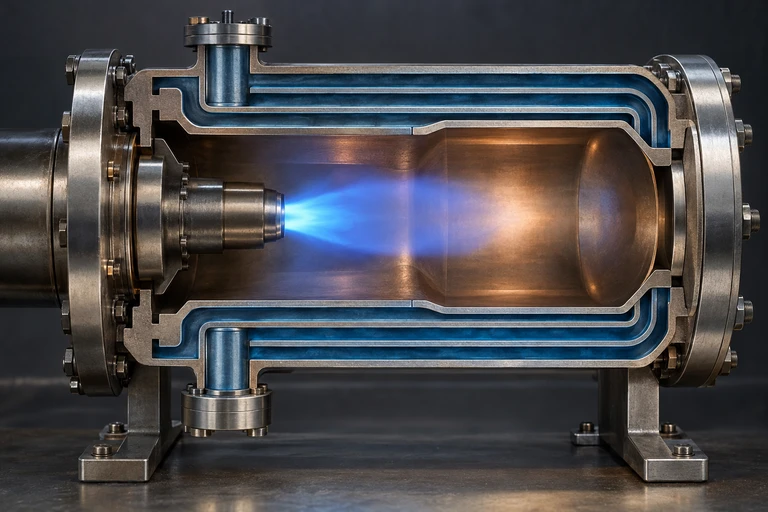 Combustion releases energy that can be transferred as heat to the surrounding enclosure.
Example 2: Dissolving Ammonium Nitrate
When ammonium nitrate dissolves in water, one solid crystal lattice breaks apart into two hydrated ions dispersed throughout the solution.
\( S^{\circ}[\text{NO}_3^-] = 146.4 \)
Example 3: Decomposition of \( \text{CaCO}_3 \)
The Third Law of Thermodynamics
The entropy of a perfect crystalline substance at absolute zero (\( 0 \; \text{K} \)) is exactly zero. This gives us an absolute reference point for measuring entropy.
Entropy Across Phases
Common Mistakes with Entropy
Summary of Entropy Concepts
| Concept | Key Point | Example |
|---|---|---|
| Boltzmann Equation | \( S = k_B \ln W \) | More microstates = higher \( S \) |
| Second Law | \( \Delta S_{\text{univ}} > 0 \) | Ice melts at room temp |
| Third Law | \( S = 0 \) at 0 K (perfect crystal) | Absolute entropy scale |
| Phase Order | \( S_g \gg S_l > S_s \) | Steam > water > ice |
| Gibbs Equation | \( \Delta G = \Delta H - T\Delta S \) | Combines both driving forces |
| \( \Delta S^{\circ}_{\text{rxn}} \) | \( \sum nS^{\circ}_p - \sum mS^{\circ}_r \) | Use data table values |
Question 1 of 5
Which of the following processes would have the largest positive \( \Delta S \)?
Question 2 of 5
The standard molar entropy of \( \text{O}_2(g) \) at 298 K is \( 205.2 \; \text{J/(mol}\cdot\text{K)} \). What is the standard molar entropy of oxygen in its elemental form?
Question 3 of 5
For a reaction with \( \Delta H > 0 \) and \( \Delta S > 0 \), under what conditions is the reaction spontaneous?
Question 4 of 5
Calculate \( \Delta S^{\circ}_{\text{rxn}} \) for: \( 2\text{NO}(g) + \text{O}_2(g) \rightarrow 2\text{NO}_2(g) \)
Given: \( S^{\circ}[\text{NO}] = 210.8 \), \( S^{\circ}[\text{O}_2] = 205.2 \), \( S^{\circ}[\text{NO}_2] = 240.1 \) (all in \( \text{J/(mol}\cdot\text{K)} \))
Question 5 of 5
According to the Second Law of Thermodynamics, which statement is always true for a spontaneous process?