01 / 21

Introduction to
Chemical Reactions

Explore how reactants transform into products, learn to classify reaction types, and master the art of balancing chemical equations.

AP Chemistry

What Is a Chemical Reaction?

A chemical reaction is a process in which one or more substances (the reactants) are converted into one or more different substances (the products). During a reaction, chemical bonds are broken and formed, producing new arrangements of atoms.

Anatomy of a Chemical Equation

Reactants yields Products Coefficients show moles
\( (s), (l), (g), (aq) \)
State symbols Subscripts show atoms per formula unit

Evidence of a Reaction

Color Change
A new substance with a different color forms, indicating new bonds.
Gas Production
Bubbles or effervescence signal a gaseous product is being released.
Temperature Change
Exothermic reactions release heat; endothermic reactions absorb it.
Precipitate Forms
An insoluble solid appears when two aqueous solutions are mixed.

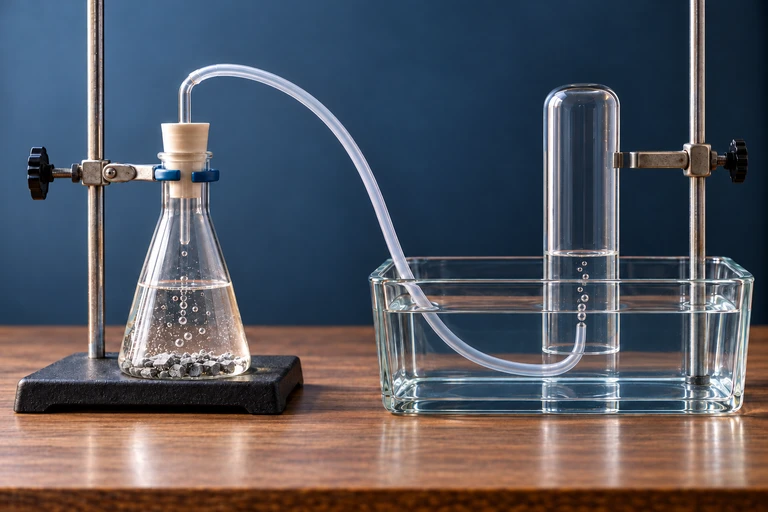
Gas collection over water

Gas collection over waterGas collected over water contains water vapor as well as the reaction’s gaseous product.

The Law of Conservation of Mass

Reactants 36 g Products 36 g = Mass is conserved Total mass of reactants = Total mass of products

Five Major Reaction Types

1
Synthesis: Two or more substances combine to form one product. \( A + B \rightarrow AB \)
2
Decomposition: One compound breaks into simpler substances. \( AB \rightarrow A + B \)
3
Single Replacement: An element replaces another in a compound. \( A + BC \rightarrow AC + B \)
4
Double Replacement: Cations and anions of two compounds swap. \( AB + CD \rightarrow AD + CB \)
5
Combustion: A hydrocarbon reacts with \( \text{O}_2 \) to form \( \text{CO}_2 \) and \( \text{H}_2\text{O} \).

Synthesis vs Decomposition

Synthesis A + B AB Decomposition AB A + B

Single vs Double Replacement

Single Replacement Double Replacement
General Form \( A + BC \rightarrow AC + B \) \( AB + CD \rightarrow AD + CB \)
What swaps? One element replaces another Both cations swap partners
Driving force Activity series Precipitate, gas, or water forms
Example \( \text{Zn}(s) + \text{CuSO}_4(aq) \rightarrow \text{ZnSO}_4(aq) + \text{Cu}(s) \) \( \text{NaCl}(aq) + \text{AgNO}_3(aq) \rightarrow \text{AgCl}(s) + \text{NaNO}_3(aq) \)

Combustion Reactions

A combustion reaction occurs when a hydrocarbon (or organic compound) reacts with oxygen gas to produce carbon dioxide and water. These reactions are always exothermic, releasing energy as heat and light.

Hydrocarbon +
\( \text{O}_2 \)
\( \text{CO}_2 \)
+
\( \text{H}_2\text{O} \)
+ Energy (exothermic)

How to Balance an Equation

1
Write the unbalanced equation with correct formulas for all reactants and products.
2
Count atoms of each element on both sides of the arrow.
3
Adjust coefficients (not subscripts!) to equalize atom counts. Start with the most complex molecule.
4
Balance polyatomic ions as a unit if they appear unchanged on both sides.
5
Verify: confirm all atoms are equal and coefficients are in the lowest whole-number ratio.

Example 1: Synthesis

Balance the synthesis of water from hydrogen and oxygen gases:

1
Count atoms: Left: 2 H, 2 O. Right: 2 H, 1 O. Oxygen is unbalanced.
2
Place coefficient 2 before \( \text{H}_2\text{O} \): now Right has 4 H, 2 O.
3
Place coefficient 2 before \( \text{H}_2 \): Left now has 4 H, 2 O. Balanced!

Example 2: Combustion of Methane

1
C atoms: Left = 1, Right = 1. Already balanced.
2
H atoms: Left = 4, Right = 2. Place 2 before \( \text{H}_2\text{O} \): Right H = 4.
3
O atoms: Right now has 2 (from \( \text{CO}_2 \)) + 2 (from \( 2\text{H}_2\text{O} \)) = 4. Left has 2. Place 2 before \( \text{O}_2 \): Left O = 4.

Example 3: Double Replacement

Silver nitrate reacts with sodium chloride to form a white precipitate:

\( \text{Ag}^+ \)
\( \text{NO}_3^- \)
\( \text{Na}^+ \)
\( \text{Cl}^- \)
Products:
\( \text{AgCl}(s) \)
white precipitate
\( \text{NaNO}_3(aq) \)
stays dissolved

Energy in Reactions

Exothermic
Releases energy to surroundings. \( \Delta H < 0 \). Products are at lower energy than reactants. Example: combustion.
Endothermic
Absorbs energy from surroundings. \( \Delta H > 0 \). Products are at higher energy than reactants. Example: photosynthesis.
Energy Reaction Progress R P
\( \Delta H < 0 \)
Exothermic R P
\( \Delta H > 0 \)
Endothermic

Common Mistakes to Avoid

✕ Changing Subscripts
Never alter subscripts to balance: \( \text{H}_2\text{O} \) cannot become \( \text{H}_3\text{O} \). Only change coefficients.
✕ Forgetting State Symbols
AP Chemistry requires (s), (l), (g), or (aq) after every formula. Missing them loses points.
✕ Not Reducing Ratios
Coefficients must be in the lowest whole-number ratio. For example, \( 4\text{H}_2 + 2\text{O}_2 \rightarrow 4\text{H}_2\text{O} \) should be reduced to \( 2\text{H}_2 + \text{O}_2 \rightarrow 2\text{H}_2\text{O} \).

Reaction Types Summary

Type General Form Key Clue
Synthesis \( A + B \rightarrow AB \) Two+ reactants, one product
Decomposition \( AB \rightarrow A + B \) One reactant, two+ products
Single Replacement \( A + BC \rightarrow AC + B \) Element + compound
Double Replacement \( AB + CD \rightarrow AD + CB \) Two ionic compounds swap
Combustion \( \text{C}_x\text{H}_y + \text{O}_2 \rightarrow \dots \) Hydrocarbon + \( \text{O}_2 \)

Question 1 of 5

Which of the following is not evidence of a chemical reaction?

Question 2 of 5

What type of reaction is \( 2\text{KClO}_3 \rightarrow 2\text{KCl} + 3\text{O}_2 \)?

Question 3 of 5

When balancing \( \text{Fe} + \text{O}_2 \rightarrow \text{Fe}_2\text{O}_3 \), what is the coefficient in front of Fe?

Question 4 of 5

In a complete combustion reaction of a hydrocarbon, the products are always:

Question 5 of 5

Which reaction type requires checking the activity series to determine if the reaction will proceed?