01 / 21

Intramolecular &
Interparticle Forces

Understand the bonds within molecules and the forces between particles that determine every physical property you observe.

AP Chemistry

Two Categories of Forces

Every substance is held together by forces, but not all forces are the same. Chemistry divides them into two fundamental categories based on where they act:

Intramolecular
Forces within a molecule: the chemical bonds (ionic, covalent, metallic) holding atoms together.
Intermolecular
Forces between separate molecules or particles: weaker attractions that determine phase and physical properties.

Intramolecular Forces: The Bonds

Ionic Bonds
Electrostatic attraction between cations and anions. Found in salts like \( \text{NaCl} \). Very strong lattice energy.
Covalent Bonds
Shared electron pairs between nonmetals. Bond energy ranges from ~150 to ~1000 kJ/mol depending on bond order.
Metallic Bonds
Delocalized "sea of electrons" among metal cations. Explains conductivity, malleability, and luster.

Visualizing Intra vs Inter

O H H Intramolecular (covalent bonds) O H H Intermolecular (H-bonding) Strong: ~460 kJ/mol Holds atoms together Weak: ~20 kJ/mol Holds molecules together

The Hierarchy of Intermolecular Forces

Stronger Weaker Ion-Dipole Ion + polar molecule (e.g., NaCl dissolving in water) Hydrogen Bonding H bonded to F, O, or N attracts lone pair on another F, O, N Dipole-Dipole Polar molecules align: partial + attracts partial - London Dispersion (LDF) Temporary dipoles from electron fluctuation: present in ALL molecules ~50-600 kJ/mol ~10-40 kJ/mol ~5-25 kJ/mol ~0.05-40 kJ/mol

Coulomb's Law and Force Strength

The strength of electrostatic interactions, whether in ionic bonds or intermolecular forces, follows Coulomb's Law:

Larger Charges
Greater charge magnitude \(\rightarrow\) stronger force. This is why ion-dipole forces dominate in solutions of ionic compounds.
Shorter Distance
Smaller \( r \) \(\rightarrow\) much stronger force (inverse square). Compact molecules interact more strongly at close range.

Intra vs Inter: The Critical Distinction

Intramolecular Intermolecular
Location Within a molecule Between molecules
Strength Very strong (150-1000+ kJ/mol) Weak (0.05-40 kJ/mol)
Broken during Chemical reactions Phase changes
Determines Molecular formula, structure BP, MP, viscosity, solubility
Examples Ionic, covalent, metallic LDF, dipole-dipole, H-bond

Water boiling at the liquid-vapor interface
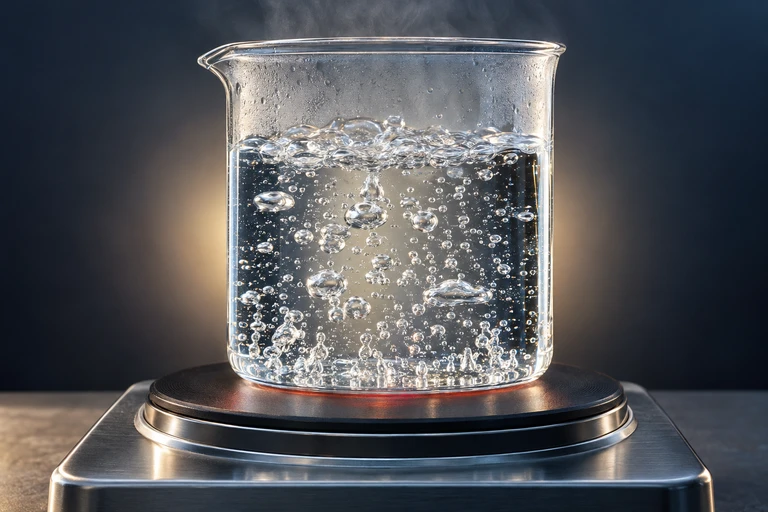
Water boiling at the liquid-vapor interfaceDuring boiling, water molecules move from liquid into vapor while retaining their molecular identity.

London Dispersion Forces in Detail

LDFs arise from temporary, instantaneous dipoles created when electrons momentarily cluster on one side of a molecule. Two factors control their strength:

1
Molar mass / electron count: More electrons means larger, more polarizable electron clouds and stronger temporary dipoles.
2
Molecular shape: Elongated molecules have more surface area for contact, increasing LDF. Compact/spherical shapes reduce it.

Interacting polarizable electron clouds
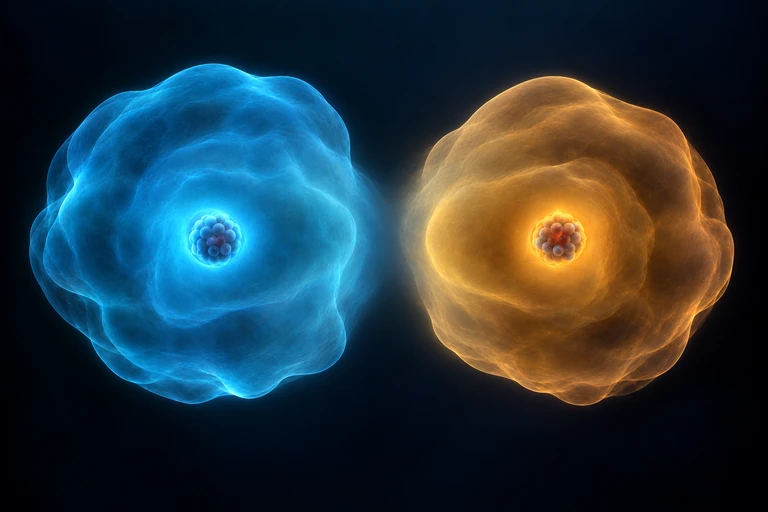
Interacting polarizable electron cloudsFluctuations in neighboring electron distributions create the temporary attractions responsible for London dispersion forces.

The Special Case of Hydrogen Bonding

O H H O H H
\( \delta^- \)
\( \delta^+ \)
\( \delta^+ \)
\( \delta^- \)
H-bond ~20 kJ/mol Requirement: H bonded to F, O, or N attracts a lone pair on another F, O, or N

How to Identify the Forces Present

1
Draw the Lewis structure and determine the molecular geometry.
2
Check polarity: Is the molecule polar or nonpolar? Consider bond dipoles and symmetry.
3
Start with LDF: All molecules have London dispersion forces. Check this box first.
4
If polar: add dipole-dipole forces to your list.
5
If H is bonded to F, O, or N: add hydrogen bonding (a special dipole-dipole).
6
If ions are present with polar molecules: add ion-dipole forces.

Example 1: Forces in \( \text{HF} \)

H F
\( \delta^+ \)
\( \delta^- \)
net dipole
1
Lewis structure: H-F (single covalent bond, 3 lone pairs on F).
2
Polarity: Highly polar: F is the most electronegative element.
3
Forces present: LDF + dipole-dipole + hydrogen bonding (H bonded to F).

Example 2: \( \text{CH}_4 \) vs \( \text{CH}_3\text{OH} \)

\( \text{CH}_4 \) (Methane)
Nonpolar (symmetric tetrahedral).
Forces: LDF only.
BP: \( -161^\circ\text{C} \)
\( \text{CH}_3\text{OH} \) (Methanol)
Polar (O-H bond, asymmetric).
Forces: LDF + dipole-dipole + H-bonding.
BP: \( 64.7^\circ\text{C} \)

Example 3: \( \text{NaCl} \) Dissolving in Water

\( \text{Na}^+ \)
\( \text{H}_2\text{O} \)
\( \text{Cl}^- \)
\( \text{H}_2\text{O} \)
Ion-Dipole Interactions

Oxygen's \( \delta^- \) faces \( \text{Na}^+ \); H's \( \delta^+ \) face \( \text{Cl}^- \)

Water orientation around one sodium ion
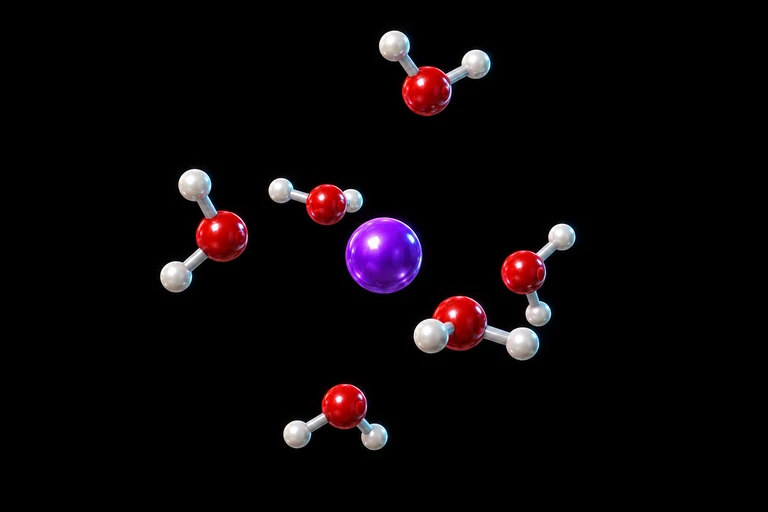
Water orientation around one sodium ionWater molecules orient their partially negative oxygen atoms toward a sodium ion.

Forces Determine Physical Properties

Stronger intermolecular forces lead to predictable changes in physical properties:

Boiling Point
Stronger IMFs require more energy to separate molecules into gas phase, so BP increases.
Viscosity
Stronger IMFs make it harder for molecules to slide past each other, increasing viscosity.
Surface Tension
Stronger IMFs pull surface molecules inward more tightly, increasing surface tension.
Vapor Pressure
Stronger IMFs make it harder to escape to gas phase, so vapor pressure decreases.

Common Mistakes to Avoid

✕ Confusing Intra and Inter
Saying "boiling breaks covalent bonds." Boiling only overcomes intermolecular forces, not the bonds within molecules.
✕ Forgetting LDF
Listing only H-bonding for water. ALL molecules have London dispersion forces: list them too.
✕ Wrong H-Bond Criteria
Claiming \( \text{CH}_4 \) has H-bonding because it has \( \text{H} \) atoms. \( \text{H} \) must be bonded to \( \text{F} \), \( \text{O} \), or \( \text{N} \), not just present.

Summary of All Forces

Force Type Strength Found In Example
Ionic Bond Very Strong Metal + nonmetal compounds \( \text{NaCl} \)
Covalent Bond Strong Nonmetal + nonmetal \( \text{H}_2\text{O} \)
Ion-Dipole Moderate-Strong Ion + polar solvent \( \text{Na}^+\text{(aq)} \)
H-Bonding Moderate H-F, H-O, H-N molecules \( \text{H}_2\text{O} \), \( \text{NH}_3 \)
Dipole-Dipole Weak-Moderate Polar molecules \( \text{HCl} \)
LDF Weakest ALL molecules \( \text{He} \), \( \text{CH}_4 \)

Question 1 of 5

When water boils at \( 100^\circ\text{C} \), which type of force is primarily being overcome?

Question 2 of 5

Which molecule can form hydrogen bonds with other molecules of the same kind?

Question 3 of 5

Substance X has a very high melting point, does not conduct electricity as a solid, but conducts well when dissolved in water. Substance X is most likely held together by:

Question 4 of 5

Rank the following in order of increasing boiling point: \( \text{Ne} \), \( \text{Ar} \), \( \text{Kr} \).

Question 5 of 5

A substance with strong intermolecular forces will have: