The Ideal Gas Law
\( PV = nRT \)
Master the relationship between pressure, volume, temperature, and amount of an ideal gas: the single equation that unifies all gas behavior.
What Is an Ideal Gas?
An ideal gas is a theoretical gas whose particles obey two simplifying assumptions that make the math tractable:
The Four Variables of Gas Behavior
Why Does the Ideal Gas Law Matter?
The ideal gas law is the master equation for gas behavior. It unifies the earlier "named" gas laws into one relationship and lets you solve for any unknown variable when the other three are known.
The Ideal Gas Law Equation
Rearranging for Any Variable
Since \( PV = nRT \) has four variables plus a constant, you can isolate whichever quantity is unknown:
Component Laws vs. Ideal Gas Law
The ideal gas law contains the earlier gas laws as special cases. Each older law holds two variables constant:
| Law | Relationship | Held Constant |
|---|---|---|
| Boyle's Law | \( P \propto \frac{1}{V} \) | \( n, T \) |
| Charles's Law | \( V \propto T \) | \( n, P \) |
| Avogadro's Law | \( V \propto n \) | \( P, T \) |
| Gay-Lussac's Law | \( P \propto T \) | \( n, V \) |
| Ideal Gas Law | \( PV = nRT \) | None: all vary |
Watch the boundary move—or stay fixed
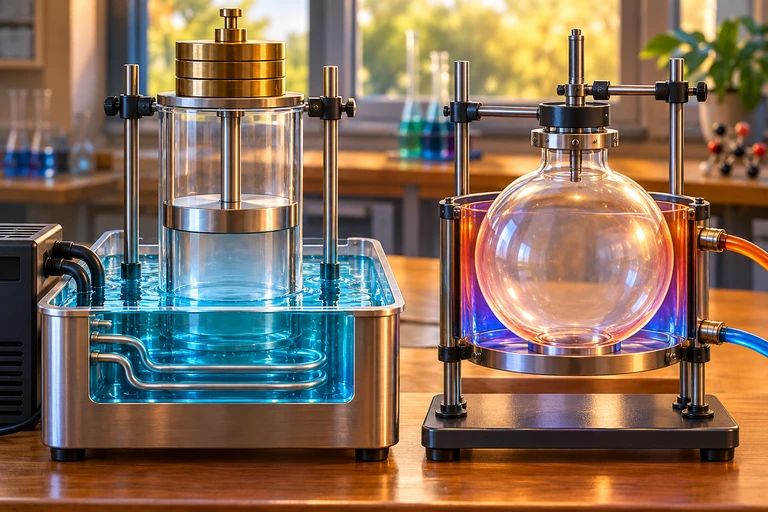 A movable boundary permits volume to change, while a rigid boundary fixes volume. For a fixed amount of ideal gas, the pressure relationship depends on which variables remain constant.
Movable boundary: an isothermal change
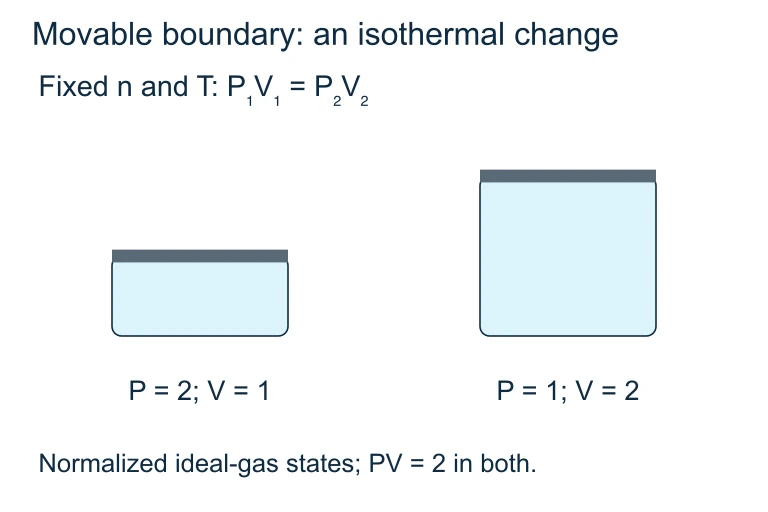 A movable boundary permits volume to change, while a rigid boundary fixes volume. For a fixed amount of ideal gas, the pressure relationship depends on which variables remain constant.
Rigid boundary: pressure rises with kelvin T
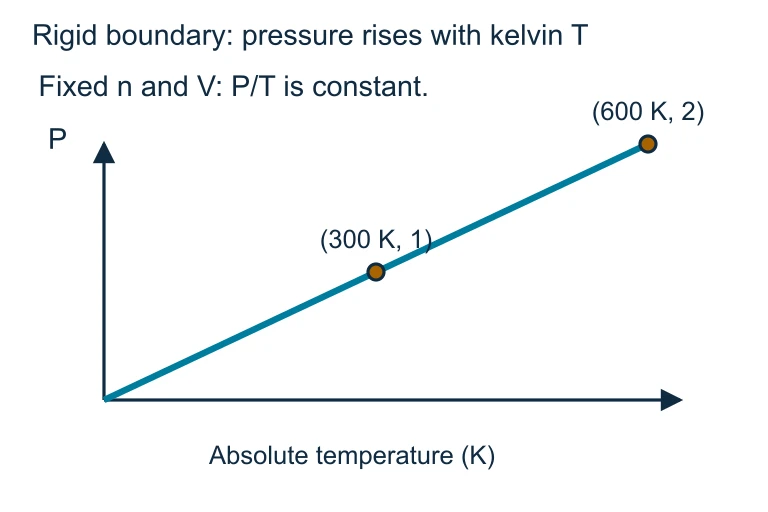 At fixed amount and volume, ideal-gas pressure is proportional to absolute temperature. Doubling temperature from 300 K to 600 K doubles pressure.
STP and Molar Volume
Standard Temperature and Pressure (STP) is defined as \( T = 273.15 \text{ K} \) (\(0\,{}^\circ\text{C}\)) and \( P = 1 \text{ atm} \). At STP, one mole of any ideal gas occupies a special volume:
How to Solve Ideal Gas Problems
Example 1: Finding Pressure
A balloon contains 0.50 mol of helium in a 12.0 L container at \(25\,{}^\circ\text{C}\). What is the pressure?
Example 2: Finding Volume
What volume does 2.00 mol of \( \text{N}_2 \) occupy at 1.50 atm and 350 K?
Example 3: Finding Molar Mass
A 3.20 g sample of an unknown gas occupies 1.75 L at 1.00 atm and \(20.0\,{}^\circ\text{C}\). Find its molar mass.
Visualizing \( P \) vs. \( V \) at Constant \( T \)
Deriving Gas Density
Since \( n = \frac{m}{M} \) (mass / molar mass), substituting into \( PV = nRT \):
The same bulb, a different gas mass
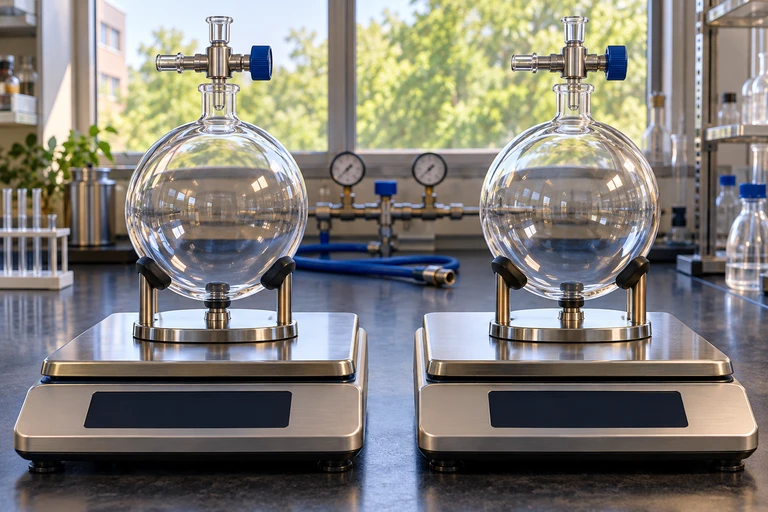 For ideal nitrogen at 1 atm and 298 K, a 1.00 L bulb contains about 1.146 g of gas. Subtract the evacuated-bulb mass from the filled-bulb mass to obtain the gas sample mass.
Subtract the vessel, compare the gas
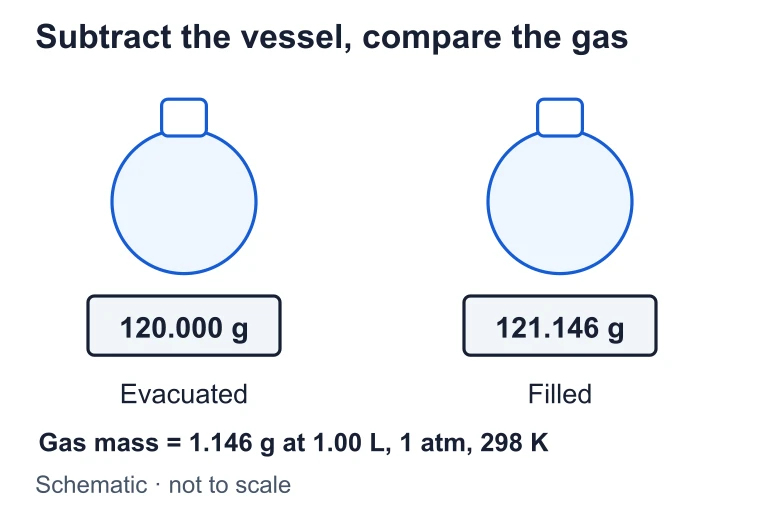 For ideal nitrogen at 1 atm and 298 K, a 1.00 L bulb contains about 1.146 g of gas. Subtract the evacuated-bulb mass from the filled-bulb mass to obtain the gas sample mass.
Common Mistakes to Avoid
Summary: Values of \( R \)
The gas constant \( R \) has different numerical values depending on the units you choose. Pick the one that matches your pressure units:
| Value of \( R \) | Pressure Unit | Volume Unit |
|---|---|---|
| \( 0.08206 \) | atm | L |
| \( 8.314 \) | kPa | L |
| \( 62.36 \) | mmHg (torr) | L |
| \( 8.314 \) | Pa | m³ |
Question 1 of 5
A 5.00 L container holds 0.250 mol of oxygen gas at 300. K. What is the pressure inside the container?
Question 2 of 5
Which temperature unit must be used in the ideal gas law?
Question 3 of 5
At STP, what volume does 2.00 mol of an ideal gas occupy?
Question 4 of 5
A gas sample has \( P = 2.00 \text{ atm} \), \( V = 10.0 \text{ L} \), and \( T = 400. \text{ K} \). How many moles of gas are present?
Question 5 of 5
An unknown gas has a density of 1.96 g/L at 1.00 atm and 273.15 K. What is its molar mass?