Heat Transfer &
Thermal Equilibrium
Master how energy flows between systems, the equation \( q = mc\Delta T \), and why all objects tend toward thermal equilibrium.
What Is Heat?
Heat (\( q \)) is the transfer of thermal energy between two objects at different temperatures. It always flows spontaneously from the hotter object to the cooler object until both reach the same temperature.
Three Modes of Heat Transfer
Heat-transfer interfaces in one vessel
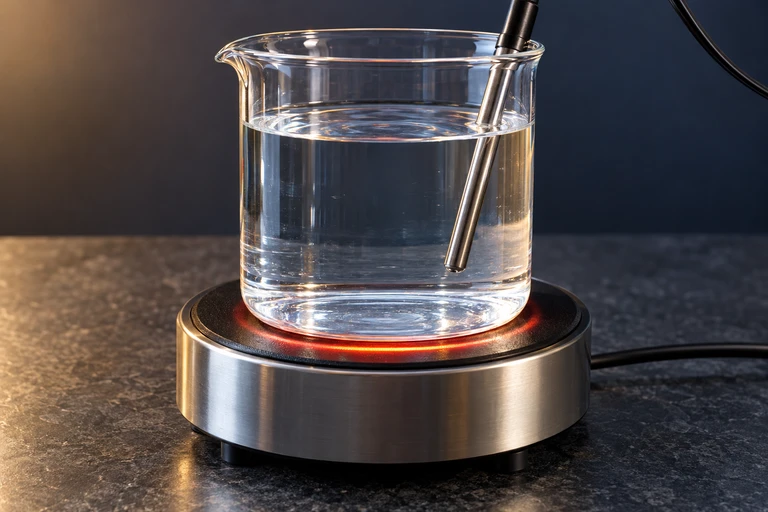 Heating a vessel involves energy transfer through the vessel and within the fluid.
What Is Thermal Equilibrium?
Thermal equilibrium is the state where two objects in thermal contact reach the same temperature, and net heat flow stops. This is formalized by the Zeroth Law of Thermodynamics: if A is in equilibrium with C, and B is in equilibrium with C, then A is in equilibrium with B.
The Calorimetry Equation
The sign of \( q \) tells you the direction of heat flow. A positive \( \Delta T \) means the substance warmed up; a negative \( \Delta T \) means it cooled down.
Specific Heat Capacity
Specific heat capacity (\( c \)) is the amount of energy required to raise 1 gram of a substance by \(1^\circ\text{C}\). Each substance has a unique value.
| Substance | \( c \) (\(\text{J/g}\cdot{}^\circ\text{C}\)) | Implication |
|---|---|---|
| Water (liquid) | 4.184 | Hard to heat, hard to cool |
| Aluminum | 0.897 | Heats and cools moderately |
| Iron | 0.449 | Heats and cools quickly |
| Copper | 0.385 | Very rapid temperature changes |
Equal energy produces unequal warming
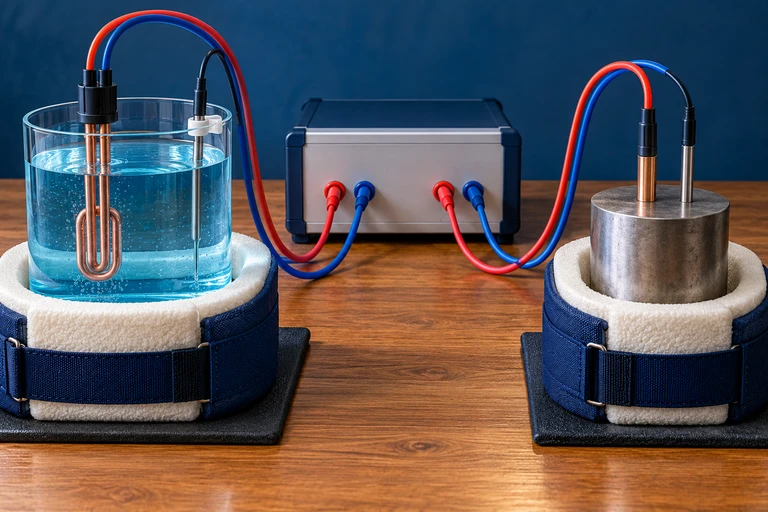 Suppose equal 100 g samples each receive 418.4 J with negligible heat loss and no phase change. Water warms by 1.00 °C and iron by about 9.32 °C because their specific heat capacities differ.
Equal energy, different warming
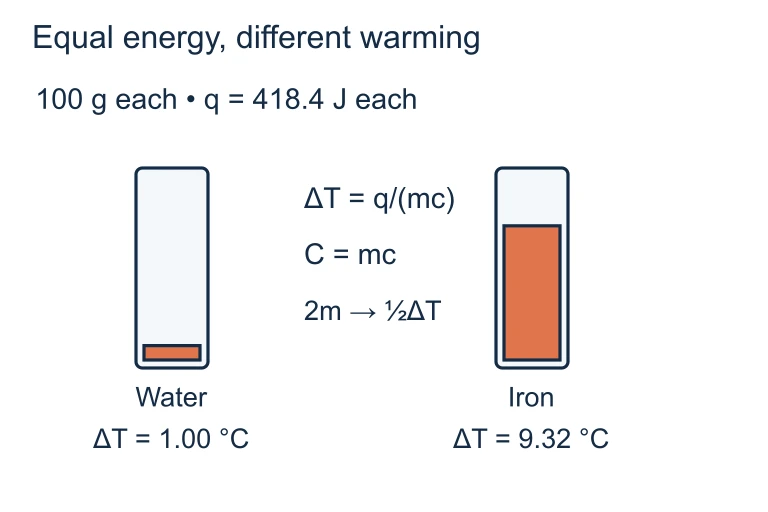 Suppose equal 100 g samples each receive 418.4 J with negligible heat loss and no phase change. Water warms by 1.00 °C and iron by about 9.32 °C because their specific heat capacities differ.
Heat vs. Temperature
| Property | Heat (\( q \)) | Temperature (\( T \)) |
|---|---|---|
| What it measures | Energy transferred | Average kinetic energy |
| Type of quantity | Extensive (depends on amount) | Intensive (independent of amount) |
| SI Unit | Joule (J) | Kelvin (K) |
| Can it be measured directly? | No: calculated via \( mc\Delta T \) | Yes: thermometer |
| At thermal equilibrium | \( q_{\text{net}} = 0 \) | \( T_A = T_B \) |
Conservation of Energy in Calorimetry
The hot metal loses heat (\( q < 0 \)) and the cool water gains the same amount (\( q > 0 \)). The total energy in the system is conserved.
A metal sample immersed in calorimeter water
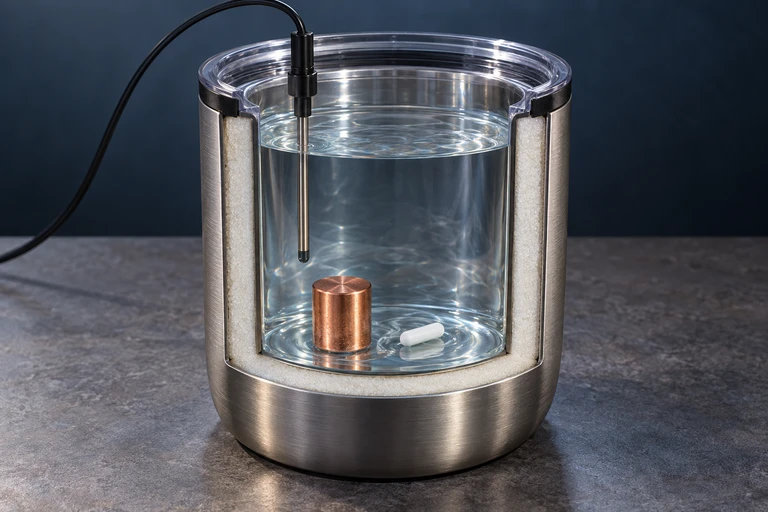 A metal sample and water exchange energy until they approach a shared temperature.
How to Solve Calorimetry Problems
Example 1: Finding \( q \)
A 150.0 g sample of water is heated from \(22.0^\circ\text{C}\) to \(78.0^\circ\text{C}\). How much heat was absorbed?
Example 2: Finding \( T_f \)
A 50.0 g piece of iron at \(200.0^\circ\text{C}\) is dropped into 200.0 g of water at \(25.0^\circ\text{C}\). Find the final equilibrium temperature. (\( c_{\text{Fe}} = 0.449 \text{ J/g}\cdot{}^\circ\text{C}\))
Example 3: Finding \( c \)
A 75.0 g unknown metal at \(100.0^\circ\text{C}\) is placed in 150.0 g of water at \(20.0^\circ\text{C}\). The final temperature is \(23.1^\circ\text{C}\). What is the metal's specific heat?
Heating Curves and Phase Changes
During a phase change (flat regions), temperature stays constant even though heat is added. Use \( q = n \Delta H \) for phase changes, not \( q = mc\Delta T \). The sloped regions use \( q = mc\Delta T \).
Endothermic vs. Exothermic
Common Mistakes
Summary of Key Equations
| Scenario | Equation | When to Use |
|---|---|---|
| Heating or cooling (no phase change) | \( q = mc\Delta T \) | Temperature changes, same phase |
| Melting or freezing | \( q = n\Delta H_{\text{fus}} \) | At the melting/freezing point |
| Boiling or condensing | \( q = n\Delta H_{\text{vap}} \) | At the boiling/condensation point |
| Thermal equilibrium (calorimetry) | \( q_{\text{lost}} + q_{\text{gained}} = 0 \) | Two substances reach same \( T_f \) |
| Enthalpy of reaction | \( q_{\text{rxn}} = -q_{\text{cal}} \) | Finding \( \Delta H \) from calorimeter data |
Question 1 of 5
How much heat is required to raise the temperature of 250.0 g of water from \(20.0^\circ\text{C}\) to \(80.0^\circ\text{C}\)? (\( c_{\text{water}} = 4.184 \text{ J/g}\cdot{}^\circ\text{C}\))
Question 2 of 5
When a hot metal is placed in cool water and they reach thermal equilibrium, which statement is true?
Question 3 of 5
A substance absorbs heat but its temperature does not change. What is most likely occurring?
Question 4 of 5
If 100.0 g of aluminum (\( c = 0.897 \text{ J/g}\cdot{}^\circ\text{C}\)) at \(90.0^\circ\text{C}\) is placed in 100.0 g of water at \(25.0^\circ\text{C}\), which substance undergoes the larger temperature change?
Question 5 of 5
A 40.0 g piece of unknown metal releases 1,500 J of heat as it cools from \(95.0^\circ\text{C}\) to \(25.0^\circ\text{C}\). What is the specific heat of the metal?