Heat Capacity &
Calorimetry
Master the relationship between heat transfer, temperature change, and specific heat capacity using the equation \( q = mc\Delta T \).
What Is Heat?
Heat is energy transferred between a system and its surroundings due to a temperature difference. It flows spontaneously from a hotter object to a cooler one until thermal equilibrium is reached.
\( q \lt 0 \) : exothermic (releases heat)
Defining Heat Capacity
Heat capacity (\( C \)) is the amount of heat required to raise the temperature of an object by \( 1\,{}^\circ\text{C} \). It depends on both the substance and the amount of material.
Specific Heat Capacity
Specific heat capacity (\( c \)) is the amount of heat required to raise \( 1\,\text{g} \) of a substance by \( 1\,{}^\circ\text{C} \). It is an intensive property: unique to each substance.
Equal energy produces unequal warming
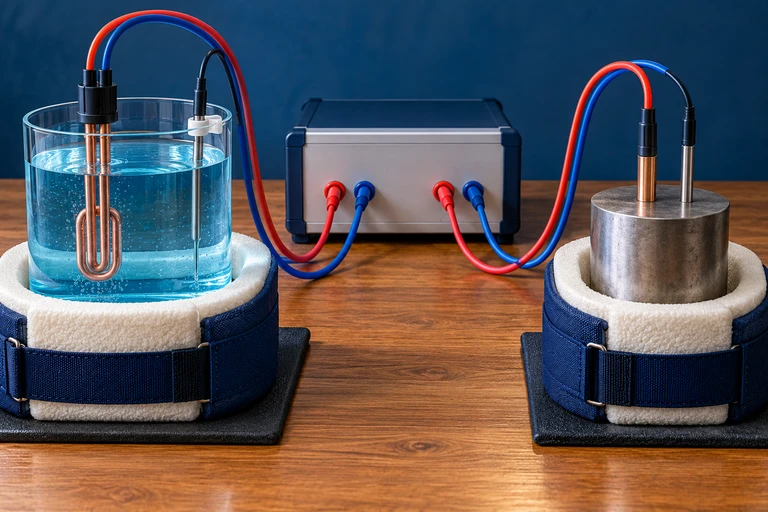 Suppose equal 100 g samples each receive 418.4 J with negligible heat loss and no phase change. Water warms by 1.00 °C and iron by about 9.32 °C because their specific heat capacities differ.
Equal energy, different warming
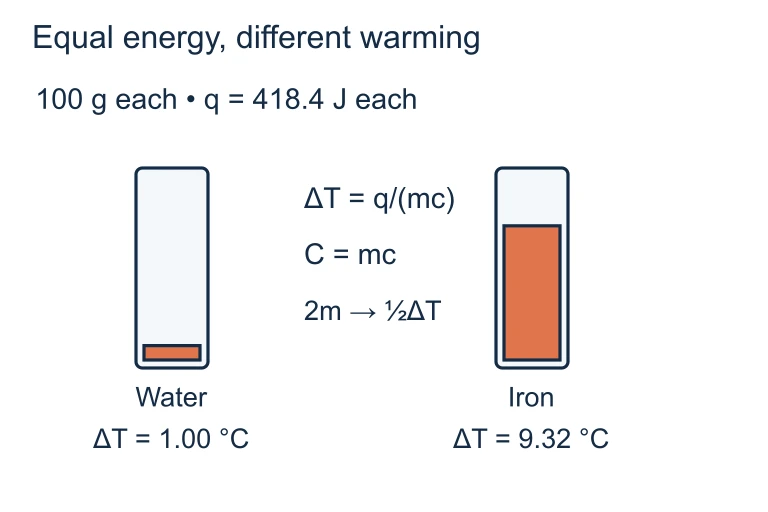 Suppose equal 100 g samples each receive 418.4 J with negligible heat loss and no phase change. Water warms by 1.00 °C and iron by about 9.32 °C because their specific heat capacities differ.
The Core Equation: \( q = mc\Delta T \)
The Heating Curve
Specific vs. Molar Heat Capacity
| Specific Heat (\( c \)) | Molar Heat (\( C_p \)) | |
|---|---|---|
| Definition | Heat per gram per \(^\circ\text{C}\) | Heat per mole per \(^\circ\text{C}\) |
| Units | \( \tfrac{\text{J}}{\text{g}\cdot{}^\circ\text{C}} \) | \( \tfrac{\text{J}}{\text{mol}\cdot{}^\circ\text{C}} \) |
| Equation | \( q = mc\Delta T \) | \( q = nC_p\Delta T \) |
| When to use | Given mass in grams | Given amount in moles |
What Is Calorimetry?
Calorimetry is the experimental technique for measuring heat flow. A calorimeter is an insulated device that isolates a reaction so all heat transfer stays within the system.
Coffee-Cup vs. Bomb Calorimeter
Inside one coffee-cup calorimeter
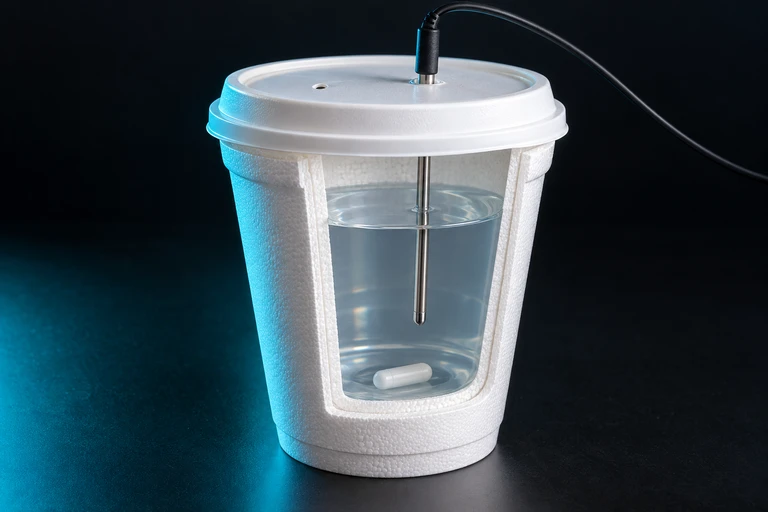 A coffee-cup calorimeter reduces heat exchange with the room while the solution’s temperature is measured.
The Calorimetry Principle
In an isolated system, heat lost by one part equals heat gained by another. For a reaction in solution:
Step-by-Step Problem Solving
Example 1: Heating Water
How much heat is needed to raise \( 250.0\;\text{g} \) of water from \( 20.0\;{}^\circ\text{C} \) to \( 85.0\;{}^\circ\text{C} \)?
Example 2: Finding Specific Heat
A \( 150.0\;\text{g} \) metal sample absorbs \( 2510\;\text{J} \) and its temperature rises from \( 22.0\;{}^\circ\text{C} \) to \( 59.3\;{}^\circ\text{C} \). What is the metal's specific heat?
Example 3: Coffee-Cup Calorimetry
When \( 50.0\;\text{mL} \) of \( 1.0\;\text{M HCl} \) is mixed with \( 50.0\;\text{mL} \) of \( 1.0\;\text{M NaOH} \), the temperature rises from \( 22.5\;{}^\circ\text{C} \) to \( 29.3\;{}^\circ\text{C} \). Find \( \Delta H_{\text{rxn}} \) per mole.
Temperature measurement during neutralization
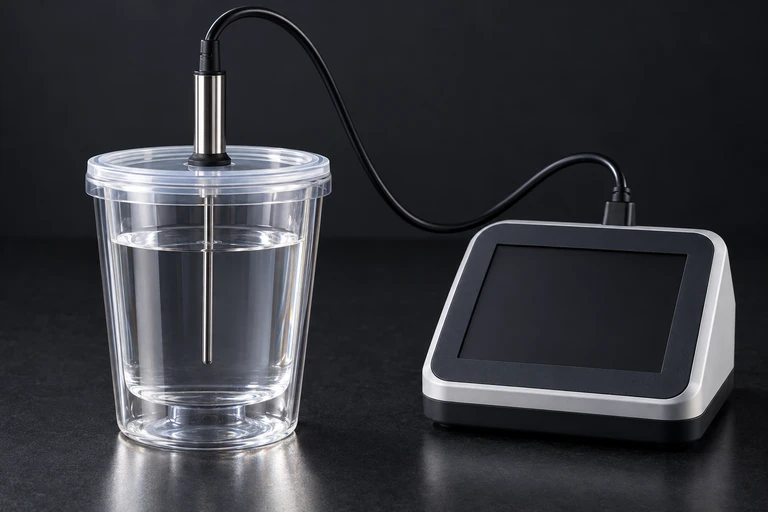 A temperature probe tracks the surroundings’ temperature during a reaction in a calorimeter.
Common Mistakes
Summary of Key Equations
| Scenario | Equation | Key Variable |
|---|---|---|
| Temperature change | \( q = mc\Delta T \) | \( c \) (specific heat) |
| Molar heat | \( q = nC_p\Delta T \) | \( C_p \) (molar heat cap.) |
| Phase change (melting) | \( q = n\Delta H_{\text{fus}} \) | \( \Delta H_{\text{fus}} \) |
| Phase change (boiling) | \( q = n\Delta H_{\text{vap}} \) | \( \Delta H_{\text{vap}} \) |
| Calorimetry | \( q_{\text{rxn}} = -q_{\text{soln}} \) | Conservation of energy |
Question 1 of 5
How much heat is required to raise the temperature of \( 100.0\;\text{g} \) of water from \( 25.0\;{}^\circ\text{C} \) to \( 75.0\;{}^\circ\text{C} \)?
(\( c_{\text{water}} = 4.184\;\tfrac{\text{J}}{\text{g}\cdot{}^\circ\text{C}} \))
Question 2 of 5
A \( 200.0\;\text{g} \) sample of an unknown metal absorbs \( 1500\;\text{J} \) and its temperature rises by \( 15.0\;{}^\circ\text{C} \). What is the specific heat of the metal?
Question 3 of 5
In a coffee-cup calorimeter, the temperature of \( 100.0\;\text{g} \) of water rises by \( 8.0\;{}^\circ\text{C} \) after a reaction. What is \( q_{\text{rxn}} \)?
Question 4 of 5
On a heating curve, what happens to the temperature during a phase change?
Question 5 of 5
Which substance requires the most heat to raise \( 50\;\text{g} \) by \( 10\;{}^\circ\text{C} \)?