Gibbs Free Energy
and Thermodynamic Favorability
Master the equation that predicts whether a reaction will occur spontaneously: understand \(\Delta G\), the interplay of enthalpy and entropy, and how temperature tips the balance.
What is Gibbs Free Energy?
Gibbs free energy, \(G\), is a thermodynamic quantity that combines enthalpy (\(H\)) and entropy (\(S\)) into a single value. The change in Gibbs free energy, \(\Delta G\), tells us whether a process is thermodynamically favorable (spontaneous) at constant temperature and pressure.
Why Does \(\Delta G\) Matter?
In chemistry, knowing whether a reaction is exothermic (\(\Delta H < 0\)) is not enough. Some endothermic reactions still proceed spontaneously because the entropy increase is large enough to drive the process forward. \(\Delta G\) captures both effects in one number.
The Tug of War: Enthalpy vs Entropy
The Gibbs Equation
Four Cases of Temperature Dependence
\(\Delta G < 0\) at all \(T\)
\(\Delta G > 0\) at all \(T\)
Enthalpy wins at low \(T\)
Entropy wins at high \(T\)
\(\Delta G\) vs Temperature Graph
Favorable vs Fast
A common source of confusion: thermodynamic favorability (\(\Delta G < 0\)) tells you a reaction can happen, not that it will happen quickly. The rate depends on kinetics (activation energy, catalysts), which is a completely separate question.
| Thermodynamics | Kinetics | |
|---|---|---|
| Question answered | Will it happen? | How fast? |
| Key quantity | \(\Delta G\) | \(E_a\) (activation energy) |
| Affected by catalyst? | No | Yes |
| Example | Diamond \(\rightarrow\) graphite is favorable | ...but takes millions of years |
How to Calculate \(\Delta G^\circ\)
Example 1: Rust Formation
For the reaction \(4\text{Fe}(s) + 3\text{O}_2(g) \rightarrow 2\text{Fe}_2\text{O}_3(s)\) at 298 K:
Example 2: Decomposition of \(\text{CaCO}_3\)
\(\text{CaCO}_3(s) \rightarrow \text{CaO}(s) + \text{CO}_2(g)\)
Given: \(\Delta H^\circ = +178.3\) kJ/mol, \(\Delta S^\circ = +160.5\) J/mol·K
A limestone grain undergoing calcination
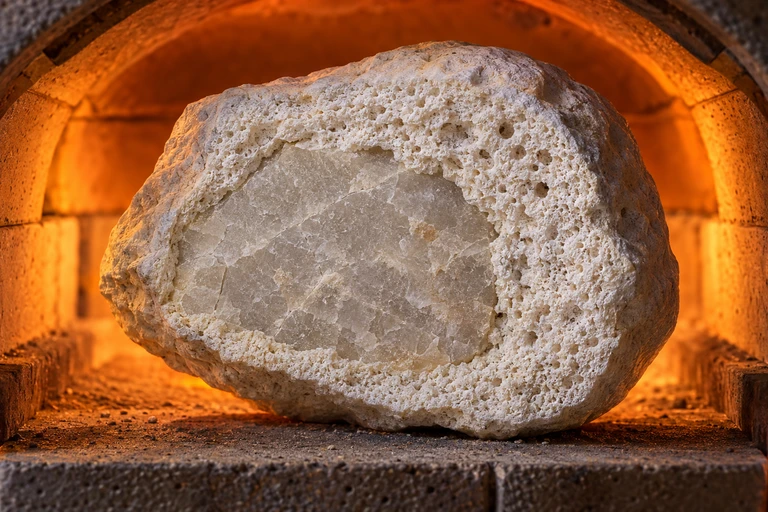 Heating calcium carbonate can produce calcium oxide and carbon dioxide.
Example 3: Using \(\Delta G^\circ_f\) Values
You can also calculate \(\Delta G^\circ\) from standard free energies of formation:
For \(\text{CH}_4(g) + 2\text{O}_2(g) \rightarrow \text{CO}_2(g) + 2\text{H}_2\text{O}(l)\):
\(\Delta G^\circ\) and the Equilibrium Constant
\(\Delta G\) vs \(\Delta G^\circ\): Know the Difference
| \(\Delta G^\circ\) | \(\Delta G\) | |
|---|---|---|
| Conditions | Standard state (1 atm, 1 M) | Any conditions |
| Formula | \(\Delta H^\circ - T\Delta S^\circ\) | \(\Delta G^\circ + RT\ln Q\) |
| Tells you | Favorability at standard state | Favorability at current conditions |
| At equilibrium | May not be zero | Always zero |
Common Mistakes to Avoid
Summary: Sign Combinations
| \(\Delta H\) | \(\Delta S\) | \(\Delta G\) | Favorability |
|---|---|---|---|
| − | + | Always − | Favorable at all \(T\) |
| + | − | Always + | Never favorable |
| − | − | Depends on \(T\) | Favorable at low \(T\) |
| + | + | Depends on \(T\) | Favorable at high \(T\) |
Question 1 of 5
A reaction has \(\Delta H^\circ = -120\) kJ/mol and \(\Delta S^\circ = +250\) J/mol·K. At 298 K, what is the sign of \(\Delta G^\circ\)?
Question 2 of 5
For a reaction with \(\Delta H^\circ = +50\) kJ/mol and \(\Delta S^\circ = +150\) J/mol·K, above what temperature does the reaction become favorable?
Question 3 of 5
If \(\Delta G^\circ\) for a reaction is \(-30\) kJ/mol, what can you conclude about the equilibrium constant \(K\)?
Question 4 of 5
A student calculates \(\Delta G^\circ = \Delta H^\circ - T\Delta S^\circ\) using \(\Delta H^\circ = -100\) kJ/mol, \(T = 298\) K, and \(\Delta S^\circ = -200\) J/mol·K but gets \(\Delta G^\circ = -100 - 298(200) = -59{,}700\) kJ/mol. What is the error?
Question 5 of 5
Which of the following reactions is favorable at all temperatures?