Galvanic & Electrolytic
Cells
Understand how spontaneous and non-spontaneous redox reactions power electrochemical cells: from batteries to electroplating.
What Is Electrochemistry?
Electrochemistry is the branch of chemistry that studies the interconversion of chemical energy and electrical energy. Every electrochemical process involves oxidation-reduction (redox) reactions: one species loses electrons while another gains them.
Two Types of Electrochemical Cells
All electrochemical cells contain two electrodes immersed in electrolyte solutions and connected by an external circuit. The key difference is whether the reaction is spontaneous.
Anatomy of a Galvanic Cell
One connected zinc-copper cell
 A zinc–copper cell connects two half-cells through an external circuit and a salt bridge.
Role of the Salt Bridge
Without a salt bridge, charge would build up in each half-cell and the reaction would stop almost immediately. The salt bridge serves two critical functions:
Standard Cell Potential: \(E^\circ_{\text{cell}}\)
The standard cell potential measures the driving force of the electrochemical reaction under standard conditions (1 M, 1 atm, 25 °C). It is calculated from standard reduction potentials:
Linking \(E^\circ\), \(\Delta G^\circ\), and \(K\)
Three thermodynamic quantities are connected for any redox reaction at standard conditions:
Galvanic vs. Electrolytic Cells
| Feature | Galvanic (Voltaic) | Electrolytic |
|---|---|---|
| Reaction type | Spontaneous | Non-spontaneous |
| \(E^\circ_{\text{cell}}\) | > 0 | < 0 |
| \(\Delta G^\circ\) | < 0 | > 0 |
| Anode charge | Negative (−) | Positive (+) |
| Cathode charge | Positive (+) | Negative (−) |
| Energy source | Chemical reaction | External battery/power supply |
| Salt bridge | Required (two solutions) | Usually one shared electrolyte |
| Example | Battery | Electroplating, electrolysis |
Transverse cutaway of a wound rechargeable cell
 A wound rechargeable cell contains alternating electrode and separator layers.
Inside an Electrolytic Cell
Separated products in a molten-salt cell
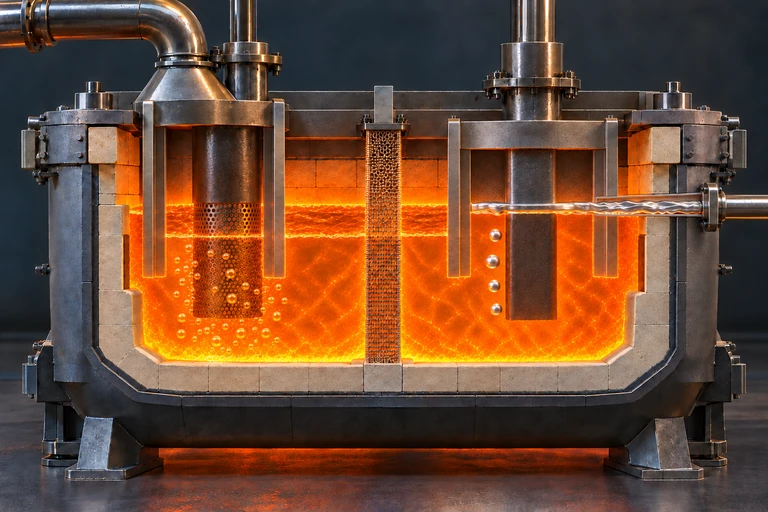 A molten-salt electrolytic cell separates the products formed at its two electrodes.
The Nernst Equation
When conditions are not standard (concentrations differ from 1 M), the cell potential changes. The Nernst equation adjusts \(E^\circ\) for non-standard conditions:
How to Calculate \(E^\circ_{\text{cell}}\)
Example 1: Zn-Cu Cell
Calculate \(E^\circ_{\text{cell}}\) for a galvanic cell made of Zn and Cu electrodes.
Example 2: \(\Delta G^\circ\) from \(E^\circ\)
For the Zn-Cu cell (\(E^\circ_{\text{cell}} = +1.10\;\text{V}\), \(n = 2\)), calculate \(\Delta G^\circ\).
Example 3: Nernst Equation
For the Zn-Cu cell with \([\text{Zn}^{2+}] = 0.10\;\text{M}\) and \([\text{Cu}^{2+}] = 2.0\;\text{M}\), find \(E_{\text{cell}}\) at 25 °C.
Faraday's Laws of Electrolysis
Faraday's law connects the amount of substance deposited or dissolved at an electrode to the charge passed through the cell:
Common Mistakes
Key Equations Summary
| Equation | Formula | When to Use |
|---|---|---|
| Standard cell potential | \(E^\circ_{\text{cell}} = E^\circ_{\text{cath}} - E^\circ_{\text{an}}\) | Standard conditions |
| Gibbs free energy | \(\Delta G^\circ = -nFE^\circ_{\text{cell}}\) | Linking \(E^\circ\) and spontaneity |
| Nernst equation | \(E = E^\circ - \frac{0.0592}{n}\log Q\) | Non-standard concentrations |
| Faraday's law | \(\text{mol} = \frac{It}{nF}\) | Electrolysis calculations |
| Equilibrium link | \(E^\circ = \frac{0.0592}{n}\log K\) | Relating \(E^\circ\) and \(K\) |
Question 1 of 5
In a galvanic cell, which electrode is negative?
Question 2 of 5
Given \(E^\circ(\text{Ag}^+/\text{Ag}) = +0.80\;\text{V}\) and \(E^\circ(\text{Fe}^{2+}/\text{Fe}) = -0.44\;\text{V}\), what is \(E^\circ_{\text{cell}}\) for the spontaneous cell?
Question 3 of 5
What is the primary function of the salt bridge in a galvanic cell?
Question 4 of 5
A current of \(2.00\;\text{A}\) passes through a solution of \(\text{CuSO}_4\) for \(1.00\;\text{hour}\). How many grams of Cu are deposited? (\(M_{\text{Cu}} = 63.55\;\text{g/mol}\), \(n = 2\))
Question 5 of 5
In an electrolytic cell, which statement is true?