Free Energy of
Dissolution
Understand how enthalpy, entropy, and temperature determine whether a solute dissolves spontaneously using \( \Delta G^\circ_{\text{diss}} = \Delta H^\circ_{\text{diss}} - T\Delta S^\circ_{\text{diss}} \).
What Is Dissolution?
Dissolution is the process in which a solute (solid, liquid, or gas) disperses into a solvent to form a homogeneous solution. At the molecular level, solute-solute interactions break, solvent-solvent interactions break, and new solute-solvent interactions form.
Three Energy Steps of Dissolution
Water orientation around one sodium ion
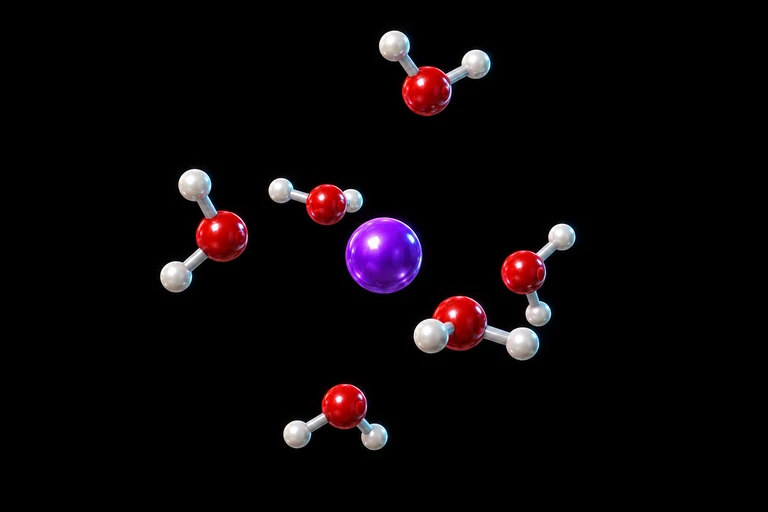 Water molecules orient their partially negative oxygen atoms toward a sodium ion.
Why Entropy Matters
Dissolution almost always increases entropy (\(\Delta S_{\text{diss}} > 0\)) because solute particles disperse throughout the solvent, creating more microstates. This positive \(\Delta S\) can drive dissolution even when \(\Delta H_{\text{diss}}\) is endothermic.
One chloride hydration environment
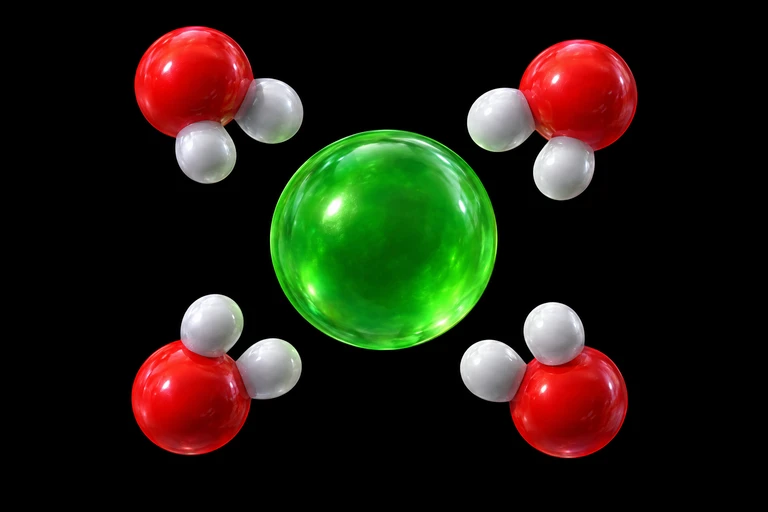 Water molecules orient their partially positive hydrogen atoms toward a chloride ion.
The Gibbs Free Energy Equation
The Enthalpy-Entropy Interplay
\(\Delta G^\circ\) vs. \(K_{sp}\): Key Distinction
Both \(\Delta G^\circ\) and \(K_{sp}\) describe dissolution thermodynamics but from different perspectives. They are connected by a powerful equation:
| \(\Delta G^\circ_{\text{diss}}\) | \(K_{sp}\) | |
|---|---|---|
| What it measures | Energy change at standard state | Equilibrium ion concentrations |
| Units | kJ/mol | Unitless (activity-based) |
| Spontaneous when | < 0 | > 1 |
| Temperature dependence | Through \(\Delta H\) and \(\Delta S\) | Shifts with \(T\) via van 't Hoff |
Temperature Dependence of \(\Delta G\)
How to Calculate \(\Delta G^\circ_{\text{diss}}\)
Example 1: NaCl in Water
Given: \(\Delta H^\circ_{\text{diss}} = +3.87 \text{ kJ/mol}\), \(\Delta S^\circ_{\text{diss}} = +43.2 \text{ J/(mol} \cdot \text{K)}\). Find \(\Delta G^\circ\) at 25 \(^\circ\)C.
Example 2: \(\text{NH}_4\text{NO}_3\) at Two Temperatures
Given: \(\Delta H^\circ_{\text{diss}} = +25.7 \text{ kJ/mol}\), \(\Delta S^\circ_{\text{diss}} = +108.0 \text{ J/(mol} \cdot \text{K)}\). Compare \(\Delta G^\circ\) at 10 \(^\circ\)C and 50 \(^\circ\)C.
\(= 25.7 - 30.58\)
\(= \) \(-4.88\) kJ/mol
\(= 25.7 - 34.90\)
\(= \) \(-9.20\) kJ/mol
Inside one activated cold pack
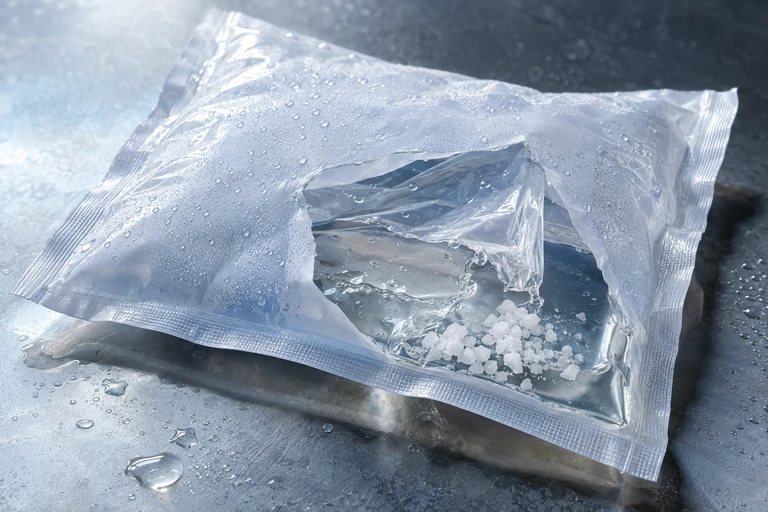 Dissolution inside an activated cold pack absorbs heat from the surroundings.
Example 3: Finding Crossover Temperature
A solute has \(\Delta H^\circ_{\text{diss}} = +18.0 \text{ kJ/mol}\) and \(\Delta S^\circ_{\text{diss}} = +55.0 \text{ J/(mol} \cdot \text{K)}\). At what temperature does dissolution become spontaneous?
Lattice Energy vs. Hydration Energy
Common Mistakes
Summary of Spontaneity Conditions
| Condition | \(\Delta H\) | \(\Delta S\) | \(\Delta G\) | Spontaneous? |
|---|---|---|---|---|
| Exothermic, more disorder | \(< 0\) | \(> 0\) | \(< 0\) always | Yes, all T |
| Endothermic, more disorder | \(> 0\) | \(> 0\) | Depends on T | At high T |
| Exothermic, less disorder | \(< 0\) | \(< 0\) | Depends on T | At low T |
| Endothermic, less disorder | \(> 0\) | \(< 0\) | \(> 0\) always | Never |
Question 1 of 5
A salt has \(\Delta H^\circ_{\text{diss}} = +12.0\) kJ/mol and \(\Delta S^\circ_{\text{diss}} = +40.0\) \(\text{J/(mol}\cdot\text{K)}\). What is \(\Delta G^\circ_{\text{diss}}\) at 25 \(^\circ\)C?
Question 2 of 5
If a dissolution process has \(\Delta H^\circ < 0\) and \(\Delta S^\circ > 0\), the process is:
Question 3 of 5
A compound has \(\Delta H^\circ_{\text{diss}} = +30.0\) kJ/mol and \(\Delta S^\circ_{\text{diss}} = +100.0\) \(\text{J/(mol}\cdot\text{K)}\). Above what temperature is dissolution spontaneous?
Question 4 of 5
Which of the following correctly relates \(\Delta G^\circ\) to the solubility product constant \(K_{sp}\)?
Question 5 of 5
Ammonium nitrate (\(\text{NH}_4\text{NO}_3\)) dissolves endothermically in water and the solution feels cold. Why does it still dissolve spontaneously at room temperature?