Enthalpy of
Formation
Master the standard enthalpy of formation and learn how to use \(\Delta H_f^\circ\) values to calculate enthalpy changes for any reaction using Hess's Law.
What Is Enthalpy?
Enthalpy (\(H\)) is a thermodynamic quantity that represents the total heat content of a system at constant pressure. We cannot measure \(H\) directly, but we can measure changes in enthalpy: \(\Delta H\).
Defining \(\Delta H_f^\circ\)
The standard enthalpy of formation (\(\Delta H_f^\circ\)) is the enthalpy change when one mole of a compound is formed from its constituent elements in their standard states.
Standard States of Elements
The "standard state" is the most stable form of an element at 1 bar and \(25^\circ\text{C}\). Getting these right is essential for writing formation reactions.
The zero belongs to a chosen elemental form
 At 298.15 K and 1 bar, graphite, O₂(g) and Br₂(l) are elemental reference forms with standard formation enthalpy zero. Diamond is a different allotrope; a formation equation produces exactly one mole of the specified product.
Zero is a reference convention
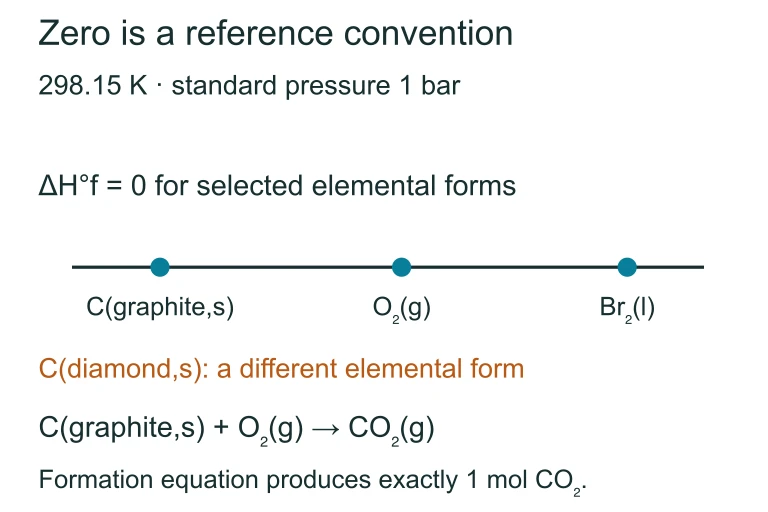 At 298.15 K and 1 bar, graphite, O₂(g) and Br₂(l) are elemental reference forms with standard formation enthalpy zero. Diamond is a different allotrope; a formation equation produces exactly one mole of the specified product.
Visualizing Formation Energy
The Core Equation
Hess's Law lets us calculate the enthalpy change for any reaction using tabulated \(\Delta H_f^\circ\) values:
Hess's Law Pathway
\(\Delta H_f^\circ\) vs. \(\Delta H_{\text{rxn}}^\circ\)
| \(\Delta H_f^\circ\) | \(\Delta H_{\text{rxn}}^\circ\) | |
|---|---|---|
| Definition | Formation of 1 mol compound from elements | Enthalpy change for any balanced reaction |
| Reactants | Elements in standard states only | Any substances |
| Product | Exactly 1 mole of one compound | Whatever the equation specifies |
| Tabulated? | Yes: standard reference tables | Calculated from \(\Delta H_f^\circ\) values |
| Elements | Always 0 in standard state | Not necessarily 0 |
Step-by-Step Method
Example 1: Combustion of Methane
Example 1: Solution
Example 2: Decomposition of Water
Example 3: Photosynthesis
Common Mistakes
Key \(\Delta H_f^\circ\) Values
| Substance | \(\Delta H_f^\circ\) (kJ/mol) | Notes |
|---|---|---|
| \(\text{H}_2\text{O}(l)\) | \(-285.8\) | Liquid water |
| \(\text{H}_2\text{O}(g)\) | \(-241.8\) | Steam: less negative |
| \(\text{CO}_2(g)\) | \(-393.5\) | Very stable compound |
| \(\text{CH}_4(g)\) | \(-74.8\) | Methane (natural gas) |
| \(\text{C}_6\text{H}_{12}\text{O}_6(s)\) | \(-1273.3\) | Glucose |
| \(\text{O}_2(g), \text{H}_2(g), \text{C}(\text{graphite})\) | 0 | Elements in standard state |
Question 1 of 5
What is \(\Delta H_f^\circ\) for \(\text{O}_2(g)\) at standard conditions?
Question 2 of 5
Which equation correctly represents the standard formation reaction for \(\text{NO}_2(g)\)?
Question 3 of 5
Given: \(\Delta H_f^\circ[\text{NH}_3(g)] = -45.9\ \text{kJ/mol}\). Calculate \(\Delta H_{\text{rxn}}^\circ\) for:
\(\text{N}_2(g) + 3\text{H}_2(g) \rightarrow 2\text{NH}_3(g)\)
Question 4 of 5
For the reaction \(\text{CaCO}_3(s) \rightarrow \text{CaO}(s) + \text{CO}_2(g)\), given:
\(\Delta H_f^\circ[\text{CaCO}_3] = -1206.9\), \(\Delta H_f^\circ[\text{CaO}] = -635.1\), \(\Delta H_f^\circ[\text{CO}_2] = -393.5\) (all kJ/mol).
What is \(\Delta H_{\text{rxn}}^\circ\)?
Question 5 of 5
If a compound has a large negative \(\Delta H_f^\circ\), which statement is most accurate?