Energy of
Phase Changes
Explore how enthalpy governs transitions between solid, liquid, and gas, and master the calculations behind heating curves and latent heat.
What Are Phase Changes?
A phase change is a physical transformation in which a substance converts from one state of matter to another: solid, liquid, or gas. During a phase change, the temperature remains constant even though energy is being added or removed.
The Six Phase Transitions
Enthalpy: \(\Delta H\) of Phase Changes
Each phase change has a characteristic enthalpy value that quantifies the energy per mole required (or released). These are measured at the substance's normal transition temperature and 1 atm pressure.
The Heating Curve
Core Equations
Why \(\Delta H_{\text{vap}}\) >> \(\Delta H_{\text{fus}}\)
Vaporization requires far more energy than fusion. During melting, molecules only partially overcome intermolecular forces (they still touch in the liquid). During boiling, molecules must completely separate, breaking essentially all intermolecular attractions.
The melting interface of ice and water
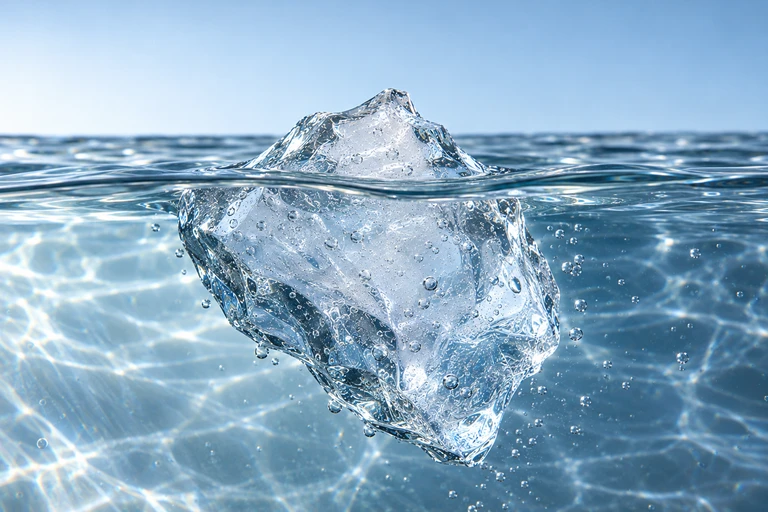 At an ice–water interface, melting changes molecular organization while preserving water molecules.
Endothermic vs Exothermic
| Endothermic (+\(\Delta H\)) | Exothermic (-\(\Delta H\)) | |
|---|---|---|
| Energy flow | System absorbs heat | System releases heat |
| IMF effect | IMFs are broken | IMFs are formed |
| Examples | Melting, boiling, sublimation | Freezing, condensation, deposition |
| Sign of \(q\) | \(q > 0\) | \(q < 0\) |
How to Solve Heating Curve Problems
Warm water must pay the melting cost first
 In an insulated mixture, 400 g of water at 60 °C can release 100.320 kJ before reaching 0 °C. Warming and melting 150 g of ice initially at −10 °C requires 53.235 kJ; the remaining energy warms 550 g of liquid to about 20.5 °C.
Check the melting threshold first
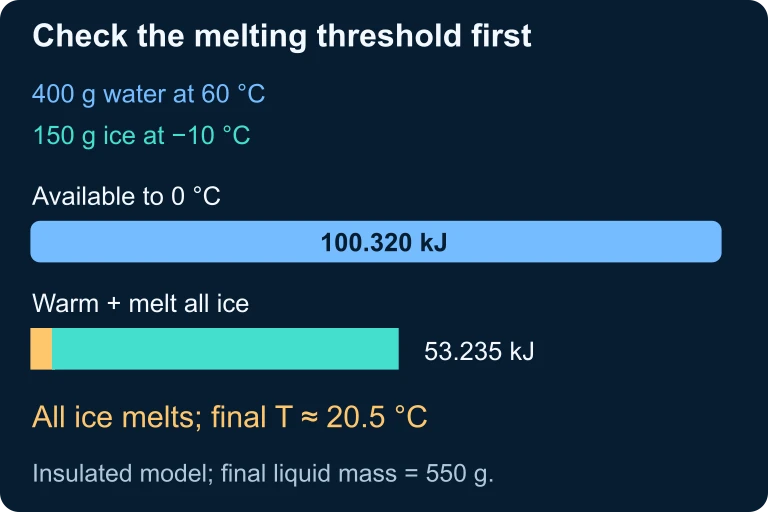 In an insulated mixture, 400 g of water at 60 °C can release 100.320 kJ before reaching 0 °C. Warming and melting 150 g of ice initially at −10 °C requires 53.235 kJ; the remaining energy warms 550 g of liquid to about 20.5 °C.
Insufficient heat leaves ice at 0 °C
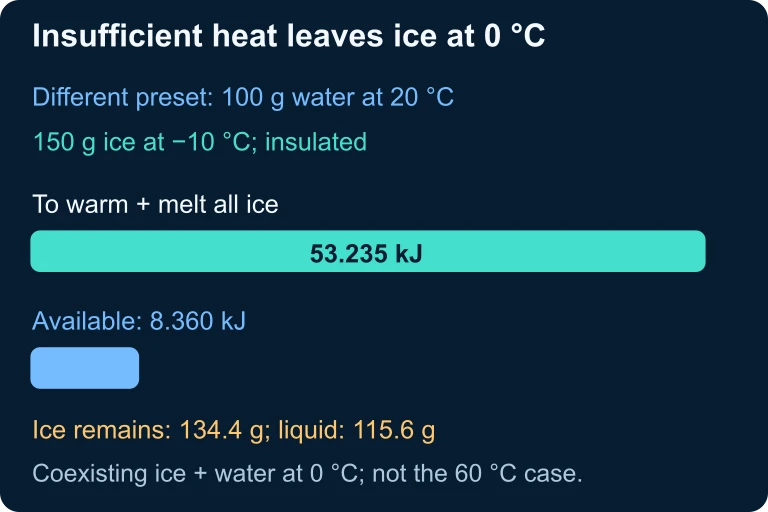 In a separate insulated mixture, 100 g of water at 20 °C cannot melt 150 g of ice initially at −10 °C. About 134.4 g of ice remains with 115.6 g of liquid at 0 °C.
Example 1: Melting Ice
Problem: How much energy is needed to melt 36.0 g of ice at 0 °C? \(\Delta H_{\text{fus}} = 6.02 \text{ kJ/mol}\)
Example 2: Ice to Steam
Problem: Calculate the total energy to convert 18.02 g (1.00 mol) of ice at -20 °C to steam at 120 °C.
Given: \(c_{\text{ice}} = 2.09 \text{ J/(g}\cdot{}^\circ\text{C)}\), \(c_{\text{liq}} = 4.18 \text{ J/(g}\cdot{}^\circ\text{C)}\), \(c_{\text{steam}} = 2.01 \text{ J/(g}\cdot{}^\circ\text{C)}\), \(\Delta H_{\text{fus}} = 6.02 \text{ kJ/mol}\), \(\Delta H_{\text{vap}} = 40.7 \text{ kJ/mol}\)
Example 2: Total Energy
Notice that vaporization dominates: it accounts for approximately 73% of the total energy. This visually shows why \(\Delta H_{\text{vap}}\) is so much larger than \(\Delta H_{\text{fus}}\).
Example 3: Cooling Steam
Problem: How much energy is released when 2.00 mol of steam at 100 °C condenses to liquid water at 100 °C?
IMF Strength and \(\Delta H\)
Substances with stronger intermolecular forces have higher enthalpies of phase change. More energy is needed to overcome stronger attractions between molecules.
| Substance | \(\Delta H_{\text{fus}}\) (kJ/mol) | \(\Delta H_{\text{vap}}\) (kJ/mol) | Dominant IMF |
|---|---|---|---|
| \(\text{CH}_4\) | 0.94 | 8.2 | London dispersion |
| \(\text{HCl}\) | 2.0 | 16.2 | Dipole-dipole |
| \(\text{H}_2\text{O}\) | 6.02 | 40.7 | H-bonding |
| \(\text{NaCl}\) | 28.0 | 171 | Ionic bonds |
Common Mistakes
Summary Reference Table
| Region | Equation | What changes | What stays constant |
|---|---|---|---|
| Heating solid | \(q = mc_{\text{s}}\Delta T\) | Temperature | Phase (solid) |
| Melting | \(q = n\Delta H_{\text{fus}}\) | Phase (S → L) | Temperature |
| Heating liquid | \(q = mc_{\text{l}}\Delta T\) | Temperature | Phase (liquid) |
| Boiling | \(q = n\Delta H_{\text{vap}}\) | Phase (L → G) | Temperature |
| Heating gas | \(q = mc_{\text{g}}\Delta T\) | Temperature | Phase (gas) |
Question 1 of 5
During the melting of ice at 0 °C, the temperature of the ice-water mixture remains constant. Where does the added energy go?
Question 2 of 5
How much energy is required to melt 90.1 g of ice at 0 °C?
(\(\Delta H_{\text{fus}} = 6.02 \text{ kJ/mol}\), molar mass of water = 18.02 g/mol)
Question 3 of 5
Which process is exothermic?
Question 4 of 5
On a heating curve, the boiling plateau is much longer (wider) than the melting plateau. What does this indicate?
Question 5 of 5
A student heats 36.04 g of liquid water from 25 °C to 100 °C, then boils it all to steam. What is the total energy required?
(\(c_{\text{liq}} = 4.18 \text{ J/(g}\cdot{}^\circ\text{C)}\), \(\Delta H_{\text{vap}} = 40.7 \text{ kJ/mol}\))