Endothermic &
Exothermic Processes
Understand how energy flows during chemical reactions: when systems absorb or release heat, and how to quantify it using \( \Delta H \).
What is Enthalpy?
Enthalpy (\( H \)) is the total heat content of a system at constant pressure. We cannot measure \( H \) directly, but we can measure the change in enthalpy during a process:
Enthalpy change is the key quantity that tells us whether a process is endothermic or exothermic.
Exothermic Processes
In an exothermic process, the system releases heat to the surroundings. The products have less energy than the reactants.
Endothermic Processes
In an endothermic process, the system absorbs heat from the surroundings. The products have more energy than the reactants.
Why Energy Flow Matters
The First Law of Thermodynamics
Energy cannot be created or destroyed: it is only transferred or converted. In a chemical reaction at constant pressure, the heat exchanged equals the enthalpy change:
This means every joule of energy released by an exothermic reaction is absorbed by the surroundings, and every joule absorbed in an endothermic reaction comes from the surroundings.
System vs Surroundings
Exothermic vs Endothermic
| Property | Exothermic | Endothermic |
|---|---|---|
| Sign of \( \Delta H \) | Negative (\( - \)) | Positive (\( + \)) |
| Heat flow | System → Surroundings | Surroundings → System |
| Temperature of surroundings | Increases | Decreases |
| Bond energy | \( \text{Bonds formed} > \text{Bonds broken} \) | \( \text{Bonds broken} > \text{Bonds formed} \) |
| Energy diagram | Products lower than reactants | Products higher than reactants |
| Example | Combustion of methane | Photosynthesis |
The Bond Energy Perspective
Every chemical reaction involves breaking old bonds (requires energy) and forming new bonds (releases energy). The balance determines \( \Delta H \):
How to Identify the Process
Example 1: Combustion of Methane
The negative sign tells us this is exothermic. For every mole of methane burned, 890 kJ of heat is released to the surroundings.
Example 2: Dissolving \(\text{NH}_4\text{NO}_3\)
The positive \( \Delta H \) means this is endothermic. The system absorbs 25.7 kJ of heat from the water, causing the solution to feel cold.
Example 3: Hess's Law Calculation
Find \( \Delta H \) for the formation of ethanol:
Using standard enthalpies of formation:
Measuring \( \Delta H \): Calorimetry
A calorimeter measures the heat exchanged during a reaction by tracking temperature changes in a known mass of water:
Temperature measurement during neutralization
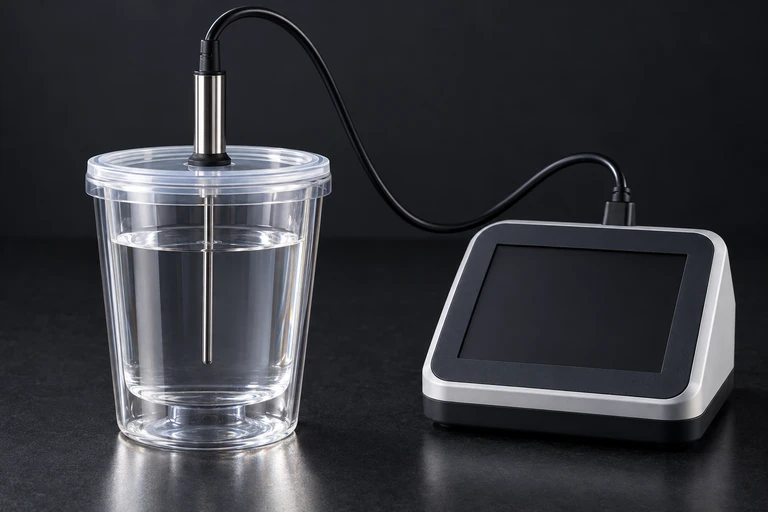 A temperature probe tracks the surroundings’ temperature during a reaction in a calorimeter.
Phase Changes and Energy
Common Mistakes to Avoid
Question 1 of 5
The combustion of propane has \( \Delta H = -2220 \text{ kJ/mol} \). Which statement is correct?
Question 2 of 5
When ammonium nitrate dissolves in water, the solution feels cold. What can you conclude about \( \Delta H \) for this dissolution?
Question 3 of 5
Using bond energies, a reaction breaks bonds totaling 1500 kJ and forms bonds totaling 1800 kJ. What is \( \Delta H \)?
Question 4 of 5
A coffee-cup calorimeter shows the temperature of 100.0 g of water rising from \( 22.0\,{}^{\circ}\text{C} \) to \( 28.5\,{}^{\circ}\text{C} \). Using \( q = mc\Delta T \) with \( c = 4.184 \text{ J/g}\cdot{}^{\circ}\text{C} \), what is \( q_{\text{rxn}} \)?
Question 5 of 5
Which of the following phase changes is exothermic?