Elemental Composition
of Pure Substances
Learn how to determine the percent composition by mass of elements within compounds using molar masses and chemical formulas.
What Are Pure Substances?
A pure substance has a fixed, definite composition that does not vary from sample to sample. There are two types:
Why Elemental Composition Matters
Knowing the elemental composition of a substance allows chemists to:
Key Vocabulary for This Lesson
The Percent Composition Formula
Visualizing Composition of \(\mathrm{H_2O}\)
Elements vs Compounds: A Key Distinction
| Element | Compound | |
|---|---|---|
| Composition | One type of atom only | Two or more elements in fixed ratio |
| Percent Composition | 100% of itself | Each element < 100% |
| Decomposition | Cannot be decomposed chemically | Can be broken into elements |
| Examples | Fe, \(\mathrm{O_2}\), Ne | \(\mathrm{H_2O}\), \(\mathrm{NaCl}\), \(\mathrm{CO_2}\) |
| Molar Mass Source | Periodic table directly | Sum of constituent atomic masses |
How to Calculate Percent Composition
Worked Example: \(\mathrm{CO_2}\)
Find the percent composition by mass of carbon and oxygen in carbon dioxide.
Worked Example: \(\mathrm{Ca(OH)_2}\)
Find the percent composition of each element in calcium hydroxide.
Advanced: \(\mathrm{(NH_4)_2SO_4}\)
Find the percent nitrogen in ammonium sulfate, a common fertilizer.
Reverse Direction: Percent to Formula
You can also work backwards: given percent composition data, determine the empirical formula of an unknown compound.
One connected combustion-analysis train
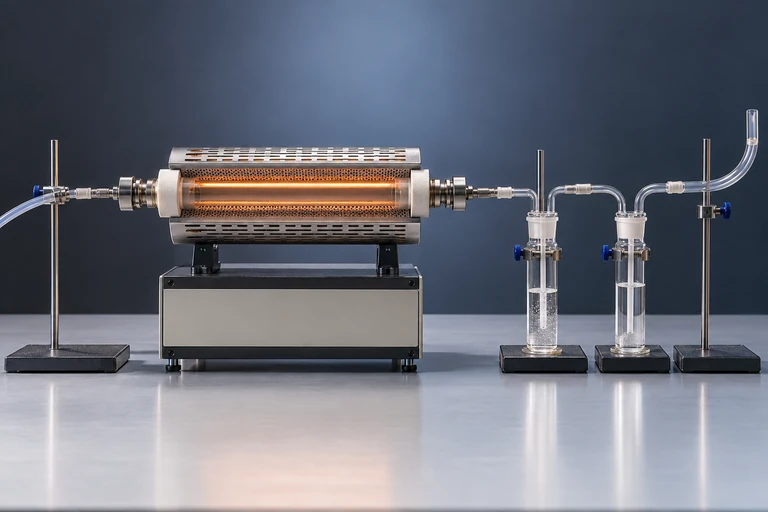 A combustion-analysis train carries combustion products through collection stages for analysis.
Example: Finding the Empirical Formula
A compound is 40.00% C, 6.71% H, and 53.29% O by mass. Find the empirical formula.
| Step | C | H | O |
|---|---|---|---|
| Assume 100 g | 40.00 g | 6.71 g | 53.29 g |
| Convert to mol | 3.331 | 6.657 | 3.331 |
| Divide by smallest | 1.000 | 1.998 | 1.000 |
| Whole-number ratio | 1 | 2 | 1 |
Molecular vs Empirical Formulas
Common Mistakes to Avoid
Summary: Key Formulas and Relationships
| Concept | Formula / Rule | Key Detail |
|---|---|---|
| Molar Mass | Sum of all atomic masses | Units: g/mol |
| % Composition | \(\frac{n \times M_{\text{element}}}{M_{\text{compound}}} \times 100\%\) | Must sum to 100% |
| Empirical Formula | Simplest whole-number ratio | Derived from % or mass data |
| Molecular Formula | \(n \times\) empirical formula | Requires experimental molar mass |
| Law of Definite Proportions | Fixed ratio by mass | Regardless of sample source |
Question 1 of 5
What is the approximate percent composition of oxygen by mass in \(\mathrm{CO_2}\)? (Molar masses: C = 12.01, O = 16.00)
Question 2 of 5
A compound has the empirical formula \(\mathrm{CH_2O}\) and a molar mass of 180.16 g/mol. What is the molecular formula?
Question 3 of 5
Which of the following statements about the Law of Definite Proportions is correct?
Question 4 of 5
How many total atoms of hydrogen are in one formula unit of \(\mathrm{(NH_4)_2SO_4}\)?
Question 5 of 5
A compound is found to be 52.14% C, 13.13% H, and 34.73% O by mass. What is its empirical formula?