Electrolysis &
Faraday's Law
Master the quantitative relationship between electrical charge and chemical change in electrolytic cells.
What Is Electrolysis?
Electrolysis uses electrical energy to drive a non-spontaneous chemical reaction. An external power source forces electrons through an electrolyte solution, causing reduction at the cathode and oxidation at the anode.
One powered copper electrolysis cell
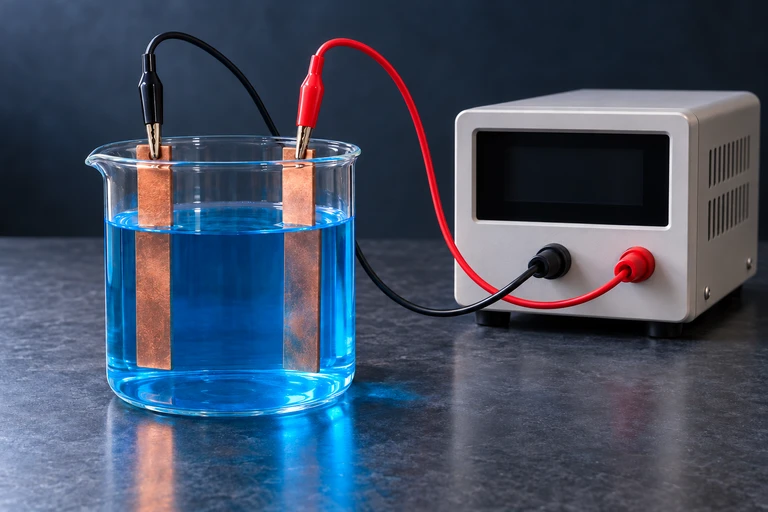 An external power supply drives electrode reactions in an electrolytic cell.
Anatomy of an Electrolytic Cell
Why Does Electrolysis Matter?
Copper depositing on a metal object
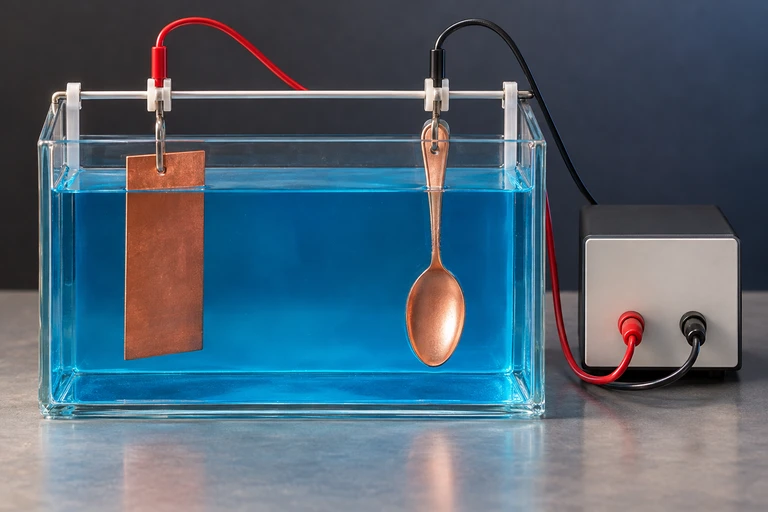 During copper electroplating, copper ions are reduced onto the object connected as the cathode.
Key Quantities You Need
Faraday's Law of Electrolysis
The Logic Chain
Galvanic vs. Electrolytic
| Galvanic Cell | Electrolytic Cell | |
|---|---|---|
| Reaction Type | Spontaneous | Non-spontaneous |
| \( \Delta G \) | \( \lt 0 \) | \( \gt 0 \) |
| Energy | Produces electricity | Consumes electricity |
| Anode Charge | Negative (−) | Positive (+) |
| Cathode Charge | Positive (+) | Negative (−) |
| Salt Bridge | Required | Not needed (shared solution) |
Determining \( n \): Electrons Transferred
The value of \( n \) comes from the balanced half-reaction. It equals the number of electrons gained (at cathode) or lost (at anode) per formula unit.
How to Solve Any Problem
Example 1: Copper Plating
A current of 5.00 A is passed through a \( \text{CuSO}_4 \) solution for 40.0 minutes. How many grams of copper are deposited at the cathode?
Example 2: Silver Electroplating
How long must a 2.50 A current flow through an \( \text{AgNO}_3 \) solution to deposit 10.0 g of silver?
Example 3: Gas Production
What volume of \( \text{O}_2 \) gas at STP is produced at the anode when 3.00 A flows through water for 1.00 hour?
One current, two unequal gas collections
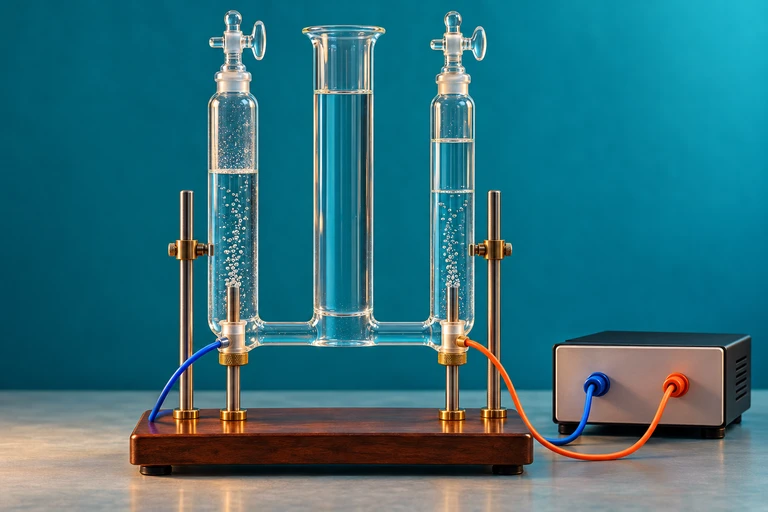 In dilute sulfuric acid with inert electrodes, the negative cathode produces hydrogen and the positive anode produces oxygen. Equal charge at both electrodes gives a 2:1 mole ratio; comparing dry-gas volumes requires matched temperature and pressure.
One charge, two gas amounts
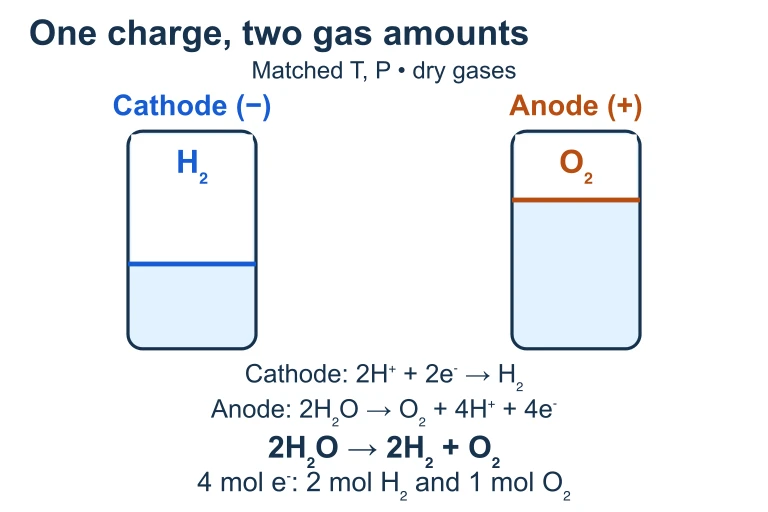 In dilute sulfuric acid with inert electrodes, the negative cathode produces hydrogen and the positive anode produces oxygen. Equal charge at both electrodes gives a 2:1 mole ratio; comparing dry-gas volumes requires matched temperature and pressure.
Cells in Series: Same Charge
Common Mistakes
Summary Reference Table
| Quantity | Symbol | Formula / Value | Unit |
|---|---|---|---|
| Total charge | \( Q \) | \( I \times t \) | Coulombs (C) |
| Moles of \( e^- \) | \( n_{e^-} \) | \( Q / F \) | mol |
| Moles of substance | \( n_{\text{sub}} \) | \( n_{e^-} / n \) | mol |
| Mass deposited | \( m \) | \( n_{\text{sub}} \times M \) | grams (g) |
| Faraday's constant | \( F \) | \( 96{,}485 \) | C/mol |
Question 1 of 5
A current of 10.0 A passes through a solution of \( \text{NiCl}_2 \) for 30.0 minutes. Given \( \text{Ni}^{2+} + 2e^- \to \text{Ni} \) and \( M_{\text{Ni}} = 58.69 \text{ g/mol} \), what mass of nickel is deposited?
Question 2 of 5
In electrolysis, oxidation always occurs at which electrode?
Question 3 of 5
Two electrolytic cells are connected in series. Cell A contains \( \text{AgNO}_3 \) (\( n=1 \)) and Cell B contains \( \text{CuSO}_4 \) (\( n=2 \)). If 1.08 g of silver is deposited in Cell A, what mass of copper is deposited in Cell B?
Question 4 of 5
What is the value of Faraday's constant \( F \), and what does it physically represent?
Question 5 of 5
During the electrolysis of water, hydrogen gas is produced at the cathode. If \( 0.500 \) mol of \( \text{H}_2 \) is collected, how many coulombs of charge were passed? (Half-reaction: \( 2\text{H}^+ + 2e^- \to \text{H}_2 \))