Coupled
Reactions
Learn how thermodynamically unfavorable reactions can be driven forward by pairing them with highly favorable reactions using Gibbs free energy.
What is Gibbs Free Energy?
Every chemical reaction has a change in Gibbs free energy, symbolized \( \Delta G \). This single value tells us whether a reaction is thermodynamically favorable (spontaneous) or unfavorable (nonspontaneous) under given conditions.
The Problem: Unfavorable Reactions
Many reactions essential to life and industry have positive \( \Delta G \) values. On their own, they simply will not happen. For example, synthesizing glucose from \( \text{CO}_2 \) and \( \text{H}_2\text{O} \) is highly unfavorable.
The Solution: Coupling Reactions
Nature's elegant trick: pair an unfavorable reaction with a highly favorable one. If the combined \( \Delta G \) is negative, the overall process becomes spontaneous. This is called reaction coupling.
This works because of Hess's Law: the total free energy change depends only on the initial and final states, not the pathway taken.
Thermite products in a refractory vessel
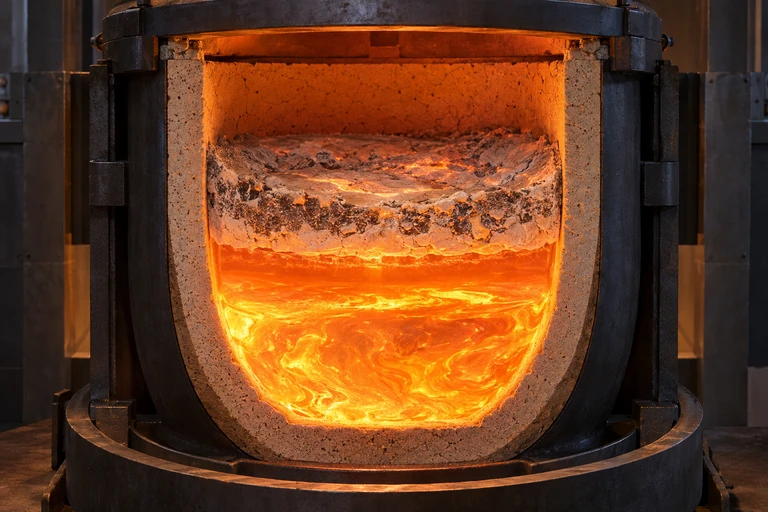 The thermite reaction produces iron and aluminum oxide while releasing enough heat to generate very hot products.
The Coupling Principle
Energy Diagram: How Coupling Works
Coupled vs. Catalyzed Reactions
| Coupled Reactions | Catalyzed Reactions | |
|---|---|---|
| What changes? | \( \Delta G_{\text{overall}} \) | Activation energy \( E_a \) only |
| Effect on \( \Delta G \) | Makes overall \( \Delta G < 0 \) | No change to \( \Delta G \) |
| Mechanism | Adds a second reaction | Provides an alternate pathway |
| Can drive unfavorable rxn? | Yes | No |
| Example | ATP hydrolysis + biosynthesis | Enzyme lowering \( E_a \) |
ATP: Nature's Coupling Agent
In biological systems, adenosine triphosphate (ATP) is the most common energy currency. Its hydrolysis is highly favorable and is coupled to drive countless unfavorable biochemical reactions.
\( \Delta G = -30.5 \text{ kJ/mol} \)
\( \Delta G = +14.2 \text{ kJ/mol} \)
\( = -16.3 \text{ kJ/mol} \) ✓
Coupling happens at a shared chemical workspace
 An enzyme links ATP-dependent phosphoryl transfer to glucose phosphorylation. Using +14.0 kJ/mol for glucose phosphorylation and −30.5 kJ/mol for ATP hydrolysis under the stated biochemical convention gives a net −16.5 kJ/mol.
Coupling requires a linked chemical transfer
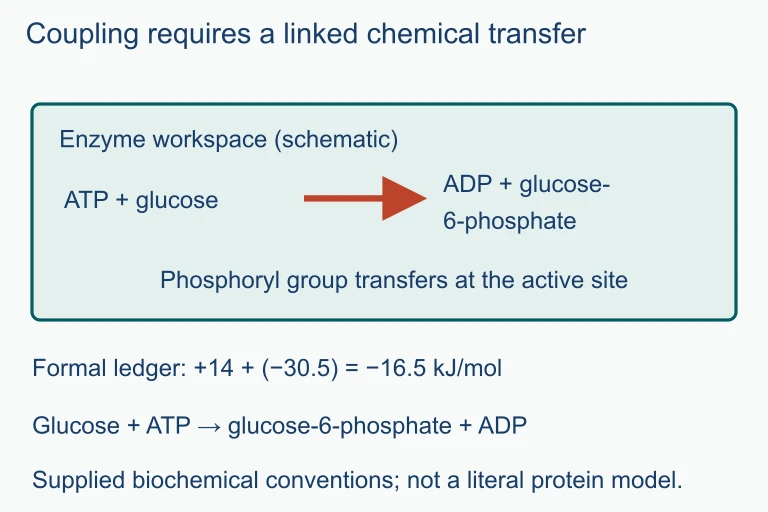 An enzyme links ATP-dependent phosphoryl transfer to glucose phosphorylation. Using +14.0 kJ/mol for glucose phosphorylation and −30.5 kJ/mol for ATP hydrolysis under the stated biochemical convention gives a net −16.5 kJ/mol.
How to Solve Coupling Problems
Example 1: Iron Smelting
Problem: Reducing iron oxide to iron is unfavorable. Can we couple it with carbon combustion?
Oxide reduction in a furnace zone
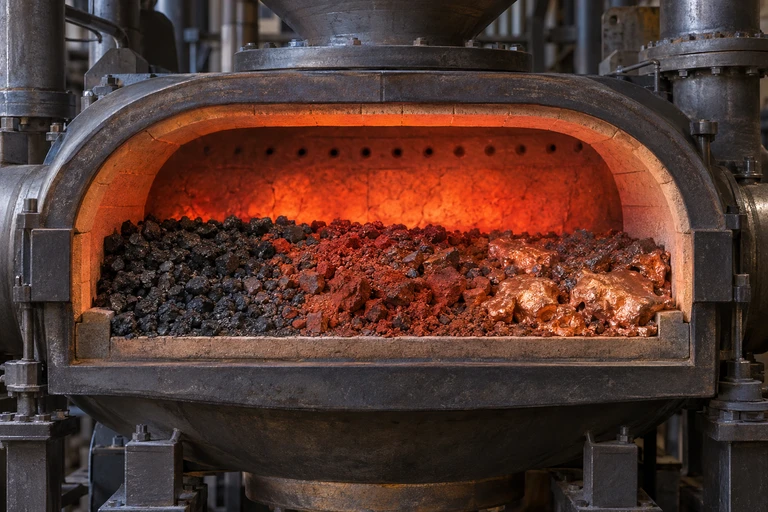 In a furnace, an oxide can be reduced through coupling to a reaction that removes oxygen and forms gaseous products.
Example 1: Analysis
Wait: the overall \( \Delta G \) is still +150.1 kJ/mol. Carbon combustion alone is not enough! This is why industrial smelting uses very high temperatures (the \( T\Delta S \) term) to shift \( \Delta G \) negative.
Example 2: Phosphorylation of Glucose
Problem: The first step of glycolysis phosphorylates glucose. Can ATP hydrolysis drive this reaction?
Example 2: Energy Diagram
Example 3: Multi-Step Coupling
Problem: Three reactions are coupled. Find \( \Delta G_{\text{overall}} \) and determine if the process is favorable.
Common Mistakes
Summary Table
| Concept | Key Idea | Formula / Rule |
|---|---|---|
| Gibbs Free Energy | Predicts spontaneity | \( \Delta G = \Delta H - T\Delta S \) |
| Favorable Reaction | Occurs spontaneously | \( \Delta G < 0 \) |
| Unfavorable Reaction | Requires energy input | \( \Delta G > 0 \) |
| Coupling Principle | Sum \( \Delta G \) values | \( \Delta G_{\text{net}} = \Sigma \Delta G_i \) |
| Coupling Succeeds | Net must be negative | \( \Delta G_{\text{net}} < 0 \) |
| Reversing a Reaction | Flip the sign | \( \Delta G_{\text{rev}} = -\Delta G_{\text{fwd}} \) |
Question 1 of 5
Reaction A has \( \Delta G = +85 \text{ kJ/mol} \) and Reaction B has \( \Delta G = -120 \text{ kJ/mol} \). If they are coupled, what is \( \Delta G_{\text{overall}} \)?
Question 2 of 5
What is the primary difference between coupling a reaction and catalyzing it?
Question 3 of 5
ATP hydrolysis has \( \Delta G = -30.5 \text{ kJ/mol} \). Which unfavorable reaction can it successfully drive when coupled?
Question 4 of 5
If a reaction is reversed, how does its \( \Delta G \) change?
Question 5 of 5
Three reactions are coupled: \( \Delta G_1 = +50 \), \( \Delta G_2 = -30 \), and \( \Delta G_3 = -15 \) (all in kJ/mol). Is the overall process favorable?