Composition of
Mixtures
Understand how to describe and calculate the composition of mixtures using mass percent, molarity, and mole fraction.
What Is a Mixture?
A mixture is a physical combination of two or more substances where each substance retains its own chemical identity. Unlike pure compounds, the components of a mixture can be present in any proportion.
Why Composition Matters
Knowing the exact composition of a mixture is essential for predicting reaction outcomes, calculating stoichiometric quantities, and understanding physical properties like boiling point and vapor pressure.
Key Terms to Know
Three Ways to Express Concentration
Visualizing a Solution
Water orientation around one sodium ion
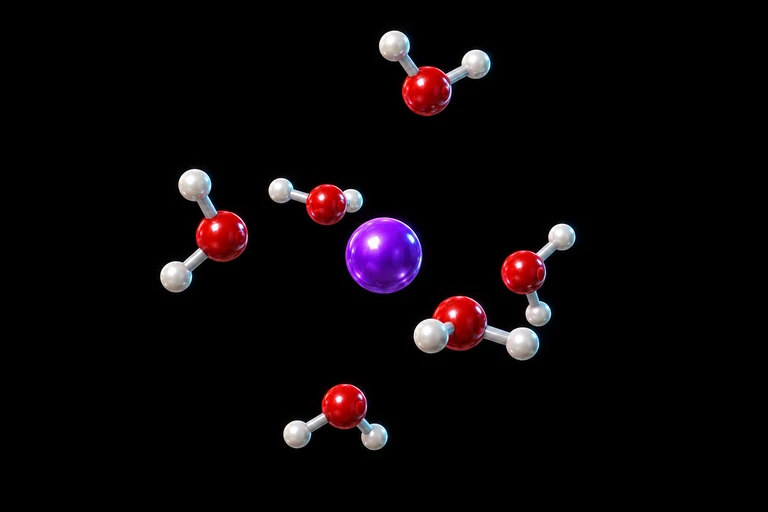 Water molecules orient their partially negative oxygen atoms toward a sodium ion.
Mass Percent in Detail
Mass percent tells us the fraction of the total mass contributed by the solute. It does not change with temperature because mass is independent of temperature.
Molarity (\( M \)) in Detail
Molarity is the most commonly used concentration unit in chemistry. It relates moles of solute to the volume of the total solution in liters.
One volumetric flask at final dilution
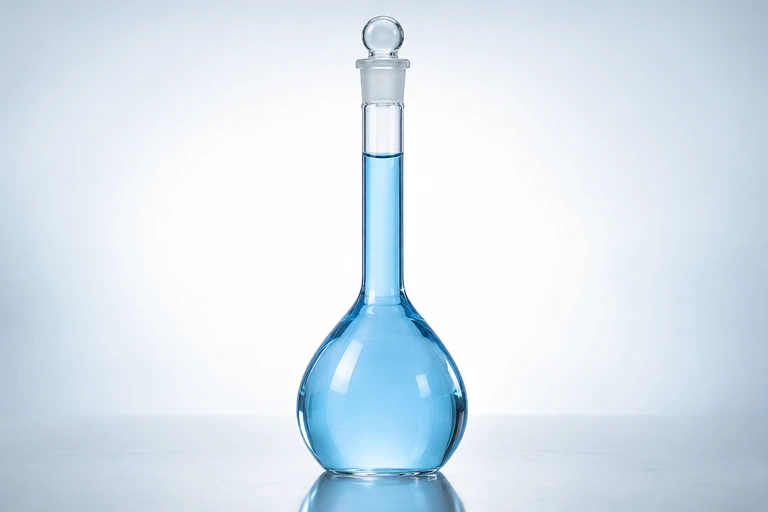 A volumetric flask is filled to its calibration mark to establish the final solution volume.
Mole Fraction (\( \chi \))
Mole fraction expresses the ratio of moles of one component to the total moles in the mixture. The sum of all mole fractions always equals 1.
Molarity vs. Molality vs. Mole Fraction
| Property | Molarity (M) | Molality (m) | Mole Fraction (\( \chi \)) |
|---|---|---|---|
| Formula | \( \frac{n}{V_{\text{soln}}} \) | \( \frac{n}{m_{\text{solvent (kg)}}} \) | \( \frac{n_A}{n_{\text{total}}} \) |
| Units | \( \text{mol/L} \) | \( \text{mol/kg} \) | None |
| Temp. Dependent? | Yes | No | No |
| Uses volume? | Yes | No | No |
| Key Application | Titrations, dilutions | Colligative properties | Raoult's Law, gas laws |
Step-by-Step Problem Solving
Example 1: Mass Percent
A solution is prepared by dissolving 15.0 g of NaCl in 85.0 g of water. What is the mass percent of NaCl?
Example 2: Molarity
What is the molarity of a solution containing 4.00 g of NaOH (\( M_r = 40.00\;\text{g/mol} \)) dissolved in enough water to make 500.0 mL of solution?
Example 3: Mole Fraction
A mixture contains 2.00 mol of ethanol (\( \text{C}_2\text{H}_5\text{OH} \)) and 8.00 mol of water. Find the mole fraction of ethanol.
Common Mistakes
Summary: Choosing the Right Unit
| Scenario | Best Unit | Reason |
|---|---|---|
| Titration / dilution | Molarity | Volume is measured directly |
| Boiling point / freezing point | Molality | Independent of temperature |
| Vapor pressure (Raoult's Law) | Mole fraction | Directly proportional to partial pressure |
| Product labels / food science | Mass percent | Easy to measure, no mole calc needed |
| Gas mixtures (Dalton's Law) | Mole fraction | \( P_A = \chi_A \cdot P_{\text{total}} \) |
Question 1 of 5
A solution is made by dissolving 20.0 g of glucose (\( M_r = 180.0\;\text{g/mol} \)) in 500.0 mL of solution. What is the molarity?
Question 2 of 5
What is the mass percent of KBr in a solution containing 10.0 g of KBr dissolved in 90.0 g of water?
Question 3 of 5
A solution contains 3.00 mol of acetone and 7.00 mol of water. What is the mole fraction of acetone?
Question 4 of 5
Which concentration unit is temperature-dependent?
Question 5 of 5
You dissolve 5.85 g of NaCl (\( M_r = 58.44\;\text{g/mol} \)) in 250.0 g of water (\( M_r = 18.02\;\text{g/mol} \)). What is the mole fraction of NaCl?