The Common-Ion
Effect
Discover how adding a shared ion to a solution shifts equilibrium, suppresses dissociation, and changes solubility in powerful ways.
Quick Review: Chemical Equilibrium
In a reversible reaction, equilibrium is the state where the forward and reverse rates are equal. The concentrations of reactants and products remain constant (but not necessarily equal).
Defining the Common-Ion Effect
The common-ion effect is the suppression of the dissociation (or solubility) of a weak electrolyte when a strong electrolyte that shares a common ion is added to the solution.
Why Does It Matter?
The common-ion effect is foundational to understanding buffer solutions, selective precipitation, and qualitative analysis in chemistry.
Core Principle: Solubility Suppression
Silver chloride precipitation context
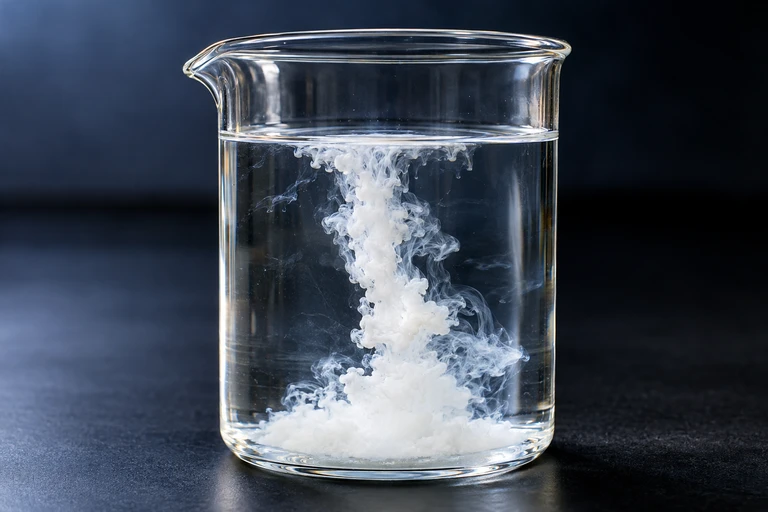 Silver chloride forms a white precipitate when the dissolved ion product exceeds its solubility product.
Core Principle: Acid-Base Suppression
The common-ion effect also applies to weak acids and bases. Adding a salt that shares an ion with the weak electrolyte suppresses its ionization.
Common-Ion vs. Salt Effect
| Common-Ion Effect | Diverse-Ion (Salt) Effect | |
|---|---|---|
| Ion added | Shares an ion with the equilibrium | Does not share an ion |
| Effect on solubility | Decreases | Slightly increases |
| Mechanism | Le Chatelier shift left | Ionic atmosphere lowers activity coefficients |
| AP Chemistry scope | Tested frequently | Rarely tested |
How to Apply the Common-Ion Effect
Example 1: Solubility of \(\text{PbCl}_2\)
Find the molar solubility of \(\text{PbCl}_2\) in 0.10 M \(\text{NaCl}\). Given: \(K_{sp} = 1.7 \times 10^{-5}\).
Example 2: pH of Acetic Acid + NaOAc
Find the \( \text{pH} \) of a solution that is 0.50 M \(\text{CH}_3\text{COOH}\) and 0.50 M \(\text{NaCH}_3\text{COO}\). \(K_a = 1.8 \times 10^{-5}\).
The Henderson-Hasselbalch Shortcut
When a weak acid and its conjugate base are both present (common-ion scenario), the Henderson-Hasselbalch equation provides a direct route to pH:
Example 3: Unequal Concentrations
Find the solubility of \(\text{CaF}_2\) in 0.020 M \(\text{NaF}\). \(K_{sp} = 3.9 \times 10^{-11}\).
Visualizing the Shift
Summary of Effects
| System | Common Ion Added | Equilibrium Shift | Observable Result |
|---|---|---|---|
| Sparingly soluble salt | One of its ions | ← Left | Solubility decreases |
| Weak acid \(\text{HA}\) | \(\text{A}^-\) (conjugate base) | ← Left | \( \text{pH} \) increases |
| Weak base \(\text{B}\) | \(\text{BH}^+\) (conjugate acid) | ← Left | \( \text{pH} \) decreases |
| Buffer solution | Both acid and conjugate base present | Resists shift | \( \text{pH} \) stays stable |
Common Mistakes to Avoid
Question 1 of 5
What happens to the solubility of \(\text{AgCl}\) when \(\text{NaCl}\) is added to the solution?
Question 2 of 5
A buffer is made from 0.30 M \(\text{NH}_3\) and 0.30 M \(\text{NH}_4\text{Cl}\). The \(K_b\) of \(\text{NH}_3\) is \(1.8 \times 10^{-5}\). What is the \( \text{pOH} \)?
Question 3 of 5
In an ICE table for dissolving \(\text{BaSO}_4\) in 0.050 M \(\text{Na}_2\text{SO}_4\), what is the initial concentration of \(\text{SO}_4^{2-}\)?
Question 4 of 5
Adding \(\text{NaCH}_3\text{COO}\) to a solution of \(\text{CH}_3\text{COOH}\) causes the \( \text{pH} \) to:
Question 5 of 5
The \(K_{sp}\) of \(\text{CaF}_2\) is \(3.9 \times 10^{-11}\). What is its molar solubility in 0.10 M \(\text{NaF}\)?